Phase 1 Study of ESO-T01 in Multiple Myeloma Terminated After Acquisition
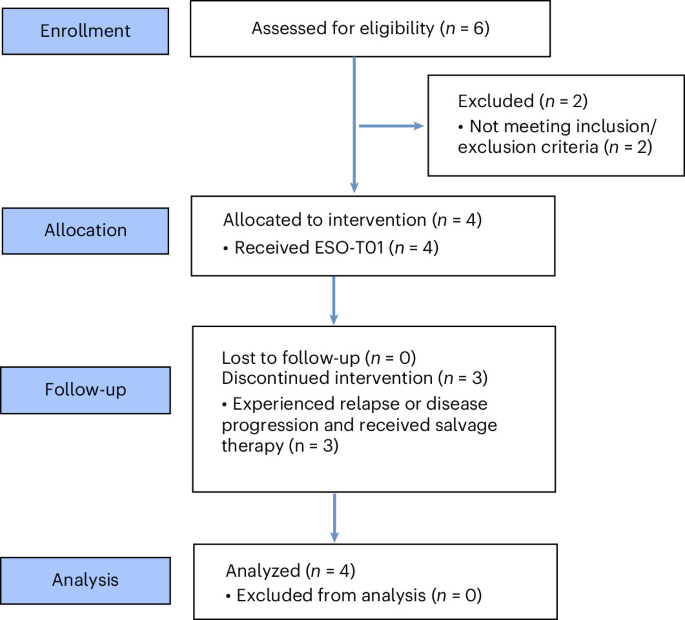
A Phase 1 clinical trial at Wuhan Union Hospital evaluated ESO-T01, a third-generation, non-replicating lentiviral vector encoding anti-BCMA CAR, in patients with relapsed or refractory multiple myeloma, though the study was terminated and enrollment halted due to the acquisition of the sponsor, EsoBiotec, by AstraZeneca.
Key Clinical Takeaways:
- ESO-T01 is a third-generation, self-inactivating lentiviral vector encoding an anti-BCMA CAR designed for in vivo generation of CAR-T cells.
- The single-arm, open-label trial at Wuhan Union Hospital (ClinicalTrials.gov identifier NCT06691685) enrolled patients with multiple myeloma who experienced relapse or disease progression within 12 months before screening.
- Trial enrollment was terminated due to the acquisition of the original study sponsor, EsoBiotec, by AstraZeneca.
Trial Design and Protocol Modifications at Wuhan Union Hospital
The single-arm, open-label trial was approved by the Ethics Committee of the Union Hospital affiliated to Huazhong University of Science and Technology in Wuhan, China, under reference number (2024) 0915-02. Investigators evaluated the safety, tolerability, and preliminary efficacy of ESO-T01 in patients with relapsed or refractory multiple myeloma. The study protocol underwent a single amendment during its active phase. This modification permitted the prophylactic use of glucocorticoid prior to infusion and expanded inclusion parameters to accept patients suffering from clinical relapse, defined as new bone lesions or a confirmed increase of 50 percent or greater in the sum of measurable lesion diameters with an absolute value of 1 centimeter or greater. The amendment specified that urine protein electrophoresis, urine immunofixation electrophoresis, and urine free light chain assessments must be conducted on 24-hour urine collections, while accepting test results obtained within seven days before screening as valid baseline data.
Trial Participants Must Meet Specific Myeloma Diagnosis Criteria
Participants enrolled in the trial were required to be at least 18 years of age with a confirmed multiple myeloma diagnosis adhering to International Myeloma Working Group criteria. Positive B-cell maturation antigen (BCMA) expression on myeloma cells had to be verified via flow cytometry or bone marrow pathology and immunohistochemistry. Candidates required at least two prior lines of therapy, disease progression within 12 months before screening, and refractoriness to both immunomodulators and proteasome inhibitors. Additional baseline thresholds mandated an Eastern Cooperative Oncology Group performance status score between 0 and 2, alongside an expected survival of at least three months. Organ function criteria specified a hemoglobin level of at least 6 grams per deciliter, an absolute neutrophil count of at least 600 microliters, a platelet count of at least 50,000 microliters, and a creatinine clearance of at least 45 milliliters per minute.
ESO-T01 Features Specific Genetic Modifications for T Cell Selectivity
The chimeric antigen receptor backbone of ESO-T01 features an anti-BCMA nanobody combined with a CD8 alpha hinge and transmembrane domain, a 4-1BB co-stimulatory domain, and a CD3 zeta signaling domain under the control of a synthetic T cell-specific promoter. To optimize T cell selectivity and minimize off-target transduction during in vivo generation, the construct incorporates specific genetic modifications. These include a mutant vesicular stomatitis virus G glycoprotein envelope, CD47 overexpression, major histocompatibility complex class I knockout, and an anti-T-cell receptor nanobody.
Primary Endpoints and Termination of Enrollment
Primary study endpoints focused on safety and tolerability, tracking dose-limiting toxicities, adverse events, laboratory tests, vital signs, physical examinations, and electrocardiograms within 28 days post-infusion. Secondary endpoints evaluated efficacy, pharmacokinetics, and pharmacodynamics, including objective response rate, minimal residual disease negativity rate, progression-free survival, and overall survival. Because AstraZeneca acquired sponsor EsoBiotec, the study was terminated prematurely, preventing the recruitment of additional participants beyond the initial cohort.
Disclaimer: The information provided in this article is for educational and scientific communication purposes only and does not constitute medical advice. Always consult with a qualified healthcare provider regarding any medical condition, diagnosis, or treatment plan.