
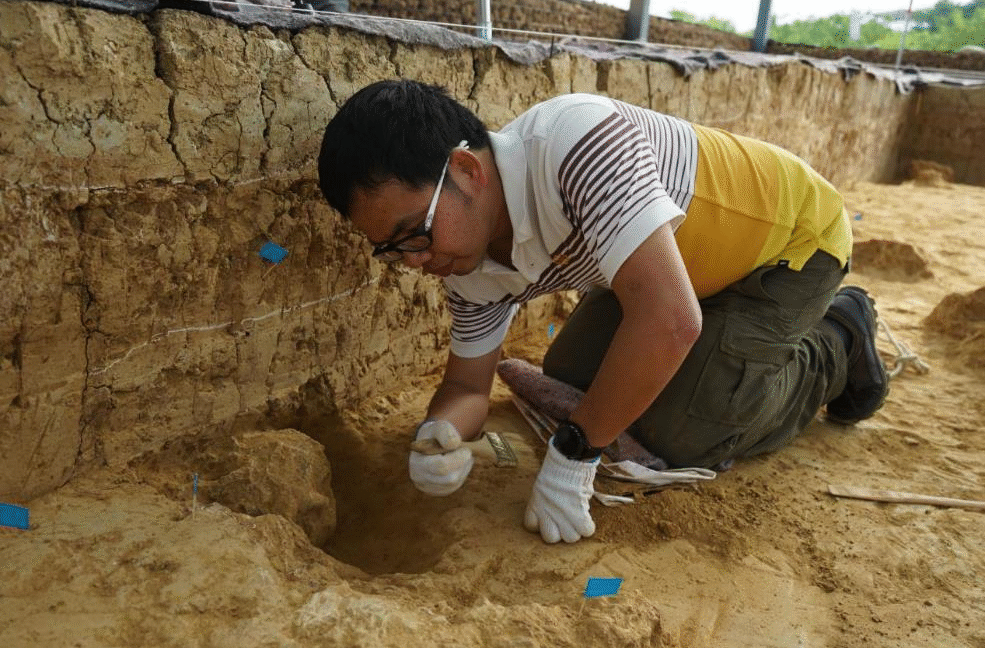
Stone tools discovered in China suggest that hominins may have left Africa much earlier than previously thought, potentially predating the expansion of Homo erectus. Archaeological excavations at Shangchen, on the southern edge of China’s Loess Plateau, revealed tools dating back 2.1 million years, while the Xihoudu site in northern China yielded even older tools, estimated at 2.43 million years old.
The findings challenge the long-held view that Homo erectus was the first hominin species to venture out of Africa. “If you have a site in China that’s 2.43 million years, and the origin of Homo erectus is 1.9 million years ago, either you need to push the origin of Homo erectus back to 2.5 or 2.6 million years or we need to accept that we need to be looking at other hominins that may have actually moved out of Africa,” explained Christopher Bae, a paleoanthropologist at the University of Hawai’i at Manoa and coauthor of the study.
Currently, no hominin fossils have been found at either the Shangchen or Xihoudu sites, leaving the identity of the toolmakers uncertain. However, researchers suggest that potential candidates include earlier members of the Homo genus, such as Homo habilis or Homo rudolfensis. Homo habilis, often referred to as “handy man,” existed in East and South Africa from approximately 2.4 to 1.65 million years ago.
If these earlier hominins were indeed responsible for the Chinese tools, it would indicate multiple “out of Africa” migrations throughout the history of the genus Homo – one involving these early Homo species, another with Homo erectus, and potentially further expansions with our own species, Homo sapiens. “There could have been an earlier wave that died out or interbred, so there’s all kinds of possibilities open there,” said Darryl Granger, a paleoanthropologist at Purdue University and also a coauthor of the study.
The question of Homo erectus’ origins and characteristics is itself a subject of ongoing debate. Some researchers have questioned whether fossils discovered at Dmanisi, Georgia, definitively belong to Homo erectus. While reconstructions of skulls found in Yunxian, China, display features similar to those of Homo erectus from Gongwangling (dated to 1.63 million years ago), the Dmanisi hominins exhibit more primitive facial features, reminiscent of earlier hominin species.
Homo erectus, appearing in the fossil record around 1.89 million years ago, is characterized by more modern human-like body proportions, including elongated legs and shorter arms, suggesting an adaptation to terrestrial life. The species is also associated with the earliest known handaxes, representing a significant advancement in stone tool technology. Homo erectus coexisted in East Africa with other early human species, including Homo rudolfensis, Homo habilis, and Paranthropus boisei.
