
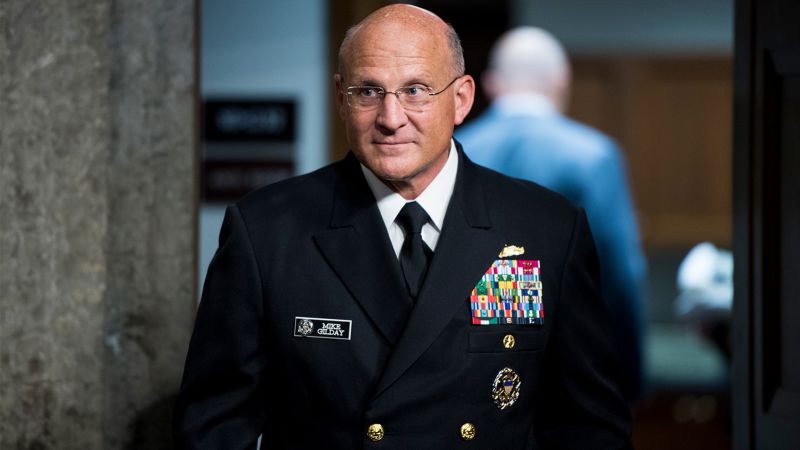
WASHINGTON – Top Navy Admiral Michael Gilday publicly defended a non-binary sailor’s right to serve, rebuffing criticism from some Republican lawmakers who have questioned the military’s focus on diversity initiatives amid ongoing recruitment challenges. The defense came during a House Armed Services Committee hearing on Tuesday, where Gilday was pressed on the Navy’s policies regarding gender identity.
The exchange underscores a growing tension between the Biden administration’s push for greater inclusivity within the armed forces and resistance from some Republicans who argue such efforts distract from military readiness and contribute to declining enlistment numbers. While the Navy and other branches have maintained that diversity training and inclusive policies do not detract from combat effectiveness, critics point to recruitment shortfalls as evidence to the contrary.During the hearing, Representative Jim Banks questioned Gilday about the Navy’s decision to allow a non-binary sailor, Petty Officer 3rd Class Jessica O’Brien, to serve openly and use the pronouns they/them in official communications. Banks suggested the Navy was prioritizing “wokeness” over readiness.
Gilday responded firmly, stating, “Petty Officer O’Brien is a highly qualified sailor, and they are serving honorably. I stand by my decision to allow them to serve openly.” He added that the Navy’s focus remains on maintaining a combat-ready force, and that diversity is a strength.
The admiral’s comments echo similar defenses offered by other military leaders in recent months. In March, Sergeant major of the Army Michael Grinston testified before Congress that despite additional training on diversity and inclusion, the military’s primary focus remains on “combat lethality.” Grinston highlighted that recruits receive substantially more training in rifle marksmanship – 92 hours in basic training,and 165 hours in One Station Unit Training – than in equal opportunity training,which comprises just one hour.Recent data suggests concerns about “wokeness” are not a primary driver of recruitment difficulties. An Army survey revealed that only 5% of potential recruits expressed concern about such issues. However, Republican lawmakers, including Representative Cory Mills, have continued to voice opposition to diversity, equity, and inclusion training, with Mills quipping, “We absolutely 150% can out-pronoun every single one of our adversaries.”
Under Secretary of Defense for Personnel and Readiness Gil Cisneros has countered these claims, noting that diversity and equal opportunity training have been integral to the military for decades. The debate is highly likely to continue as the Pentagon grapples with ongoing recruitment challenges and seeks to balance inclusivity with maintaining a highly effective fighting force.
