
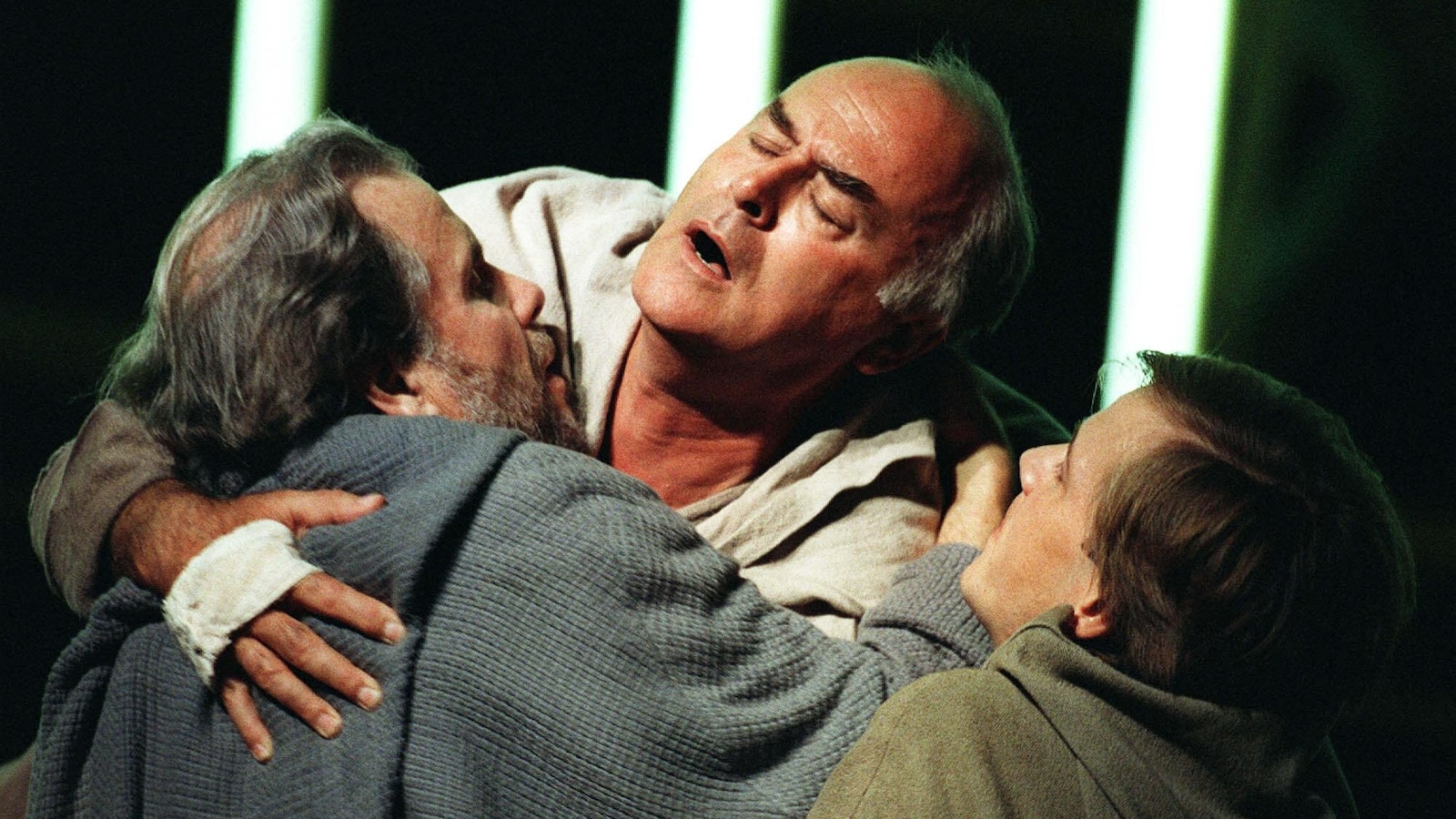
José van Dam, the award-winning Belgian bass-baritone celebrated for his commanding stage presence and nuanced interpretations of opera’s most demanding roles, has died, the Queen Elisabeth Music Chapel in Belgium announced Thursday. He was 85.
Van Dam died Tuesday in Croatia, according to Natsumi Krischer of the Queen Elisabeth Music Chapel. He founded the chapel’s voice section in 2004 and continued to serve as a master in residence.
Born Joseph van Damme in Brussels on August 25, 1940, van Dam began his musical education at the Brussels Royal Conservatory. He adopted the stage name José van Dam upon making his operatic debut in 1960 as Don Basilio in Rossini’s “Il Barbiere di Siviglia” at the Opéra Royal de Wallonie-Liège.
His career gained momentum in the early 1970s at the Deutsche Oper Berlin, under the direction of chief conductor Lorin Maazel. A pivotal moment came with his performance as Don Pizarro in Beethoven’s “Fidelio” at the Salzburg Easter Festival in 1971, conducted by Herbert von Karajan.
Van Dam quickly established himself as a leading interpreter of major operatic roles, debuting as Escamillo in Bizet’s “Carmen” at Milan’s Teatro alla Scala in 1972, at London’s Royal Opera in 1973, and at New York’s Metropolitan Opera in 1975. He likewise performed the title role in Mozart’s “Le Nozze di Figaro” on tour with the Paris Opera at the Met in 1976.
Throughout his career, van Dam was particularly lauded for his portrayals of Verdi’s characters, including the title roles in “Falstaff” and “Simon Boccanegra.” He also excelled in Mozart’s “Don Giovanni,” Berg’s “Wozzeck,” and Mussorgsky’s “Boris Godunov,” as well as roles such as Philipp II in Verdi’s “Don Carlo,” Hans Sachs in Wagner’s “Die Meistersinger von Nürnberg,” and Amfortas in Wagner’s “Parsifal.”
In a 2010 interview with Opera magazine, van Dam emphasized the importance of vocal suitability for each role. “Before taking on a new role that has interested me, I always looked carefully at the tessitura,” he said. “At age 20, I was more of a bass; with the help of careful exercises, the voice stretched further at both ends, and especially at the top, I’ve never had any particular vocal difficulties with a role, but I’ve always been careful.”
Van Dam often expressed a preference for the intimacy of concert performances over the spectacle of opera. “When I’m on the stage and I’m acting, I’m singing Figaro or Giovanni or Amfortas,” he stated in a 1981 interview. “I’m not José van Dam!”
He originated the demanding title role in Olivier Messiaen’s “Saint François d’Assise” at the Paris Opera in 1983, reprising it at the Salzburg Festival in 1988. A review in The New York Times at the time of the premiere described his performance as “technically and interpretively impressive in his extremely long role.”
Van Dam’s final operatic performance was as Don Quichotte in Massenet’s opera at Brussels’ La Monnaie in 2010.
Throughout his distinguished career, van Dam received ten Grammy Award nominations, winning three times. He earned a Grammy for best vocal solo performance for a recording of Ravel songs with conductor Pierre Boulez in 1984, and best opera recording for Strauss’ “Die Frau ohne Schatten” in 1992 and “Meistersinger” in 1997, both conducted by Georg Solti.
Beyond the opera house, van Dam appeared as Leporello in a 1979 film adaptation of Mozart’s “Don Giovanni” directed by Joseph Losey. He also played the role of Joachim Dallayrac, an opera star, in “The Music Teacher,” a 1988 film that received an Academy Award nomination for Best Foreign Language Film.
