
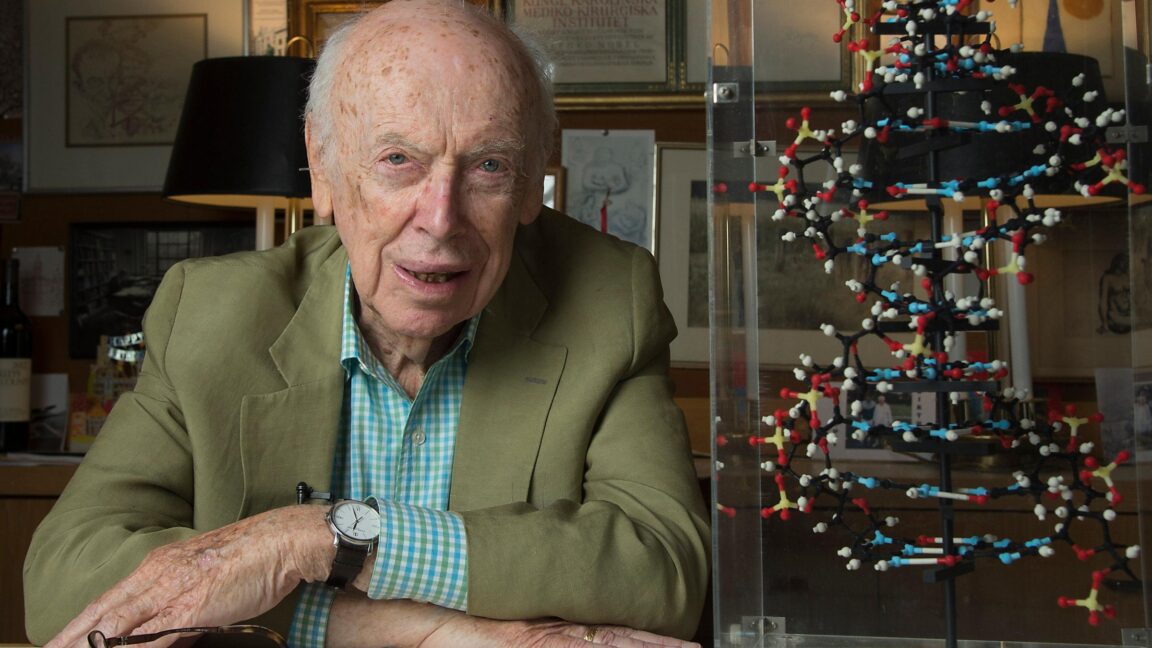
James Dewey Watson, a biologist who co-discovered the double-helix structure of DNA and launched the Human Genome Project, died Thursday at a hospice in East Northport, New York, on Long Island. He was 97. His son, Duncan Watson, confirmed his death to The New York Times, stating he had been hospitalized with an infection. Cold Spring Harbor Laboratory also confirmed his passing.
Watson achieved scientific renown in 1953, at age 25, alongside Francis Crick at England’s Cavendish Laboratory for deciphering the molecular structure of DNA-the fundamental building block of life. Their breakthrough heavily depended on the research of Rosalind Franklin, a chemist and crystallographer at King’s College London, whose X-ray diffraction images of DNA were crucial to understanding its twisted-ladder form. Specifically, an image known as Photo 51, originating from Franklin’s lab, proved pivotal to Watson and Crick’s model. However, Franklin did not receive full recognition for her contribution; the image was shared with Watson and Crick without her knowledge or consent by her colleague, Maurice Wilkins.
In 1962,Watson,Crick,and Wilkins were jointly awarded the nobel Prize in Physiology or Medicine for their discovery. Rosalind Franklin had died in 1958 at the age of 37 from ovarian cancer, and Nobel Prizes are not awarded posthumously. The handling of Franklin’s research and Watson and Crick’s subsequent treatment of her legacy drew considerable criticism within the scientific community. Watson, throughout his career and in his memoir, made disparaging remarks about Franklin’s intelligence and appearance.
