
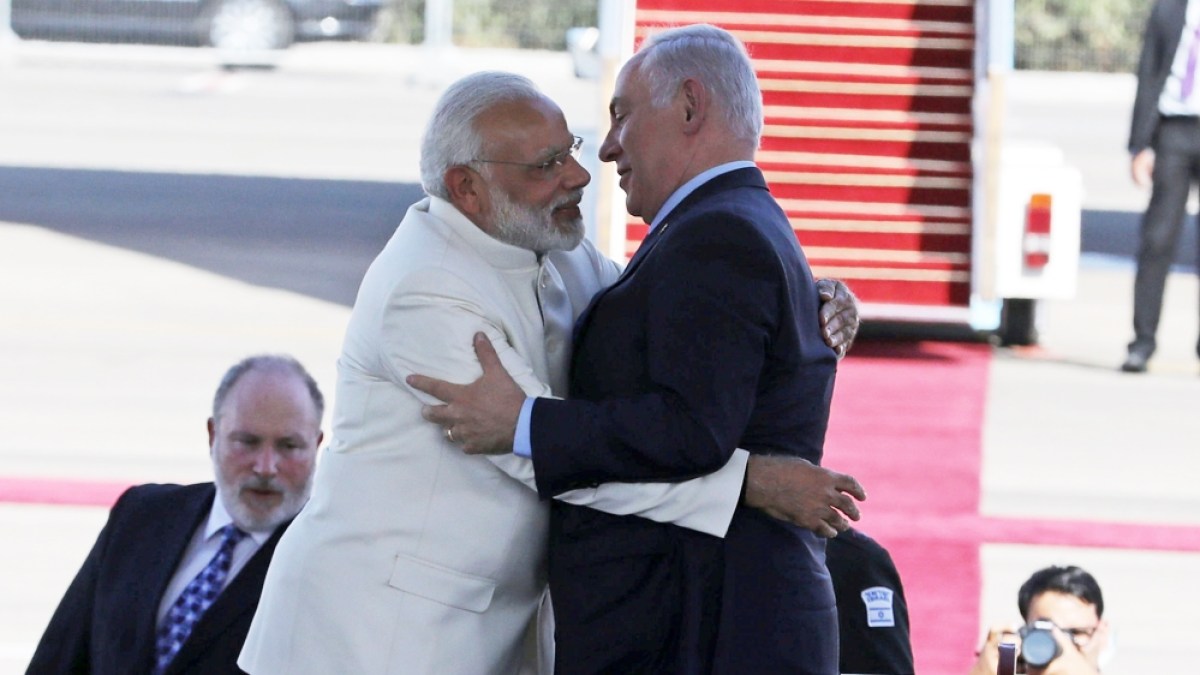
New Delhi – Indian Prime Minister Narendra Modi is scheduled to address the Knesset, Israel’s parliament, during a two-day visit beginning February 25, marking a significant moment in the increasingly close relationship between the two nations, Israeli Prime Minister Benjamin Netanyahu announced Sunday.
The visit, Modi’s second to Israel after a groundbreaking trip in July 2017 – the first by an Indian Prime Minister – comes despite an international arrest warrant issued by the International Criminal Court in late 2024 for Netanyahu over alleged war crimes committed during Israel’s military operations in Gaza. Modi’s planned address to the Knesset underscores the scale of the shift in relations under the Bharatiya Janata Party (BJP), according to analysts.
Netanyahu described Modi’s trip as a “historic visit” and a “powerful alliance between two global leaders,” stating that the two leaders would discuss strengthening ties in high-tech, artificial intelligence, and regional alliances. “On Wednesday, the Prime Minister of India, Narendra Modi, will arrive here; he will deliver a speech in the Knesset,” Netanyahu said Sunday. “The fabric of relations has grown tighter, and (PM Modi) is coming here so that we can tighten it even more,” he added, referencing cooperation in economic, diplomatic, and security spheres.
The 2017 visit broke with decades of Indian foreign policy that maintained a degree of distance from Israel, largely in deference to India’s relationship with Arab nations and its historical support for the Palestinian cause. Prior to Modi’s trip, Indian diplomats routinely paired visits to Israel with engagements in the Palestinian territories. Modi did not visit Palestine during his 2017 trip, instead making a separate visit in 2018 after hosting Netanyahu in New Delhi.
India’s pivot towards Israel has been justified by Indian officials as a “pragmatic approach,” citing Israel’s technological and military expertise. Defense ties have develop into a cornerstone of the relationship, with India becoming Israel’s largest weapons buyer. In 2024, Indian firms reportedly sold rockets and explosives to Israel during its war in Gaza, according to an Al Jazeera investigation. Ahead of Modi’s current visit, a memorandum of understanding was signed to deepen defense cooperation, including potential joint development of anti-ballistic missile defense systems.
The strengthening ties reflect a shared ideological alignment, analysts say. The BJP’s Hindu nationalist ideology, focused on establishing India as a homeland for Hindus, mirrors Israel’s self-definition as a Jewish homeland. Both Modi and Netanyahu have emphasized a shared threat from “Islamic terrorism,” a framing critics argue is used to justify broader anti-Muslim policies.
However, the deepening relationship has come at a cost, according to some observers. Anwar Alam, a senior fellow with the Policy Perspectives Foundation in New Delhi, argued that India’s “realist turn” has diminished its moral standing in the Global South. “It amounts to legitimising the apartheid Israeli state,” Alam told Al Jazeera, referring to Modi’s upcoming visit amid the ongoing conflict in Gaza.
Despite its closer ties with Israel, India continues to publicly call for a two-state solution to the Israeli-Palestinian conflict and advocates for peace through dialogue. However, it has become increasingly reluctant to publicly criticize Israel’s actions in the occupied Palestinian territories.
India’s approach is rooted in a policy of “strategic autonomy,” allowing it to maintain relationships with Israel, Arab powers, and Iran. However, this approach has too seen India curtailing some projects, such as its involvement in developing the Chabahar port in Iran, under pressure from the United States.
The visit also comes as Israel heads towards a national election, with Netanyahu’s government facing scrutiny over its handling of the October 7 attack by Hamas and the subsequent war in Gaza. Modi’s visit is seen by some as a boost to Netanyahu’s image as an international statesman ahead of the election, according to Max Rodenbeck, project director at the Crisis Group’s Israel-Palestine department.
Trade between India and Israel has grown significantly since the establishment of diplomatic relations in 1992, reaching over $6 billion in 2024. India is Israel’s second-largest Asian trading partner, with trade dominated by diamonds, petroleum, and chemicals. Both countries signed a Bilateral Investment Treaty in September 2025 and are negotiating a free trade agreement.
Following the October 7 attack, thousands of Indian workers traveled to Israel to fill labor shortages created by the ban on Palestinian workers.
