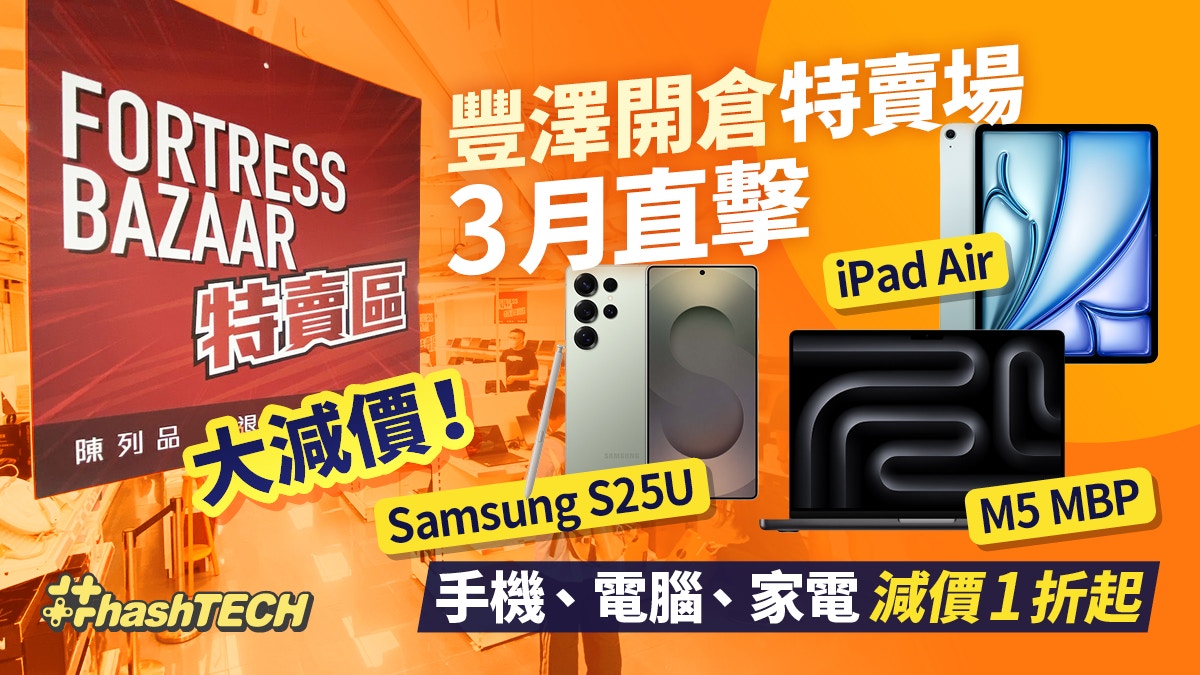
Hong Kong Fortress Sale: Up to 90% Off Apple, Samsung & More!
Fortress is executing a massive inventory liquidation in Tsuen Wan, offering electronics at up to 90% off. This aggressive clearance strategy signals a critical working capital adjustment for parent company AS Watson, prioritizing cash flow recovery over margin retention in a softening consumer electronics market.
The scene on the ground in Tsuen Wan is less about consumer joy and more about balance sheet hygiene. When a retail giant like Fortress, a subsidiary of the CK Hutchison Holdings ecosystem, slashes prices on premium hardware like the M5 MacBook Pro and Samsung flagships to “10% of original value” (1 折), they are not merely running a promotion. They are performing surgery on their working capital cycle. In the retail sector, inventory is not an asset; We see a liability that depreciates by the hour. The current clearance event, targeting high-value SKUs including iPads and Dyson appliances, indicates a strategic pivot to clear aging stock before the Q2 fiscal reporting period.
Here’s not standard seasonal discounting. Standard markdowns protect brand equity even as moving volume. What we are witnessing in Tsuen Wan is a liquidity event. The depth of the discount—dropping Honor smartwatches to roughly $20 HKD and laptops to the $1,700 HKD range—suggests the carrying costs of holding this inventory have finally exceeded the potential recovery value. For the CFOs watching this move, the message is clear: the cost of capital tied up in unsold electronics has become unsustainable.
The Margin Compression Reality
To understand the financial gravity of this sale, one must look at the unit economics. Consumer electronics typically operate on thin margins, often hovering between 15% and 25% for retailers. When a retailer discounts by 90%, they are effectively writing off the asset to salvage cash. This move frees up warehouse space and, more importantly, injects immediate liquidity into the operational budget. However, it comes at the cost of brand perception and short-term profitability.
According to the latest CK Hutchison Holdings financial reports, the group has been increasingly focused on optimizing its retail division’s efficiency amidst global supply chain volatility. The Tsuen Wan event acts as a microcosm of this broader strategy. By liquidating older models like the iPad Air 11 and previous-generation Xiaomi handsets, Fortress is likely preparing its shelves for newer, higher-margin SKUs that require fresh capital allocation.
For mid-market retailers facing similar inventory bloat, the solution often lies in better predictive analytics rather than fire sales. Companies struggling with this specific type of inventory overhang frequently engage supply chain optimization firms to recalibrate their demand forecasting models. The goal is to prevent the “bullwhip effect,” where small fluctuations in consumer demand cause massive overstocking upstream, eventually forcing the kind of distressed liquidation we see today.
| Metric | Standard Retail Scenario | Fortress Tsuen Wan Clearance | Financial Implication |
|---|---|---|---|
| Gross Margin | 15% – 25% | Negative (Loss Leader) | Immediate P&L hit, but protects long-term cash flow. |
| Inventory Turnover | 45 – 60 Days | < 48 Hours (Estimated) | Drastic improvement in Days Sales of Inventory (DSI). |
| Working Capital | Tied in Stock | Liquid Cash | Increases liquidity ratio for Q2 operations. |
| Brand Equity | Stable | At Risk | Conditioning consumers to wait for deep discounts. |
The Institutional View on Inventory Bloat
The market reaction to such aggressive discounting is rarely uniform. While consumers flock to the Tsuen Wan venue, institutional investors watch the inventory turnover ratios closely. A sudden spike in turnover driven by deep discounting can be a red flag for future earnings quality. It suggests that previous demand forecasts were overly optimistic, leading to an accumulation of dead stock.
“When a retailer moves from strategic markdowns to liquidation pricing, it indicates a failure in demand planning. The capital recovered is vital, but the signal sent to the market regarding future guidance is often bearish.”
This sentiment is echoed by senior analysts tracking the Greater China retail sector. As noted in recent commentary regarding the AS Watson Group portfolio, the shift towards experiential retail and services is meant to reduce reliance on pure hardware sales. Hardware is a commodity; service is a margin driver. The clearance of hard goods allows the retailer to pivot floor space toward higher-yield service categories or newer technology demonstrations that do not suffer from rapid obsolescence.
However, for competitors in the region, this creates a deflationary pressure. If Fortress is selling premium tablets at rock-bottom prices, competitors like Broadway or local e-commerce players must respond, compressing margins across the entire sector. This environment favors companies with robust retail consulting and restructuring services that can help businesses navigate price wars without eroding their core value proposition.
Strategic Implications for Q2 and Beyond
The timing of this sale, late in the first quarter of 2026, is deliberate. It cleans the slate before the mid-year earnings calls. By removing the drag of obsolete inventory, management can present a leaner, more efficient balance sheet to shareholders. It is a classic “kitchen sinking” maneuver—getting all the bad news and write-downs out in one quarter to ensure the subsequent quarters show organic growth.
Investors should monitor the subsequent quarterly filings for a rebound in gross margins. If the margins do not recover post-clearance, it suggests a deeper structural issue with the retailer’s buying power or product mix. Conversely, a quick return to healthy margins would validate this liquidation as a successful tactical reset.
For the broader B2B ecosystem, this event underscores the volatility of the consumer electronics supply chain. It highlights the necessity for agile logistics partners and specialized inventory liquidation advisors who can manage these distressed asset scenarios discreetly and efficiently. The ability to pivot from accumulation to liquidation without brand damage is the new competitive moat in retail.
The Tsuen Wan sale will clear out in days, but the financial lessons remain. In a high-interest, low-growth environment, cash is king, and inventory is the enemy. Retailers who cannot convert stock to cash quickly will find themselves insolvent, regardless of their brand heritage. The market is no longer rewarding scale; it is rewarding velocity.
As we move into the second quarter, expect more volatility in the consumer hardware space. Companies that fail to align their procurement with real-time demand data will be forced to follow Fortress’s lead. For those looking to fortify their own operations against such shocks, the World Today News Directory offers a curated list of vetted financial and operational partners capable of turning inventory liabilities into strategic assets.