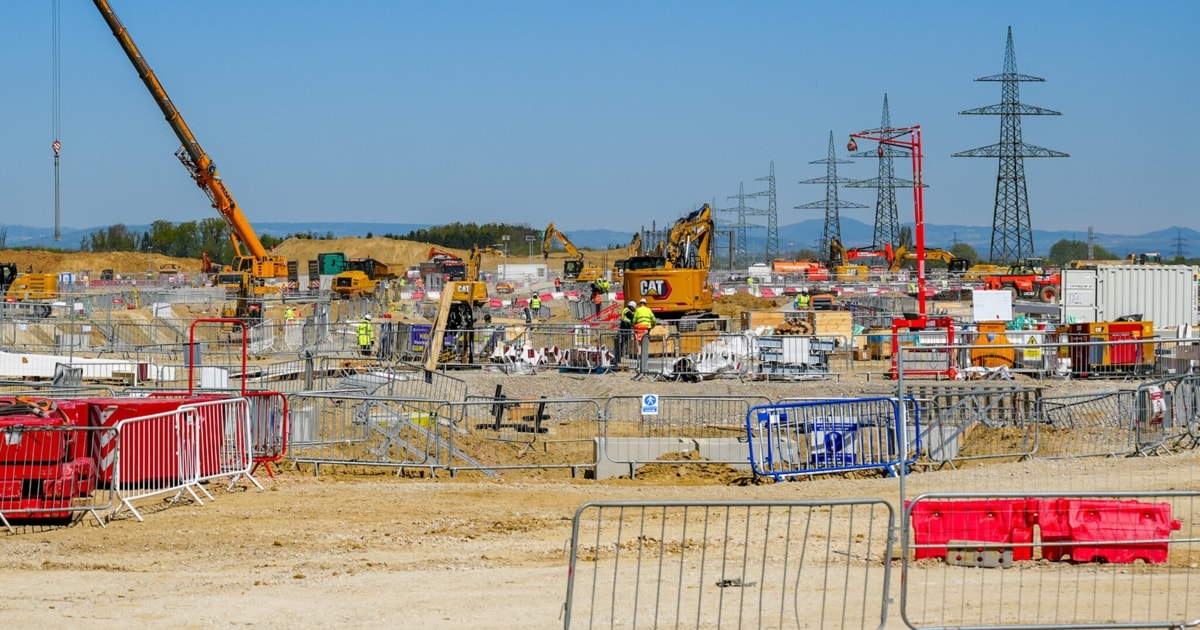
Google and Amazon to Build Data Centers in Upper Austria
Google is finally moving the heavy machinery into Kronstorf, Upper Austria. While the press releases lean heavily on “innovation” and “community,” the architectural reality is simpler: the AI arms race is a game of physics. To scale LLMs and maintain acceptable inference latency across the EU, you can’t rely on distant hubs; you need compute at the edge of the regional grid.
The Tech TL;DR:
- Infrastructure: First Austrian data center deployment in Kronstorf, focusing on AI-driven workloads and digital services.
- Sustainability Stack: Implementation of off-site heat recovery and solar-integrated green roofing to meet decarbonization targets.
- Human Capital: 100 direct operational roles and a dedicated AI skilling partnership with the University of Applied Sciences Upper Austria.
The deployment in Kronstorf isn’t a vanity project; it’s a response to the “AI Tax”—the exponential increase in power and cooling requirements demanded by next-gen tensor processing units (TPUs) and GPUs. When you’re running clusters of H100s or the newer Blackwell architectures, the thermal envelope shifts from “manageable” to “critical.” The mention of off-site heat recovery is the most telling technical detail here. In a legacy data center, heat is a waste product to be exhausted; in an AI-native facility, heat is a byproduct that must be engineered out of the system to prevent thermal throttling of the NPUs.
The Hardware Pivot: From General Compute to AI-Native Racks
Traditional cloud architecture was built for virtualization and containerization—think Kubernetes clusters running lightweight microservices. AI workloads are different. They require massive interconnect bandwidth (InfiniBand or RoCE v2) and power densities that would melt a standard 2010-era server rack. By establishing a footprint in Upper Austria, Google is likely deploying a high-density pod design tailored for TPU v5p or subsequent iterations, prioritizing low-latency paths to European enterprise endpoints.

For CTOs, this regional expansion solves a specific bottleneck: data residency and the “speed of light” problem. Every millisecond of round-trip time (RTT) added by routing traffic to a hub in Belgium or Finland degrades the user experience for real-time AI applications. As firms scale their deployments, they are increasingly relying on cloud migration specialists to optimize their VPC configurations and minimize egress costs during this transition.
| Metric | Legacy Cloud Facility | AI-Native Facility (Kronstorf Spec) |
|---|---|---|
| Rack Power Density | 5–15 kW per rack | 40–100+ kW per rack |
| Cooling Strategy | CRAC / Air-cooled | Liquid-to-chip / Heat Recovery |
| Primary Workload | General Purpose VM / Web | LLM Training / High-Scale Inference |
| Interconnect | Standard Ethernet | Ultra-low latency Fabric / TPU Pods |
The Thermal Engineering and ESG Constraint
The commitment to the Enns river ecosystem and the use of a green roof isn’t just corporate social responsibility; it’s a regulatory survival strategy. European energy mandates are tightening. By designing for off-site heat recovery, Google is essentially turning the data center into a thermal power plant for the local municipality. This is a necessary evolution for any facility attempting to maintain SOC 2 compliance and ESG ratings while consuming megawatts of power.

“The shift toward heat-recovery-ready architecture is no longer optional. As we move toward 100kW racks, the energy delta becomes so large that traditional cooling is an economic liability. Integrating the data center into the regional heating grid is the only way to scale compute without triggering a local energy crisis.”
— Lead Infrastructure Architect (Anonymous), via Technical Forum
From a security perspective, the physical expansion of the footprint increases the attack surface. While the internal network is hardened, the intersection of industrial control systems (ICS) for cooling and the actual compute fabric creates a potential vector for side-channel attacks. This is why enterprise IT departments are currently deploying vetted cybersecurity auditors and penetration testers to ensure that the integration of regional hubs doesn’t introduce vulnerabilities into their wider cloud architecture.
Implementation: Provisioning AI Workloads
For the developers who will actually be utilizing this new capacity, the shift is transparent at the API level but critical at the orchestration level. Scaling a workload to a new regional zone requires precise configuration of the Kubernetes cluster to ensure affinity and avoid cross-zone latency. Below is a conceptual CLI example of how a DevOps engineer might target a specific European zone for a GPU-intensive pod deployment:
# Targeting the new regional deployment for low-latency AI inference kubectl apply -f deployment.yaml --overrides='{ "spec": { "template": { "spec": { "nodeSelector": { "topology.kubernetes.io/region": "europe-austria-1", "accelerator": "nvidia-h100" }, "tolerations": [ { "key": "nvidia.com/gpu", "operator": "Exists", "effect": "NoSchedule" } ] } } } }'The Competitive Landscape: Google vs. AWS vs. Azure
Google’s move into Kronstorf is a strategic counter to the aggressive European expansions of AWS and Azure. While AWS focuses on massive “Availability Zones” (AZs), Google’s strategy often emphasizes the integration of custom silicon (TPUs). For developers, the choice between these providers usually comes down to the software stack: those deep in the PyTorch/TensorFlow ecosystem may find the TPU-optimized infrastructure in Austria more performant than general-purpose GPU instances elsewhere.

To dive deeper into the underlying hardware, developers should consult the JAX GitHub repository for optimization tips or check Stack Overflow for community-driven solutions to regional latency tuning. For a broader look at the hardware trends, Ars Technica provides excellent breakdowns of the SoC wars currently shaping these facilities.
The Kronstorf facility is a signal that the “AI era” of infrastructure has arrived. We are moving away from the monolithic, air-cooled warehouses of the 2010s and toward highly specialized, liquid-cooled compute engines that function as part of the city’s utility grid. For the enterprise, the focus now shifts from “where is my data?” to “how fast can I get a token back from the LLM?” As this capacity comes online, the bottleneck will move from hardware availability to the skill gap in managing these complex stacks—a gap Google is attempting to close via its partnership with the University of Applied Sciences Upper Austria. Those who can’t bridge this gap will find themselves paying a premium to managed service providers to keep their AI pipelines from stalling.
*Disclaimer: The technical analyses and security protocols detailed in this article are for informational purposes only. Always consult with certified IT and cybersecurity professionals before altering enterprise networks or handling sensitive data.*