
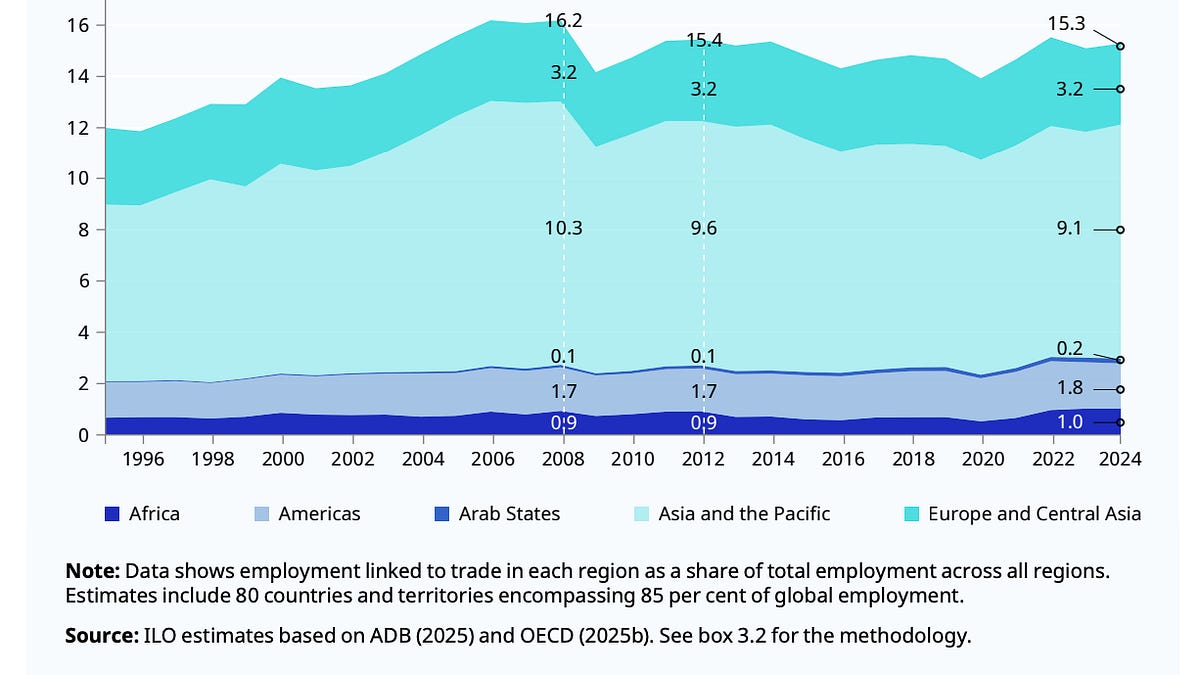
Bangkok – A new analysis from the International Labour Organization (ILO) reveals that a substantial 81 percent of employment globally linked to trade in goods and services is concentrated in Asia and the Pacific (60 percent) and Europe and Central Asia (21 percent). The findings, published in the 2026 edition of the ILO’s Employment and Social Trends report, underscore the central role of these regions in the current globalized economy.
The report identifies 465 million jobs worldwide as being connected to global trade in 2024, representing 15.3 percent of total employment. Asia and the Pacific accounts for the majority of these trade-linked jobs, with 278 million, even as Europe and Central Asia accounts for 96 million. The ILO notes that the distribution of these jobs largely corresponds with the size of the labor force in each region.
Within Asia and the Pacific, South-Eastern Asia stands out, with 24.1 percent of its employment directly tied to international trade. However, the share of employment linked to trade varies significantly across regions, ranging from 12.3 percent in Africa to 24.6 percent in Europe and Central Asia.
The ILO’s analysis indicates a rebound in trade-related employment following declines experienced during the 2008 global financial crisis and the COVID-19 pandemic. After drops of 2 percentage points in 2008 and 0.8 percentage points in 2020, the share of global employment linked to trade recovered by 1.4 percentage points to reach 15.3 percent in 2024. This recovery suggests trade played a key role in post-COVID employment gains in most regions, with the exception of the Americas.
The ILO’s methodology for estimating trade-related employment relies on input-output modelling, utilizing multi-country, multi-sector input-output tables. The 2025 version of the inter-country input–output tables of the Organization for Economic Co-operation and Development (OECD) and the multi-region input–output tables of the Asian Development Bank (ADB) are used to determine the value added required throughout supply chains to meet foreign demand. Employment figures are derived from the ILO Harmonized Microdata repository.
The ILO is currently engaged in regional consultations in preparation for the Sixth Global Conference on the Elimination of Child Labour, to be hosted by the Government of Morocco in 2026. These consultations, mandated by the ILO Governing Body, aim to incorporate regional priorities into the global dialogue on child labor, a challenge that persists alongside the benefits of increased trade and economic integration. The Asia and the Pacific Regional Tripartite Consultation aims to discuss progress since 2022 and identify policy priorities to accelerate progress towards Sustainable Development Goal Target 8.7.
The ILO Regional Office for Asia and the Pacific supports operate in 36 member countries, from Afghanistan to New Zealand, providing technical services and expertise to address challenges related to digitization, migration, climate change, and other issues impacting the region’s workforce.
