European Protesters Clash With Police Over Cost of Living and Public Investment
Mass Protests Erupt Across European Capitals Over Inflation and Housing Costs
Anti-government demonstrations drew hundreds of thousands of protesters into the streets of France, Belgium, Spain, Portugal, and Italy on October 24, 2026, demanding government action on high energy prices, housing shortages, and deteriorating public services, according to Kookje. The coordinated wave of civil unrest triggered violent clashes with police forces, property damage, and heightened political tensions as various demographic groups expressed outrage over declining living standards.
In France, student protests over inadequate educational infrastructure morphed into widespread demonstrations against the high cost of living. Police figures cited by Kookje placed the nationwide turnout at 410,000 (police estimate) despite official restrictions. Authorities deployed 70,000 officers alongside helicopters and armored vehicles to prevent a recurrence of previous violence. The government’s restrictive decrees fueled accusations that President Emmanuel Macron’s administration was attempting to suppress public grievances rather than address systemic fiscal pressures.
Clashes in Brussels and Madrid Sparked by Economic Strain
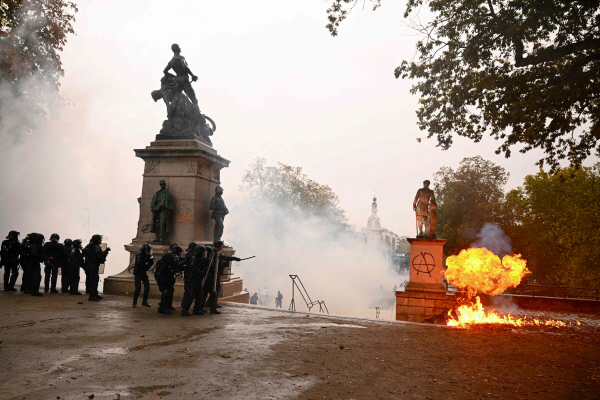
Demonstrators in Brussels clashed with police officers who deployed tear gas and spray canisters. Reuters reported that protesters fled down streets, with one individual observed being kicked by police officers while down. Some participants hurled road signs and set motor scooters and bicycles on fire.
A crowd of approximately 25,000 marched through Madrid from Atocha Station to the central shopping district of Gran Vía. Protesters demanded secure state pensions, public sector improvements, and relief from surging prices. The demonstrations coincided with a month-long wave of housing protests ahead of upcoming national elections, where pension reform has emerged as a central electoral battleground.
Protests Against Housing and Energy Policies Hit Southern Europe
Portuguese citizens gathered in Lisbon to protest recent government policies that relaxed annual rental increase caps and simplified the eviction process for tenants in arrears. Meanwhile, youth-led crowds in Milan carried placards opposing state policies, with local broadcasts showing a group targeting an energy regulatory authority building with refuse and burning model utility bills. Retail storefronts along Milanese streets responded to the unrest by boarding up windows and closing early.
Simultaneous anti-government demonstrations unfolded in Tirana, where high school and university students demanded increased educational investment, tuition reductions, and the resignation of Prime Minister Edi Rama. Police forces deployed water cannons to disperse crowds after protests against a proposed resort development by the son-in-law of United States President Donald Trump evolved into broader demands for educational reform, culminating in demonstrators setting fire to government buildings.