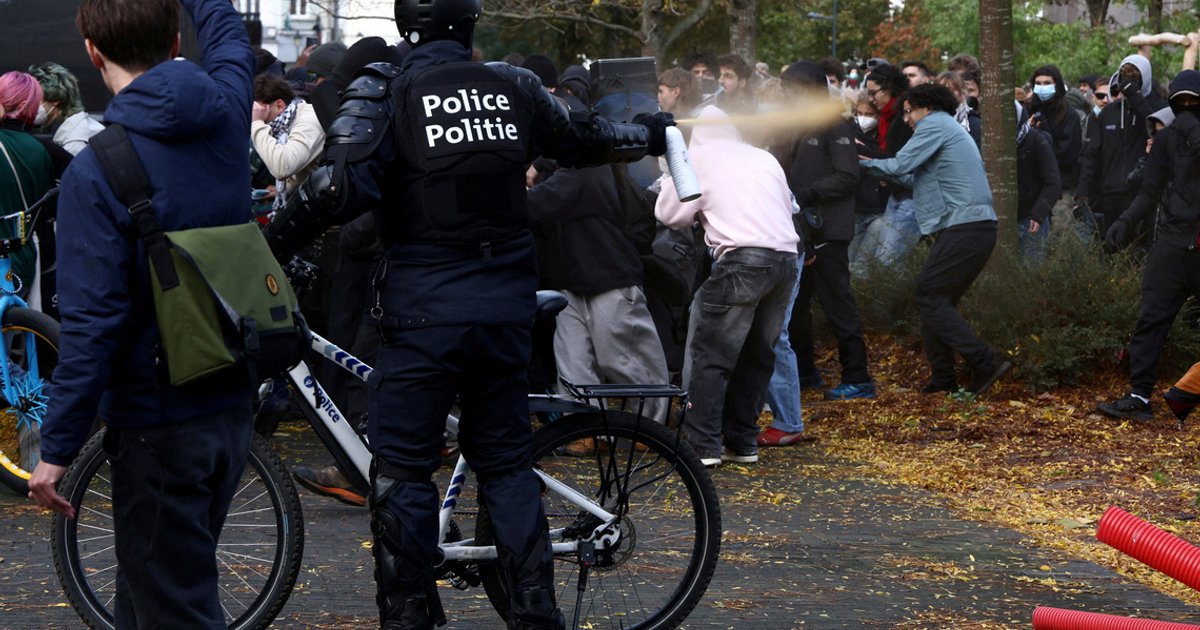
Brussels Police Clash With Education Protesters Over Funding
Belgian police deployed tear gas and pepper spray on Saturday, October 24, to disperse anti-government demonstrators in Brussels. Protesters gathered to demand increased funding for the education system, marking a continuation of rallies that have taken place in recent months. Reuters witnesses observed the skirmishes in the city center.
Clashes in Brussels and police response
The Saturday demonstration saw hundreds of participants, primarily young people, march through Brussels to voice grievances regarding education conditions. During the event, tensions escalated when some protesters threw road signs and other debris onto a pile of rental scooters and bicycles before attempting to ignite them. In response, police utilized tear gas and pepper spray to break up the gathering. Reuters observers documented an incident where officers pursued protesters, resulting in one individual being struck and kicked after falling to the ground.

This event follows a series of similar protests. On October 17, 2026, a protest in Brussels involved several hundred people, many of whom wore masks and chanted anti-fascist slogans. During that earlier demonstration, police used water cannons and tear gas, while some protesters overturned a vehicle, according to Reuters. In the eastern city of Liège, students also held demonstrations earlier this month, citing rising costs for study materials and broader concerns regarding the French-language education system.
Government stance on public demonstrations
Following the events of October 17, Belgian Interior Minister Bernard Quintin stated on X that the situation in Brussels had evolved beyond a standard protest. He declared that “all necessary means” would be employed to restore order against those he labeled as rioters.
Regional context of educational unrest
The motivation behind these protests remains rooted in student-led concerns over the accessibility of higher education. Student groups in Belgium have consistently highlighted the impact of rising education costs and proposed reforms that they argue will create further barriers for students. These local grievances have been amplified by similar movements in neighboring France, where protests originally centered on school conditions and funding before expanding into a wider movement addressing public spending, living standards, and inequality.
| Date | Location | Primary Grievance |
|---|---|---|
| Early October 2026 | Liège | Rising education costs |
| October 17, 2026 | Brussels | Education accessibility/reforms |
| October 24 | Brussels | Education system funding |
Student demands for reform clash with government enforcement
The intensity of the Saturday clashes was reported to be lower than the unrest observed last week, and notably smaller than the large-scale demonstrations occurring across the border in France. As these movements continue to evolve, the primary tension remains between the students’ demands for systemic financial reform and the government’s mandate to maintain public order through increasingly rigorous enforcement measures.