EU & Australia Finalize Free Trade Deal Amidst Trade Diversification Efforts
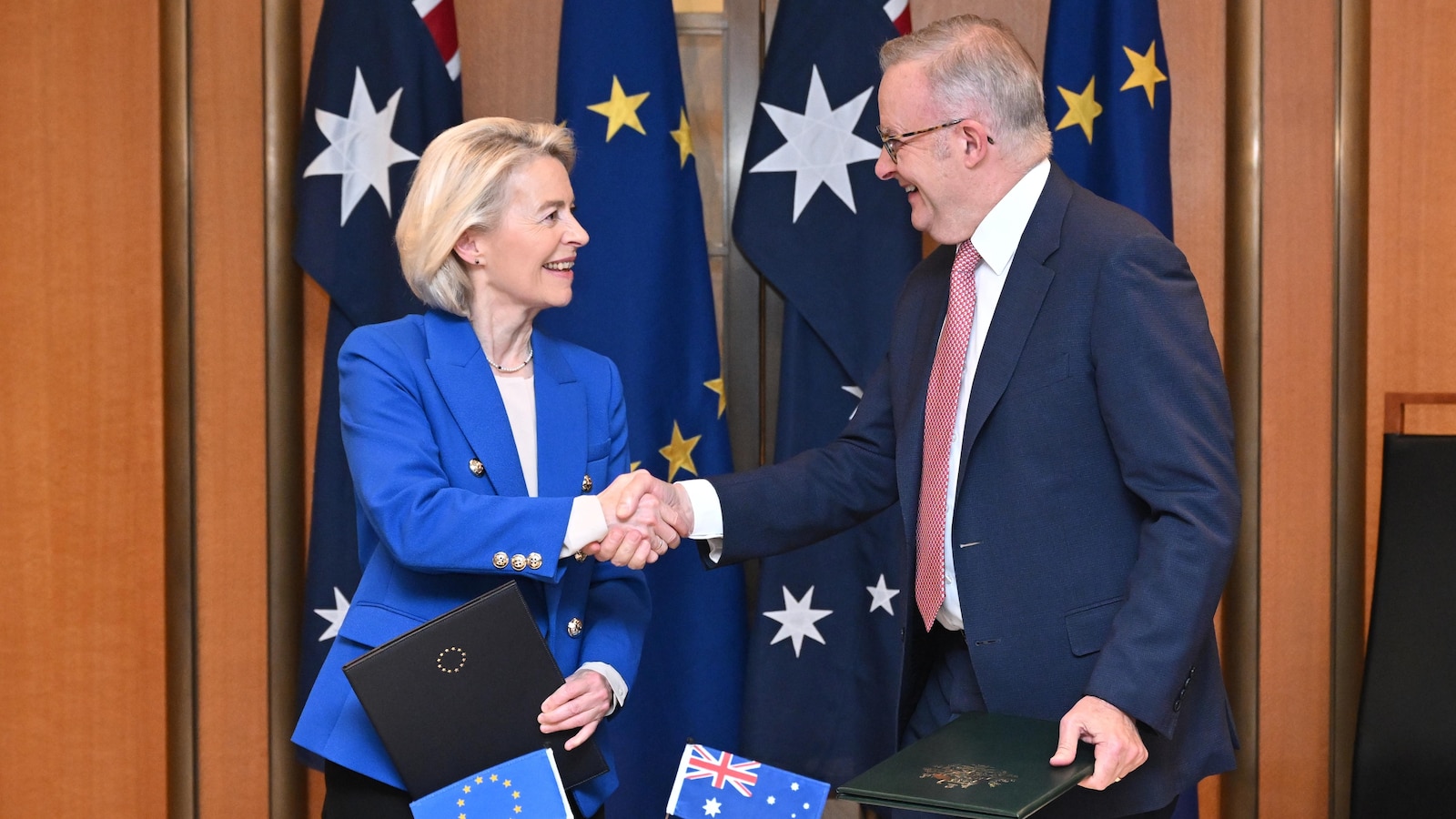
CANBERRA, Australia – The European Union and Australia finalized a free trade agreement Tuesday, a landmark deal signed in Canberra by European Commission President Ursula von der Leyen and Australian Prime Minister Anthony Albanese. The agreement, initially stalled in October 2023 over disputes regarding agricultural market access and the protection of geographical indications, represents a significant step toward diversifying trade relationships for both entities amid growing global economic uncertainty.
The agreement aims to reduce tariffs on key Australian exports, including wine, seafood, and horticultural products. Australian red meat producers will benefit from two tariff rate quotas totaling 30,600 metric tons, with 55% of that volume entering the EU duty-free. The deal as well comes as both the EU and Australia seek to lessen their economic dependence on China, a point emphasized by von der Leyen during a joint press conference.
“Today we are telling an important story to a world that is deeply changing. A world where great powers are using tariffs as a leverage and supply chains as vulnerabilities to be exploited,” von der Leyen stated. “In our story, open rules based trade delivers positive some outcomes. Trust matters more than transactions,” she added.
Albanese echoed this sentiment, highlighting the importance of the agreement as a demonstration of commitment to free and fair trade. “This is both the European Union and Australia asserting that we believe in free and fair trade, that we understand that trade advances the prosperity of both trading entities who are involved, that it is in our interest to get this done,” he said.
Beyond trade, the leaders announced a modern defense partnership focused on collaboration in areas such as defense industries, maritime security, cybersecurity, countering terrorism, and combating disinformation. The partnership also reaffirmed support for Ukraine in the face of Russia’s invasion. Negotiations will also commence for Australia to become an associate of Horizon Europe, the EU’s research and innovation funding program.
A key sticking point in previous negotiations, the use of the term “prosecco” by Australian winemakers, has been addressed. Under the terms of the agreement, Australian producers will be prohibited from using the name “prosecco” on exports ten years after the pact comes into effect, protecting the geographical indication for the Italian sparkling wine.
The EU also anticipates securing supplies of critical raw materials, including lithium and tungsten, through the agreement. This comes as the EU simultaneously prepares to implement a free trade deal with four South American countries on May 1, following over two decades of negotiations.
A specific date for the implementation of the EU-Australia trade agreement has not yet been announced, and further ratification processes remain.
- Beau Lamarre-Condon enlisted mother to cover up lie, court heard
- The Spanish Partido Popular (PP) requested the Audiencia Nacional to indict the Partido Socialista
- Team Australia purchases Te Rehutai AC75 design package from Team NZ (newsdirectory3.com)
- Why Australia Fines People Who Don't Vote (daybreakwire.com)