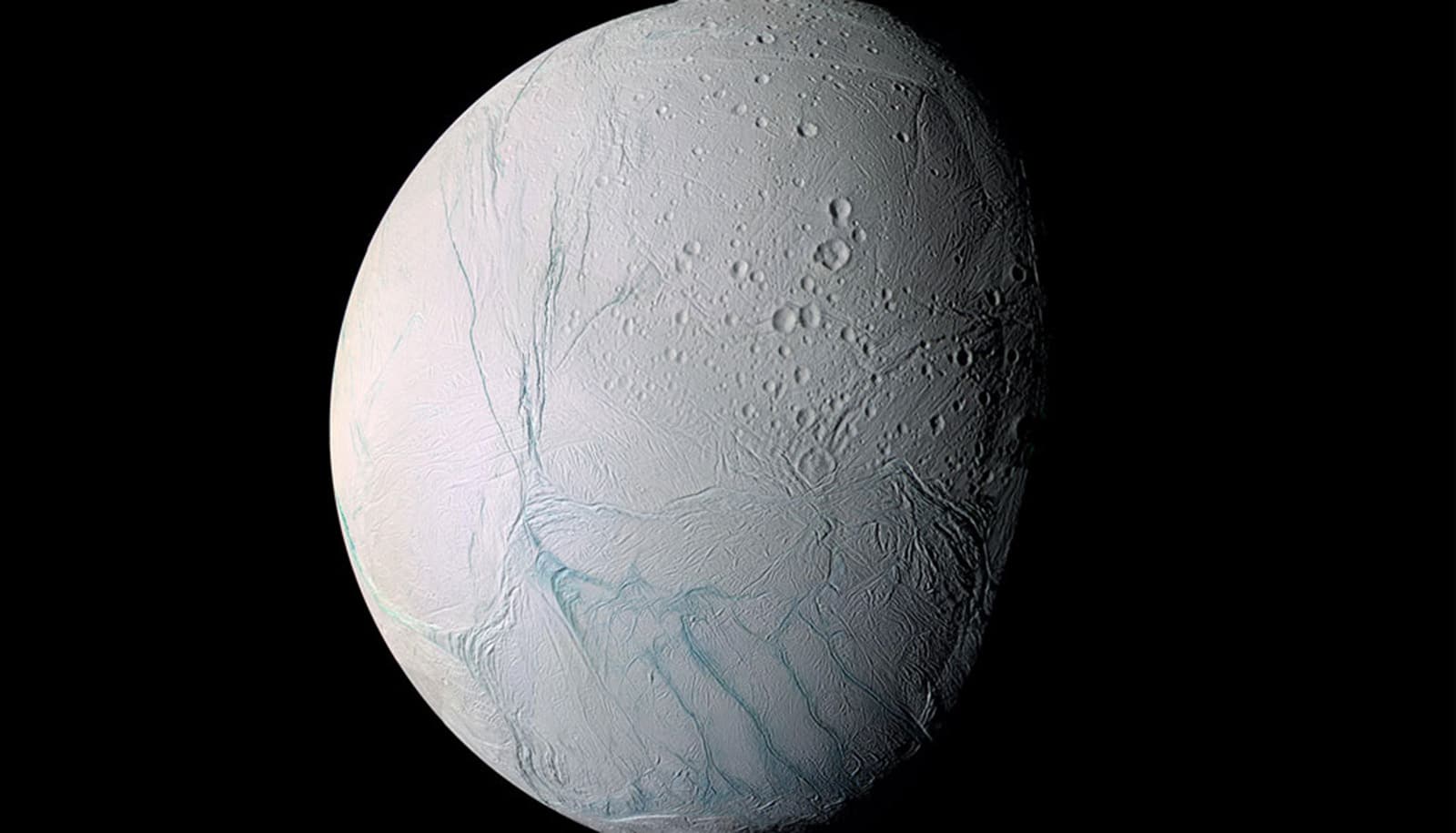
Enceladus Ice Grains May Concentrate Biosignatures for Alien Life Search
Natural sorting of ocean salts inside icy vents on Saturn’s moon Enceladus could make potential signs of alien life significantly easier for future spacecraft to detect, researchers reported in a study published in Science Advances.
- Water vapor and ice particles erupt from a global liquid ocean beneath the ice shell of Saturn’s south pole, forming a plume sampled by the Cassini spacecraft.
- Laboratory experiments and Cassini data show that slow-freezing ocean droplets inside moon vents separate into distinct salt regions before shattering into micrometer-scale fragments.
- Future space missions must analyze individual ice grains rather than bulk mixtures, as rare organic molecules or potential biosignatures may concentrate inside only a small fraction of particles.
Cassini Dust Analyzer Reveals Chemical Separation in Erupted Ice Grains
With a global ocean of liquid water situated beneath a thick crust of ice, Saturn’s moon Enceladus stands out as a prime target in the search for extraterrestrial habitability. At the moon’s south pole, jets of water vapor and tiny ice particles erupt from this hidden ocean, extending hundreds of miles into space to feed Saturn’s E ring. NASA’s Cassini spacecraft, which arrived at the Saturn system in 2004, repeatedly flew through this plume to sample ocean-derived material without requiring a landing or deep drilling operations through miles of ice. During these flybys, Cassini detected salts, organic compounds, and evidence of active water-rock interactions occurring on the rocky seafloor.
The study published in Science Advances examined 961 individual salt-rich ice grains recorded by Cassini’s Cosmic Dust Analyzer. The research team analyzed how different salts separate and concentrate into distinct grains as ocean spray freezes and travels through cracks in the ice crust. Scientists expected these grains to reflect minor variations around a uniform common ocean composition, but the particles proved remarkably different from one another. Some grains were rich in sodium chloride, while others contained carbonates, phosphates, hydroxides, or potassium-bearing salts. Chloride and carbonate signatures almost never appeared together, as only about 1.4% of the 858 regularly classified sodium-rich spectra contained both.
Laboratory Freezing Experiments Explain Vent Fragmentation Mechanisms
To understand how individual grains developed such sharp chemical divisions, researchers combined Cassini observational data with laboratory experiments, thermodynamic calculations, and mathematical models of droplet cooling. In laboratory tests, investigators froze droplets of alkaline salt water formulated to mimic estimated conditions of the Enceladus ocean. Larger droplets that cooled relatively slower developed distinct salt-rich regions, whereas the smallest and most rapidly frozen droplets remained uniform in chemical composition.
“We show that each grain is not necessarily a tiny scoop of the ocean,” Fabian Klenner, a UC Riverside assistant professor of planetary sciences and coauthor on the study, stated in the Futurity report. “It is more of a fragment of a much larger ocean droplet in which freezing separated the salts before that droplet broke apart.”
The proposed physical model begins when bursting bubbles at the ocean surface produce spray droplets tens or hundreds of micrometers across. Water vapor carries these droplets upward through vents, where they freeze slowly enough for different salts to segregate internally. Closer to the surface, narrower passages accelerate the vapor and frozen droplets to a few hundred miles per hour. Collisions with the icy walls then shatter them into micrometer-scale fragments.

“When these droplets freeze relatively slowly, different salts can separate into distinct regions within a single grain,” Klenner explained. “For example, sodium chloride could concentrate in one region and potassium chloride in another. As the grain is accelerated through the vents, collisions with the icy walls can break it into smaller fragments with different compositions. This is the mechanism we propose.”
Implications for Future Extraterrestrial Life Detection Missions
The findings alter how scientists interpret plume samples collected during planetary flybys. A single ice grain does not represent the exact average composition of the underlying ocean. Combining many particles into one bulk measurement erases natural separation and conceals rare compounds, whereas analyzing individual grains preserves critical compositional data. Klenner noted that similar physical processes may help explain why some organic compounds occur at elevated concentrations in only a tiny fraction of Enceladus ice grains.
“This tells us something important about the search for life on Enceladus,” Klenner said. “Molecular signatures of life, if present, may be concentrated in only a few grains. A future spacecraft has to find exactly those grains.”
Frank Postberg, a professor of planetary sciences at Freie Universität Berlin who led the study, emphasized the natural advantages provided by the moon’s geology. “Enceladus actually does a lot of the work for us in preparing samples for analysis that usually take a lot of effort in chemical labs on Earth,” Postberg observed. “The oceanic constituents are separated from each other and simultaneously concentrated into individual ice particles.”
The research collaboration included scientists from institutions across Germany, Japan, China, the United Kingdom, and the United States. Financial support for Klenner’s contribution came from NASA and the European Research Council. Ongoing laboratory work at UC Riverside continues to examine how organic molecules and possible biosignatures would appear in individual ice grains, helping shape instrument designs for future planetary mass spectrometers.