
A luxury hotel in Dubai was struck during retaliatory strikes launched by Iran across the Middle East on Monday, following a reported attack by the US and Israel, according to reports. The incident has prompted warnings that Dubai’s decades-long status as a safe haven for global capital and luxury investment is facing an unprecedented challenge.
Sandra Navidi, a New York-based financial expert, stated that “Iran has destroyed Dubai’s business model within 24 hours,” in a recent podcast appearance. Navidi, a German attorney and macroeconomic consultant who also serves as a financial expert for n-tv and Spreeradio (RTL), warned that the perception of absolute security in the region, central to Dubai’s appeal, has been fundamentally damaged.
For years, Dubai has cultivated an image of stability and predictability, attracting entrepreneurs, high-net-worth individuals, and businesses with its low or non-existent income taxes, luxurious lifestyle, and perceived safety. This formula has driven significant growth in tourism, infrastructure development, finance, exhibitions, and real estate. Experts had previously forecast a growth rate of around 4.5 percent for 2026, building on a 4.4 percent increase in 2025.
Yet, the recent escalation of tensions with Iran has exposed Dubai’s geopolitical vulnerability. The Emirate’s proximity to Iran – located only a few hundred kilometers away – and the strategic importance of the Strait of Hormus, a vital artery for global oil trade, make it susceptible to regional instability. Any escalation in the region directly impacts the logistics hubs of the Gulf.
Navidi’s assessment centers on the erosion of trust. She argues that the assumption of safety, crucial for those seeking to secure assets and relocate their tax residency, is now in question. The strikes, even if not directly targeting Dubai, have altered the risk assessment for investors.
The real estate market is particularly vulnerable. In recent years, Dubai has seen a surge in investment in luxury properties from European, Russian, and Asian buyers seeking stability. However, property values are heavily reliant on long-term predictability, and geopolitical risks are now being factored into investment decisions. While an abrupt collapse is not necessarily anticipated, a gradual downward re-evaluation of prices is a distinct possibility.
Despite these concerns, Dubai possesses substantial financial reserves and political maneuvering capabilities, making an immediate economic collapse unlikely. However, the cost of doing business in the Emirate may increase, with higher insurance premiums, more cautious capital inflows, and more demanding return expectations.
Born in Mönchengladbach, Germany, to an Iranian father and a German mother, Sandra Navidi has a background in both German and U.S. Law, holding degrees from the University of Cologne and Fordham University School of Law. She is the founder and CEO of BeyondGlobal, an international management consultancy.
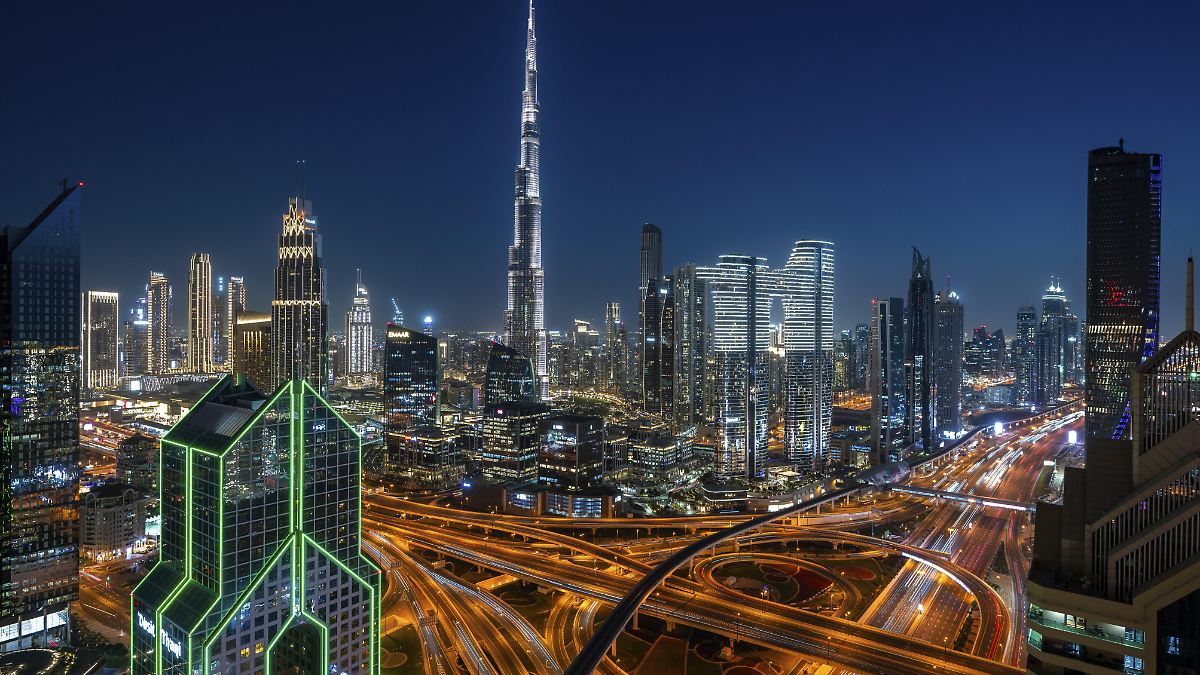
As of Monday evening, the Dubai skyline remained illuminated, hotels remained open, and influencers continued to post images of the city’s attractions. However, the fundamental promise of stability and tax attractiveness in an unstable region remains under pressure.
