
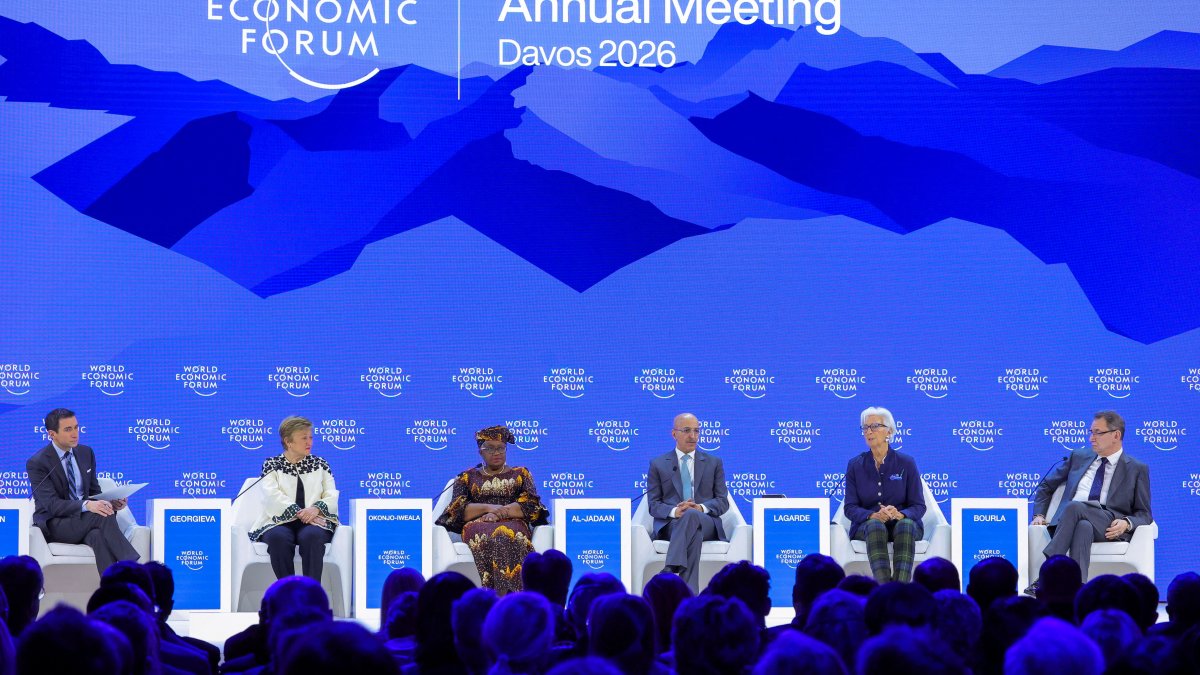
Leading global economic policymakers at the World Economic Forum (WEF) in Davos urged countries and businesses to filter out the turmoil from a week of clashes with the Trump administration and focus on boosting growth and fighting inequality in a world where trade will continue to flow and international cooperation is still badly needed.
The global economy is showing unexpected resilience despite the noise, European central Bank (ECB) President Christine Lagarde, International Monetary Fund (IMF) head Kristalina Georgieva and World Trade Organization (WTO) head Ngozi Okonjo-Iweala said in a panel discussion. But while growth is holding up, troubles like worrisome levels of government debt and inequality loom.
That resilience is holding up despite disruptions from U.S. trade policy under President Donald Trump, who roiled the weeklong forum with threats to impose tariffs on countries supporting greenland against a U.S. takeover bid, then withdrew the tariff proposal.
What is now needed, they said, are efforts to boost growth to offset heavy debt levels around the world and ensure that disruptive technologies like artificial intelligence don’t worsen inequality or devastate labor markets. And Europe needs to boost productivity and improve its business climate for investment.
Georgieva said the IMF’s recently raised forecast of 3.3% global growth for this year was ”stunning but not enough… do not fall into complacency.”
She said that level of growth wasn’t enough to wear down “the debt that is hanging around our necks” and that governments need to take care of “those who are falling off the wagon.”
“We have to look at Plan B, or Plans B,” said Lagarde. “I think we’ve had a lot of noise this week… and we need to distinguish the signal from the noise…we should be talking about alternatives.”
‘Euro-bashers’
After a week of hearing various officials denigrate europe, its leaders and its regulations at Davos, Lagarde said that the harsh words could be just what the continent needed.
Lagarde had walked out of a Davos dinner during a speech critical of Europe by U.S. Commerce Secretary Howard Lutnick.
Among the more rankling comments was U.S. Treasury Secretary Scott Bessent’s quip in a TV interview dismissing “the dreaded European working group” in response to potential U.S. tariffs aimed at seeking control of Greenland.
Ukraine’s President Volodymyr Zelenskyy, meanwhile, blasted the EU’s lack of “political will” in countering Russian leader Vladimir Putin.
“Instead of becoming a truly global power, Europe remains a beautiful but fragmented kaleidoscope of small and middle powers,” Zelenskyy said during his address at the WEF.
Lagarde said such criticism meant Europe would have to face tough realities and find alternative ways of working to make sure it carries weight on the global stage.
“I think we should say thank you to the bashers,” she said.”It has given us a complete realisation of the fact that we have to be more focused, we have to work on those plan Bs that I was talking about, and we have to focus on innovation, enhancement of productivity, and the rest of it.”
Lagarde down
