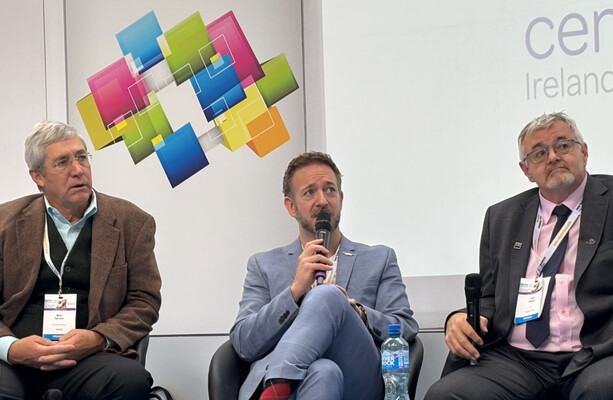
Data Centre Operators Acknowledge Backlash, Urge Private-Wire Laws at Dublin Conference
Data centre operators and designers at the Data Centres Ireland conference in Dublin this week acknowledged a growing public backlash that threatens the sector’s expansion, The Journal reported.
Speakers returned repeatedly to what they described as an industry perception problem, arguing that the public misunderstands the facilities as closed-off buildings that drain community resources.
“They think these are big closed-off buildings, and they destroy the community. But if they can start understanding that no, this is a facility that can generate power, it can give something back,” Stefanos Gkougkoustamos, director with design firm Bryden Wood, said. The sector consumes almost a quarter of the electricity produced by Ireland’s grid, a figure that has fuelled opposition in towns including Naas, Kilmeaden and Rochfortbridge.
The first national anti-data centre protest drew around 2,000 people to Dublin on 7 November. Organisers labelled conference attendees “energy vampires,” a description carried by national news outlets.
Labour TD Ciarán Ahern attended the conference and posted an Instagram reel criticising what he called greenwashing, “AI slop” posters, and sustainable businesses working for data centres rather than decarbonising existing energy use. His party is calling for legislation requiring centres to provide 100 per cent of their own energy through on-site renewables.
Grid integration and private wires
Industry representatives argued that data centres must become an integral part of the grid, contributing to renewable development that Ireland would otherwise build more slowly. Michael Martin, director of design with Echelon Data Centres, described new Commission for Regulation of Utilities rules requiring 80 per cent on-site renewable capacity for new builds and major expansions as an exciting opportunity.
“We want to be good grid citizens, and we’re prepared to walk the walk,” he said. Martin characterised the shift as a paradigm shift where centres reinforce the grid and integrate as a single system.
Speakers warned that without legislation allowing private-wire connections — direct electricity links to generators — Ireland could lose its position as a leading EU data hub to the Nordics and Spain. Next-generation AI facilities, which Martin described as generating intelligence rather than simply storing data, will require denser computing infrastructure and more sophisticated cooling.
Transparency and foreign interference claims
Matthias Haymoz, director of the Swiss Datacenter Efficiency Association, urged the sector to become more transparent about energy, water and other metrics. He described two parallel universes on social media: one celebrating the boom, the other criticising AI and moratoriums. Haymoz said even Switzerland faced a protest camp against a simple colocation centre that grew into a national movement demanding a country-wide moratorium.
John Booth, managing director of Carbon3IT, claimed without presenting evidence that recent protests are coordinated and possibly funded by bad actors in Russia and China. He told a journalist who pressed him that people are monitoring websites and Telegram chats across those countries, linking the activity to the hybrid war Russia is undertaking in Europe.
Fine Gael TD James Geoghegan told attendees that lots of Irish infrastructure has been built in the teeth of opposition and that companies must convince communities of their contribution beyond a cheque to the local GAA team.
Bryden Wood, the London-based design and engineering firm where Stefanos Gkougkoustamos is a director, developed a Reference Design for data centres that has been deployed on campuses in Dublin, Milan and Madrid. The company also created the P-DfMA methodology used on The Forge, the UK’s first net-zero carbon commercial building, and designed the Hospital 2.0 model for 40 new NHS hospitals.
The next Commission for Regulation of Utilities regulatory review will test whether the sector’s pivot to on-site generation and grid integration can close the credibility gap with a public that has already taken to the streets.