
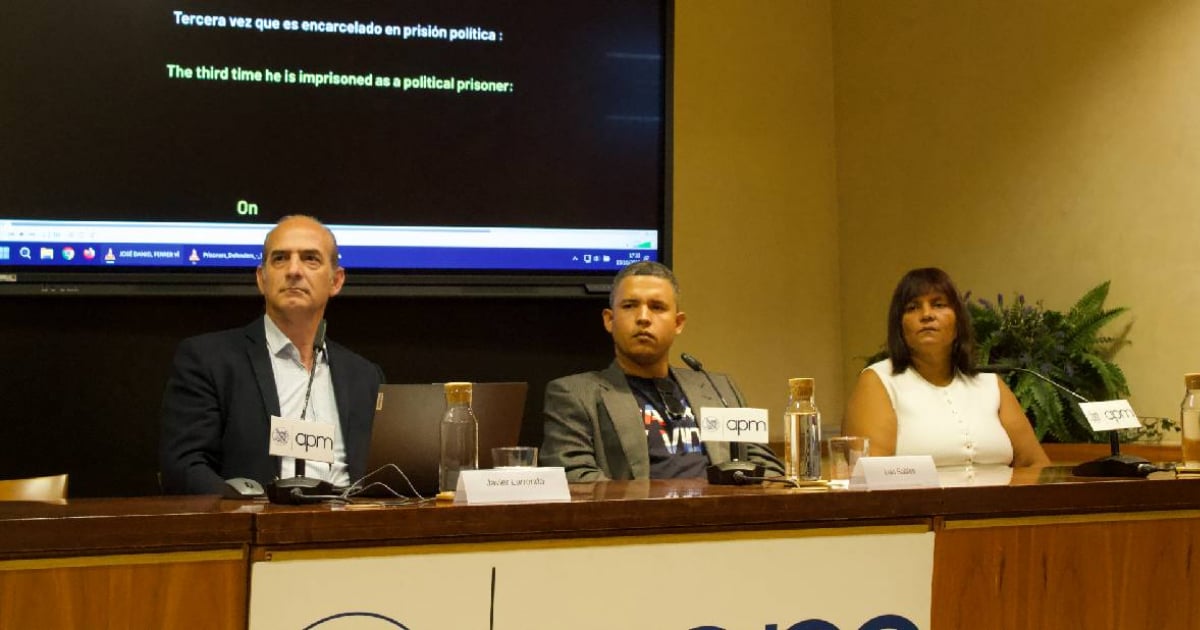
Luis Robles Surprises the Cuban Regime with His Departure: How He Managed to Escape
Luis Robles, a Cuban activist declared a prisoner of conscience by Amnesty International, and his seven-year-old son arrived at Madrid Adolfo Suarez Airport this Monday, marking the beginning of a new chapter in their lives. Robles’ departure represents a notable growth, as he revealed the Cuban state Security attempted to control the terms of his exit from the country.
Prior to leaving Cuba, Robles stated that authorities were aware of his desire to depart once his sentence concluded, but sought to silence him. “They were told that the day my sanction ended, my wish was to leave, as I suffered and my entire family suffered threats. They were interested in me leaving, but with the prohibition of talking about what I experienced in prison, under threat,” he explained.
Robles, 32, deliberately concealed his escape plans to avoid intervention. “I decided to leave the country, but I didn’t say how. When they found out,I was already out,and that took them by surprise because I didn’t give them access to my life,” he recounted.
His imprisonment stemmed from a peaceful act of protest in December 2020, where he displayed a banner on San Rafael Boulevard reading: “Freedom, no more repression, #FreeDenis” in support of rapper Denis Solís. The act, widely shared on social media, became a symbol of citizen resistance and was even incorporated into the music video for the anthem “Homeland and Life” – a video ironically used as evidence against him by the Prosecutor’s Office.
During his trial, Robles was accused of “resistance” and “enemy propaganda,” despite video evidence demonstrating his non-violent conduct during arrest and lack of incitement to violence. In March 2022, he was sentenced to five years in prison, with the court justifying the punishment by citing his connection to influencer Alexander Otaola and alleging his message aimed to “destabilize the internal order.”
The sentence drew strong condemnation from international human rights organizations.In May 2024, the United States Government responded by imposing sanctions on four Cuban judges and prosecutors involved in the case: Gladys maría Padrón Canals, María elena Fornari Conde, Juan Sosa Orama, and Yanaisa Matos Legrá. These officials, and their families, are now prohibited from entering the United States due to their participation in Robles’ “arbitrary detention” and “serious violation of human rights.”
Throughout his incarceration at the Combinado del Este prison, Robles faced punishment and periods of isolation.His family also endured constant harassment. His brother, Lester Fernandez, was arrested and fined 7,000 pesos under the accusation of ”illegal departure from the country,” despite a lack of evidence.
Robles’ mother, Yindra Elizástigui, emerged as a prominent advocate for the release of political prisoners, publicly denouncing the regime’s abuses. “We must continue defending the innocent, because our children are not criminals,” she stated in 2023 following another denial of her son’s release.
A graduate in Computer Science, Robles had previously expressed critical views of the Cuban government. Days before his arrest, he recorded a video stating: “We sincerely wish for a change in the system, as communism has turned this country into a hell where it is indeed impossible to breathe peace and freedom.”
