Clalit and NHANES analysis reveals menopause biological transitions
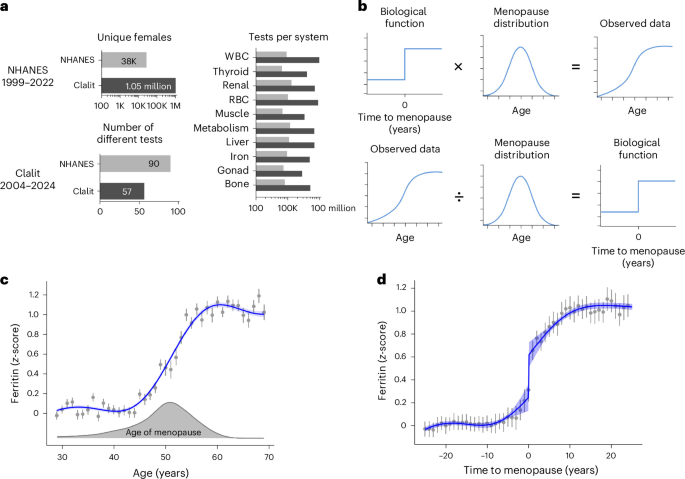
- Analysis of records from Clalit Health Services and waves of NHANES uncovered rapid biological transitions surrounding the final menstrual period.
- The study utilized the novel YoGlen algorithm to impute unknown menopause ages and deconvolve cross-sectional laboratory trajectories into time-since-FMP dynamics.
Global Dataset Integration Across Clalit and NHANES
To capture the systemic impact of the final menstrual period (FMP), investigators analyzed two large-scale health repositories: the Clalit Health Services electronic medical record dataset from Israel, and the National Health and Nutrition Examination Survey (NHANES) collected in the United States between 1999 and 2022. The NHANES cross-sectional surveys supplied detailed menstrual history, demographic variables, and medication logs, including 738 MHT users.
Algorithmic Deconvolution via the YoGlen Method
Because electronic medical records from Clalit lack explicit menstrual tracking, the research team developed and deployed the YoGlen latent variable algorithm to reconstruct individual timelines relative to the final menstrual period. For the NHANES cohort, the algorithm applied Bayes’ theorem utilizing a reference menopause age distribution modeled as a ten-knot natural spline. For the Clalit records, the method deconvolved age-dependent cross-sectional means into time-since-FMP dynamics. This computational approach accounted for data uncertainty using Rubin’s rules and enabled population-scale tracking of systemic biomarkers without relying solely on self-reported survey data.
Researchers Measure Physiological Impact of Hormone Therapy
To measure the physiological impact of medical intervention, researchers defined the menopause change as the difference between postmenopausal and premenopausal window means, comparing MHT users against matched control groups. The study complies with relevant ethical regulations, receiving approval from the Clalit Helsinki Committee under reference RMC-1059-20 and utilizing public de-identified NHANES data governed by the National Center for Health Statistics Research Ethics Review Board.
Disclaimer: The information provided in this article is for educational and scientific communication purposes only and does not constitute medical advice. Always consult with a qualified healthcare provider regarding any medical condition, diagnosis, or treatment plan.