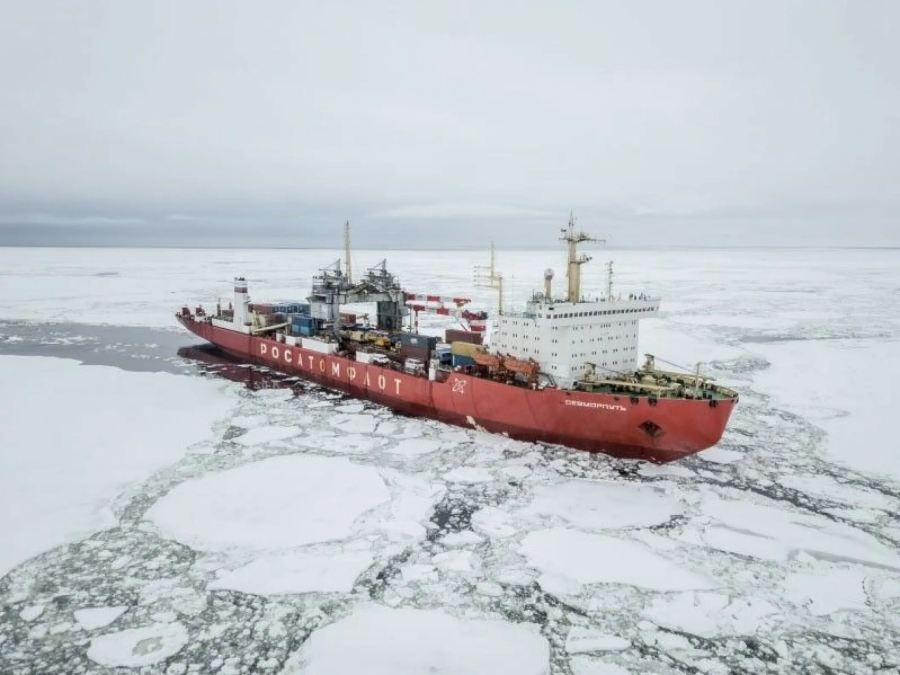
China and Russia Build Maritime Axis Through the Arctic
Trade between China and Russia grew steadily as both nations steadily build a maritime axis through the Arctic to bypass strategic maritime chokepoints. While traditional shipping via the Suez Canal faces escalating disruptions, the Northern Sea Route achieved a record 37.9 million tons of cargo volume in 2024, prompting closer commercial and logistical integration between Beijing and Moscow.
Nikolai Patrushev Visits Beijing to Advance Arctic Logistics
Russian Presidential Aide Nikolai Patrushev traveled to China, as reported by Asia Times. Moscow aims to integrate China’s Maritime Silk Road with Russia’s Trans-Arctic Transport Corridor.
Reuters reported that Russian Foreign Minister Sergey Lavrov and Chinese Foreign Minister Wang Yi met at a conference in Azerbaijan to review their comprehensive strategic partnership. Concurrently, Chinese Premier Li Qiang met with Russian President Vladimir Putin in Saint Petersburg, where Putin stated that bilateral relations are developing successfully and dynamically, independent of international circumstances.
Northern Sea Route Cargo Volumes Contrast With Suez Canal Traffic
Despite significant geopolitical ambition, Arctic shipping remains constrained by environmental and structural hurdles. Russia’s Northern Sea Route recorded 37.9 million tons of total cargo volume in 2024, which included 3.09 million tons of transit cargo. That volume represents a fraction of global trade moving through the Suez Canal.
China bypasses shipping chokepoints with ‘Ice Silk Road’ through Arctic https://t.co/aZZw8Mew4t
The route contends with heavy ice coverage, high insurance premiums, limited infrastructure, and short seasonal navigation windows. Nevertheless, commercial viability is improving. A similar commercial voyage completed by South Korea in October 2026 showed both the time savings and the persistent operational hurdles of northern transits.
Strategic Monitoring by Washington and Regional Powers
United States authorities track these developments closely, viewing the Arctic as an intensifying arena for strategic competition. The US Coast Guard reported encountering five Chinese research vessels operating near US Arctic waters in 2025. While these commercial and research initiatives do not constitute a formal military alliance, they provide both nations with strategic economic resilience.

Regional security dynamics are similarly shifting for neighboring states. Japan highlights frequent joint military and maritime activities by China and Russia near Japanese territory, complicating security planning around the Sea of Japan and the Kuril Islands.
As UNCTAD projects subdued growth for global maritime trade due to disruptions near the Middle East and the Red Sea, the developing Sino-Russian Arctic corridor offers an alternative commercial network.
More on China
How have🇨🇳China🇷🇺Russia activated a “blue engine” for cooperation in maritime and Arctic affairs?In Beijing, China's FM Wang Yi and Russian presidential aide, chairman of Maritime Board Nikolai Patrushev discussed to deepen maritime and Arctic cooperation, including the… pic.twitter.com/HF5i4MR36u
SCMP: PRC, Russia deepen maritime and Arctic logistics ties to secure energy supply; Top PRC diplomat Wang Yi says Beijing stands ready to work with Moscow and ensure passage of key global corridorsBeijing and Moscow vowed deeper maritime and logistical cooperation to protect…