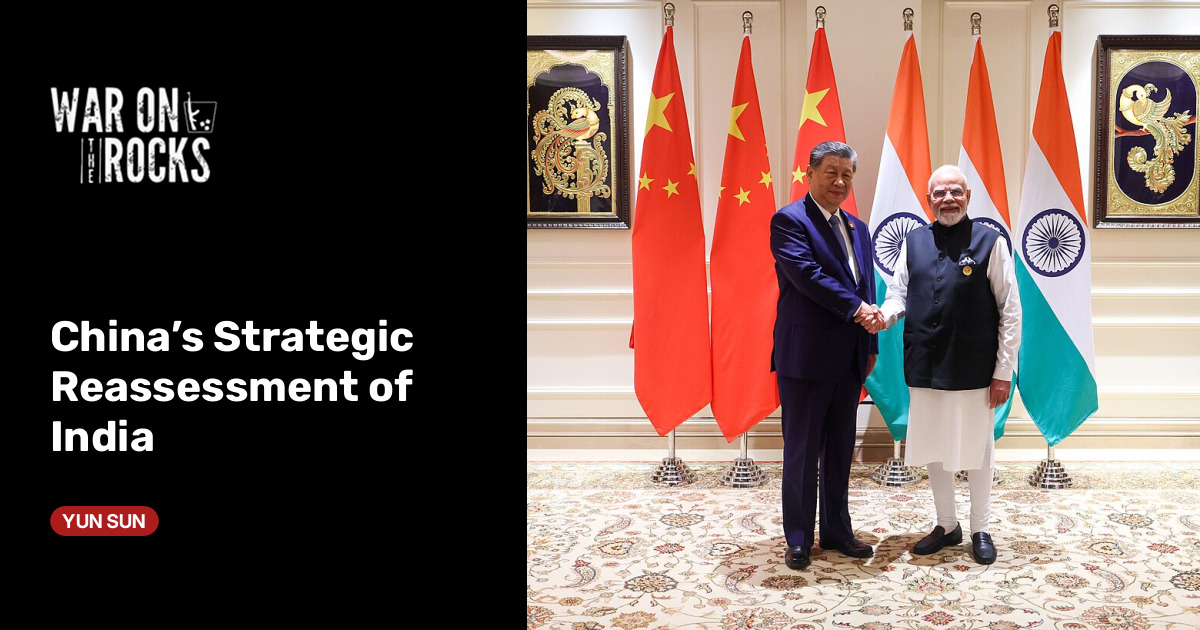
China reassesses India as a middle power amid US shifts
As bilateral ties between China and India have shown signs of improvement in recent months, observers have increasingly pointed toward a fundamental shift in Washington’s diplomatic posture. According to warontherocks.com, many analysts attribute this warming trend to the end of U.S. strategic altruism toward India, leaving Indian strategists to seek diplomatic balance through vigorous outreach to middle powers across Europe, Japan, and Canada.
Over the past year, Chinese policymakers have watched India navigate a period of strategic disorientation. Delegation after delegation of Indian strategists visited China in search of renewed equilibrium. Meanwhile, Beijing has maintained a cautious approach, weighing whether India functions primarily as a rising global great power or simply as a middle power with elevated potential.
Evaluating Great-Power Status Versus Middle-Power Realities
For years, Indian aspirations found expression in the slogan Vishwa Guru, representing an ambition not merely to attain world-class status but to guide other nations. While India’s gross domestic product has consistently been a fraction of China’s, its claim to great-power status has had major sway over China’s calculus.
Washington heavily emphasized India’s development potential and integrated New Delhi deeply into Indo-Pacific strategies. Observing this dynamic, Beijing recognized that sustained American support could rapidly elevate India’s geopolitical standing in a manner reminiscent of Washington’s approach to China during the late 20th century. Consequently, China pursued a policy of accommodation, maintaining friendly messaging from General Secretary Xi Jinping through diplomatic summits in 2018, 2024, and 2025 without enacting retaliatory economic measures after 2020. Chinese officials frequently highlighted the 280,000 visas issued to Indian nationals in 2025 compared to just 2,000 visas issued by India to Chinese nationals as evidence of Beijing’s restraint.
However, with Washington’s steadfast favor appearing to wane, Chinese strategists are reassessing India’s power status. Analysts are returning to the view that India operates fundamentally as a middle power whose internal strategic culture presents persistent obstacles to ascension.
India Maintains Strategic Autonomy Despite American Incentives
Beijing’s reassessment is heavily informed by India’s steadfast commitment to strategic autonomy. Despite significant American incentives, New Delhi refused to sever energy and economic ties with Russia during the conflict in Ukraine. As Yun Solar noted in reporting the analysis, these limitations mean India’s strategic choices cannot be easily shaped by great rewards and strategic benefits.
Faced with these persistent boundaries on diplomatic alignment, China has consolidated its position primarily through trade pressure rather than direct investment, which remains strictly limited by Indian regulatory hurdles. Bilateral trade figures illustrate a profound structural imbalance. According to official trade data, total bilateral trade reached $151.1 billion during the 2025–2026 fiscal year, with India running a substantial trade deficit of $112.1 billion, meaning roughly 87 percent of the volume consisted of Chinese exports.

Indian industries rely heavily on imported Chinese raw materials, parts, and equipment to manufacture finished goods destined for Western markets. Consequently, any abrupt attempt by New Delhi to shut out Chinese products risks triggering severe domestic economic shocks comparable to recent tariff disputes.
Future policy directions remain largely undetermined. It is unclear what specific diplomatic or economic approaches the next U.S. administration will pursue toward either Beijing or New Delhi, leaving both major Asian powers to keep their options open as regional dynamics continue to evolve.