Can Deep-Sea Mining Break China’s AI Mineral Monopoly?
China currently controls the critical mineral supply chains essential for AI hardware, creating a strategic geopolitical bottleneck. However, deep-sea mining ventures are now targeting polymetallic nodules on the ocean floor, claiming centuries of supply to break this monopoly and secure the global AI infrastructure’s raw materials.
The AI gold rush isn’t happening in Silicon Valley; it’s happening in the crust of the earth. Specifically, the rare earth elements (REEs) and battery metals—cobalt, nickel, and manganese—required for the high-performance GPUs and data center power systems that fuel large language models. China’s vertical integration of these assets has given Beijing immense leverage over the global tech stack. For Western firms, this isn’t just a procurement issue. It’s a systemic risk to the continuity of AI scaling.
The fiscal problem is clear: extreme supply chain fragility. When a single sovereign entity controls the processing and export of the minerals powering the next industrial revolution, the risk of “resource weaponization” becomes a line item on every major tech firm’s risk disclosure. Companies are now scrambling to find alternative sources that don’t involve land-based mines plagued by human rights abuses or geopolitical instability.
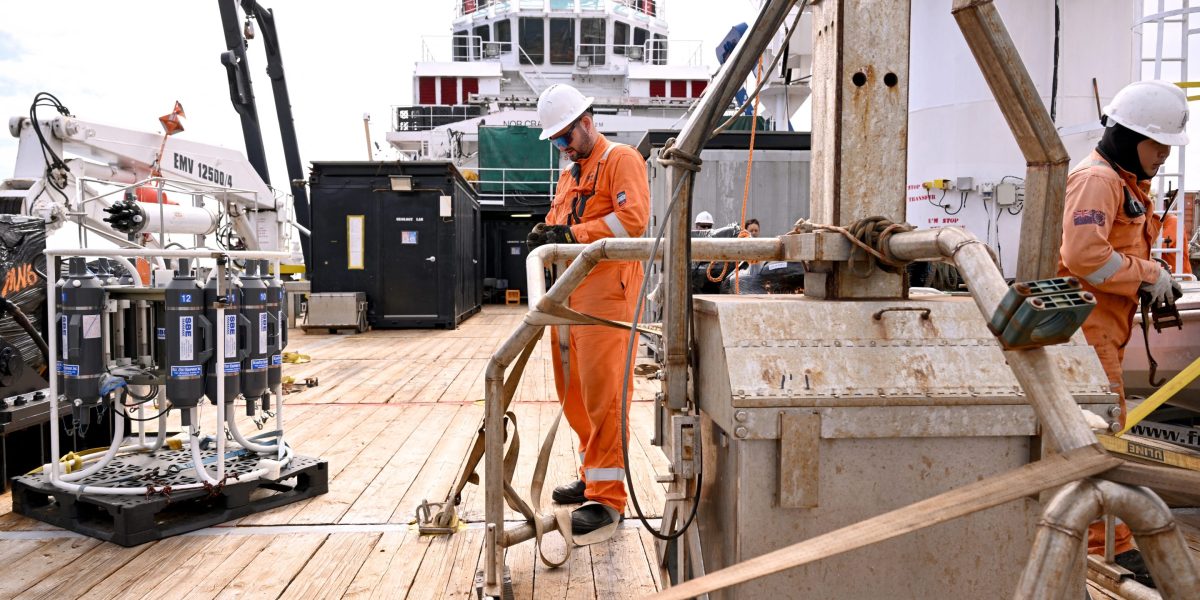
This is where the deep-sea play enters the boardroom. The Metals Company (TMC) is leading the charge, betting that the Clarion-Clipperton Zone (CCZ) in the Pacific Ocean holds the key to AI’s longevity. These polymetallic nodules—potato-sized rocks resting on the abyssal plain—contain high concentrations of the exact metals needed for the energy transition and AI hardware.
The CAPEX requirements for this are staggering. Moving from exploration to commercial extraction requires specialized robotics and massive surface vessels capable of operating in the most hostile environment on the planet. As these ventures scale, the need for frontier technology investment firms becomes paramount to bridge the gap between speculative exploration and industrial-scale production.
“The transition to deep-sea minerals isn’t just about volume; it’s about the purity of the source and the removal of geopolitical intermediaries. If the CCZ becomes viable, the cost-curve for AI hardware components could shift dramatically downward.”
The Deep-Sea Pivot: Breaking the Monopoly
China’s dominance isn’t just about having the minerals; it’s about the processing. Even when minerals are mined elsewhere, they often travel to China for refining. Breaking this cycle requires a total overhaul of the mid-stream supply chain.
According to SEC filings from emerging mining players, the focus is shifting toward “integrated recovery.” The goal is to extract and refine without relying on existing Chinese infrastructure. This transition creates a massive opening for global supply chain logistics providers who can manage the complex transit of raw nodules from international waters to specialized refineries in the West.
The claim that the ocean floor can provide supply for “hundreds of years” is a bold hedge against the projected scarcity of land-based cobalt and nickel. If true, the valuation of traditional terrestrial mines could face a significant correction as the market prices in a sudden influx of deep-sea supply.
Three Ways Deep-Sea Mining Redefines the AI Industry
- De-risking the Hardware Stack: By diversifying the source of cobalt and nickel, AI chipmakers can insulate their production timelines from export quotas or trade wars, ensuring that the lead time for next-generation H100 successors remains stable.
- The ESG Narrative Shift: Deep-sea mining presents a paradox. While it avoids the deforestation and child labor associated with terrestrial mining in regions like the DRC, it introduces unknown ecological risks to the benthic zone. This is forcing a rewrite of corporate ESG mandates.
- Geopolitical Rebalancing: The International Seabed Authority (ISA) acts as the gatekeeper. The race to secure mining contracts is effectively a new diplomatic frontier, where corporate interests and national security are indistinguishable.
The legal landscape is a minefield. The ISA’s struggle to finalize a “Mining Code” has left companies in a regulatory limbo. This uncertainty is why we are seeing a surge in demand for specialized environmental law firms capable of navigating the intersection of international maritime law and corporate liability.
One wrong move—an ecological disaster or a breach of international treaty—could render these multi-billion dollar investments worthless overnight. The volatility is high, but the reward is the keys to the AI kingdom.
Operational expenditures (OPEX) for deep-sea ventures remain prohibitively high until commercial scale is reached. We are currently in the “proof of concept” phase. The market is watching the first commercial contracts with bated breath, knowing that the first company to successfully bring nodules to market will effectively become the “OPEC of AI minerals.”
The trajectory is inevitable. The thirst for compute power is an insatiable driver of mineral demand. Whether the ocean floor becomes the savior of the AI industry or an environmental cautionary tale is secondary to the financial reality: the West cannot afford to let China hold the only key to the AI supply chain.
As the race for the abyssal plain accelerates, the winners will be those who can synchronize technical extraction with rigorous legal compliance and aggressive capital deployment. For firms looking to navigate this volatile transition, finding vetted partners is the only way to mitigate the risk. Explore the World Today News Directory to connect with the legal, financial, and logistical architects building the future of the global resource economy.