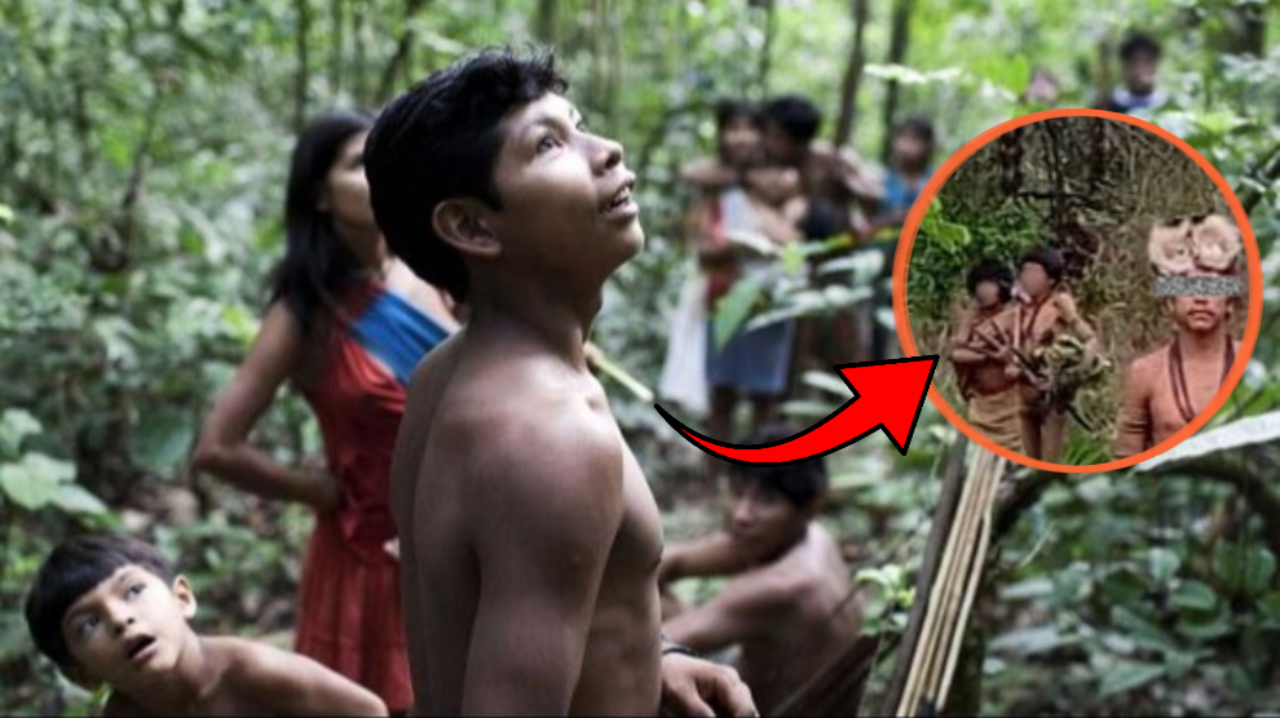
Awá People Approach Maranhão Village to Ask for Food
About 20 members of Brazil’s Awá people, who have avoided contact with the outside world, walked out of the Amazon forest on Monday, November 16, and approached an Indigenous village in Maranhão state to ask for food before returning to the forest — a contact event that Brazil’s Indigenous authorities and campaigners warn could become a matter of life both for the group and for the wider model of voluntary isolation, according to Euronews.
The encounter took place near Tawari village inside the Arariboia Indigenous Territory, home to the Guajajara people, according to Euronews, which cited Brazil’s Ministry of Indigenous Peoples. Images recorded by villagers show men carrying bows and long arrows, with women and children partly concealed by body paint.
Yeni Şafak reported that the group asked for sweet potatoes; Türkiye Gazetesi described the request as for yam, a root vegetable; and ABC Haber, citing local sources, said villagers handed over fruit and peanuts. The discrepancy over what exactly was requested or given is one detail no outlet has yet settled.
A ancestralidade presente! Não há palavras que expressem a riqueza desse momento: 15 indígenas da etnia Awá-Guajá (povo isolado) foram avistados dentro da Terra Indígena Arariboia, no Maranhão. São muitas as ameaças contra eles. A @funaioficial oficial tenta protegê-los. Força! pic.twitter.com/9W0BtceGZA
Why they came out remains unknown. Euronews reported that officials mobilised after the sighting, and that specialists see the central question as why a group that has avoided contact for decades would suddenly approach another community.
Why one village visit alarms Brazil
Coapima, which represents Indigenous groups in Maranhão, warned that the physical condition of some members was a concern. “Some members’ physical condition, particularly among children and the elderly, raised alarm among villagers who observed clear signs of wasting,” Coapima said, in wording carried by Yeni Şafak.
The organisation added that unplanned contact is dangerous for such groups because they are especially vulnerable to diseases they have never encountered, or to which their immunity is weak or absent.
Brazil indigenous people emerge after DECADES IN ISOLATION — approach village carrying WEAPONS pic.twitter.com/5WPDqUIUb3
Funai, Brazil’s National Foundation for Indigenous Peoples, set in motion an emergency coordination mechanism with health authorities to assess possible contact scenarios and disease risks, Euronews reported. The ministry stressed that government policy does not encourage contact with isolated communities: the aim is to protect the Awá people’s right to live apart and to let them decide for themselves whether to establish relations with others.
Funai told Reuters, as carried by Gazete Oksijen, that it was examining social-media videos showing the interaction in Arariboya, and ABC Haber reported that special protection teams had been dispatched and measures taken to block uncontrolled entry into the area. Officials made clear the brief encounter does not mean the group has abandoned voluntary isolation.
“Sweet potatoes were requested, and they took them and returned to their forest,” Survival International said.
The warning behind the encounter
Caroline Pearce, director of Survival International, the Indigenous-rights organisation based in Britain that first reported the meeting, described the group’s decision to leave isolation as a warning sign, according to Yeni Şafak. “It is a concerning indicator of how the ongoing invasion of uncontacted peoples’ forests is putting self-sufficient Indigenous peoples in real danger,” she said, per Yeni Şafak’s account of her statement.
Sarah Shenker, head of Survival International’s Brazil unit, went further in comments to Euronews. “It’s a genuinely critical moment and a warning sign,” Shenker said.
She added that while the footage proves isolated communities exist — their presence sometimes questioned by those seeking access to their lands — she would have preferred no footage of the Awá existed at all, because its existence would have meant they could keep living as they chose in their forest, hunting, fishing and gathering.
The Guajajara “Forest Guardians”, who have fought illegal incursions into Arariboia for years — several have died doing so, Diken reported — linked the situation to environmental pressure on the territory. “Conditions in the forest are harsh: climate change, fires, deforestation and land grabbing. These directly affect the Awá people, who live entirely by hunting and gathering,” the group said in Survival International’s statement.
One incident, different readings
The coverage splits on cause and on numbers. ABC Haber said that the group is believed to have approached the village because of difficulty finding food, but that neither food scarcity nor malnutrition has been medically confirmed.
Diken, drawing on Survival International and The Guardian, framed the departure as an act of вынужденно — the Awá sought out forest guardians on November 16 because pressure from loggers, hunters and cattle ranchers has mounted on Arariboia in recent years. Survival International had previously estimated around 100 Awá who have had no recorded contact, though it says that figure does not capture the current population, Euronews reported.
On the global picture the outlets also differ slightly. Yeni Şafak and Türkiye Gazetesi put the share of the world’s roughly 196 uncontacted groups living in the Amazon at more than 90 percent; Gazete Oksijen put it at about 95 percent, with 124 of the groups in Brazil. All figure come from Survival International’s count across ten countries in South America, Asia and the Pacific.
Every account ties the encounter back to the same pressure system: illegal logging, hunting, cattle ranching and expanding farmland shrinking the forest the Awá depend on, aggravated by fires and deforestation that the Forest Guardians blame on climate change.
FUNAI’s own framing, per ABC Haber, is that its priorities are protecting the group’s health, lives and right to maintain their chosen way of life. Brazil’s government continues to monitor developments in the region.
For companies and investors exposed to Amazon supply chains — beef, timber and the land-use risks that travel with them — events like this one sharpen a problem sectors already face: andgp verifying that sourcing does not touch contested Indigenous territory, and managing the reputational and legal fallout when it does.
Firms dealing in commodities sourced from Maranhão or comparable regions increasingly rely on external human-rights due-diligence specialists and supply-chain audit firms to check exposure, work that no directory listing can substitute for and which must rest on Independently verifiable sourcing records.
Motives and conditions of the group remain uncertain
The group’s motive remains open, and so does its condition. Coapima warned of the immunity risk; Funai has activated protection and health protocols; and the Forest Guardians, who lose members in the fight against land-grabbing, continue their patrols.
Survival International’s director said, in effect, that a self-sufficient people had been forced out by invasion — a reading the可可 outlets all anchor in the same two facts: the Awá asked for food, and then went home.
The Awá, who typically subsist on hunting and gathering within the Arariboia Indigenous Territory in Maranhão, have faced growing incursions from illegal loggers, hunters and cattle ranchers into the forest they share with the Guajajara.
The territory has become one of the front lines of Brazil’s wider struggle over the Amazon: according to Survival International, roughly 196 uncontacted peoples have been identified across 10 countries, and more than 90% of them live in the Amazon rainforest, primarily in Brazil.
“We fight to defend this people against land grabbing, even at the cost of losing our own fighters in this forest war,” the Forest Guardians said in their statement.
Earlier coverage: Awá People Approach Government Team and Guajajara Village for Food Near Araribóia Indigenous Land