How a Journey Through Australia and South Korea Redefined My Values and Way of Being
Susann fed kookaburras every morning on an Australian farm in 2012 — a routine she credits with dismantling the life she had built around performance, isolation and constant responsibility.
A personal retrospective published on susannart.de describes the five-month journey through Australia and South Korea as the turning point that split her life into a before and an after.
The account, susannart.de reported, is less a travel diary than a reckoning. The writer describes returning from Australia “confused, agitated, changed” — but above all clear. From that moment, she wrote, she understood not only what she never wanted again, but that she was permitted to build new values for herself: away from rigid functioning, toward a different way of being.
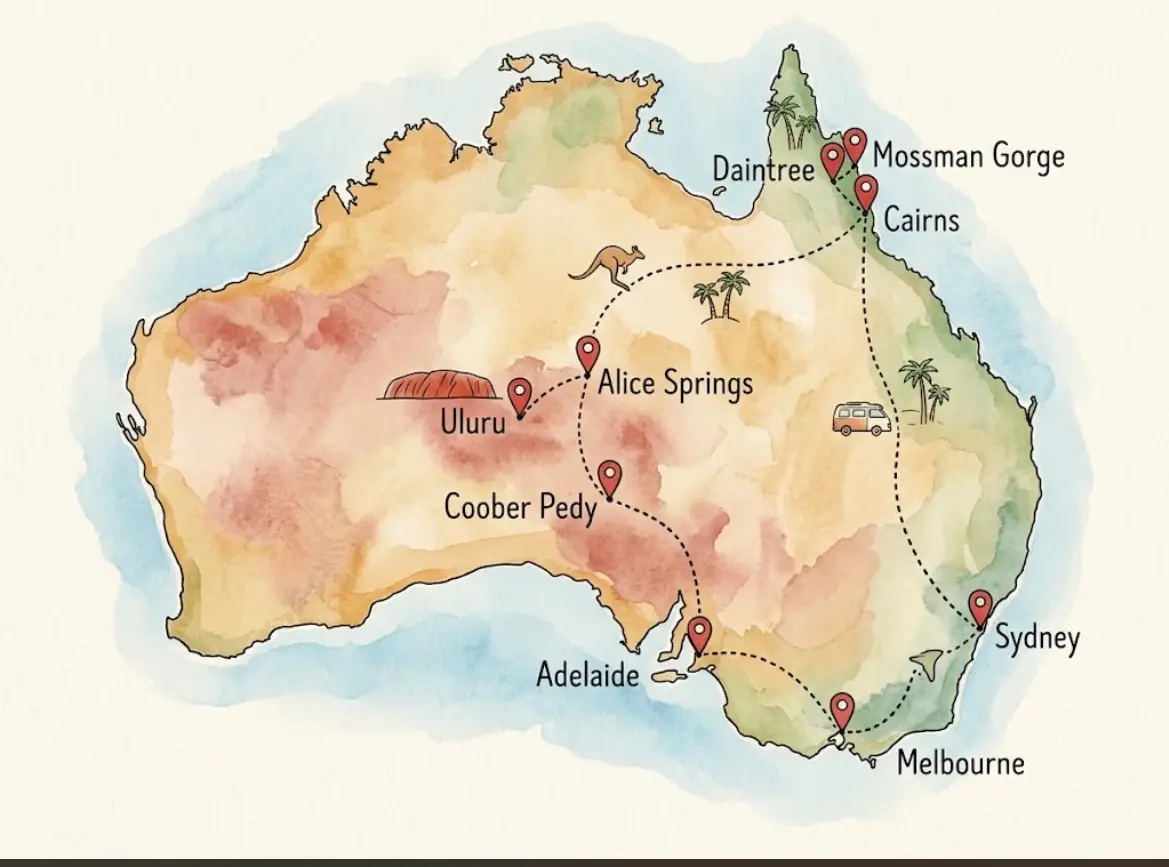
The journey began in Melbourne, where she joined a group orientation covering Australian law, workplace norms and the easygoing but firm “Aussie Way of Life.”
From there the route ran through Adelaide to Coober Pedy, the opal-mining town where residents live partly underground to escape the heat, and on to Uluru and Alice Springs in the continent’s red center. The vastness and mystical silence of the desert, she wrote, touched her deeply.
Then came the stretch she credits with the change. Three weeks at an English school in Cairns with classmates from China, Japan, Croatia and Switzerland — barbecues, parties, excursions — followed by three weeks living and working for a woman whose kookaburras she fed each morning.
That stay, susannart.de reported, brought her close to a genuine, grounded Australian everyday life and a relaxed rhythm of living. Four more weeks followed on a cattle farm with a cottage, a campground and an extensive permaculture garden, where work with nature and animals was exhausting but deeply fulfilling.
Rainforest, a campervan and the road to Bondi
The northern leg took her to Daintree National Park and Mossman Gorge — primeval rainforest, clear rivers, a place where she wrote one can “practically feel” the millennia. Back in Cairns, the second major leg began: a campervan road trip down the east coast with a friend, ending at Sydney’s Bondi Beach.
The finale was a jolt. Five days in Seoul, guided by two design students, thrust her from Outback silence into a sprawling, colorful, never-sleeping metropolis. After the wide-open desert and nature of Australia, she found the city disorienting at first — but an absolutely fascinating experience, she wrote.
A system that no longer fit
What makes the account matter beyond its route map is the diagnosis behind it. Susann describes having spent too long trying to fit into a system shaped by performance pressure, isolation, loneliness and the constant feeling of bearing responsibility for everything alone — a togetherness that often felt like a competition. Out in the world, far from familiar routines, she experienced that life could feel light, connected and vast.
The values she built in place of the old ones read almost like acts of quiet rebellion, she wrote: radical slowness, escaping the tyranny of the clock; gentle decisiveness, saying no to what burns out and yes to what nourishes; trust, abandoning the illusion of doing everything alone; and pausing instead of hurrying, resisting the pull of constant productivity.
Her answers lie in the living, she wrote — in community circles built on heart connection, honesty and mutual support rather than competition; in re-rooting in the rhythms of the seasons, the scent of wet forest soil, the sound of wind; and in the wordless humility she says animals teach by simply being present, without judgment.
She wrote that she does not have to fit into a system that does not fit her soul; she simply creates her world anew — handpicked, connected and genuine.
That is a paraphrase of her closing realization on susannart.de, and it carries a caveat. The process, she wrote, turned her whole life upside down; she still struggles, lives change and responsibility, and is allowed to fail again and again. Her motto: the path is the goal — an experiential space, not a destination.
Costa Rica in five years
The next waypoint is already set. Susann describes a dream for five years from now: six months in Costa Rica with her daughter through Work Away — working for food and lodging, perhaps in turtle rescue or on a farm, learning from life itself. She also hopes to leave Germany in part and feel a piece of her roots elsewhere, wishing herself luck, trust and the courage to do it.
Coober Pedy, which Susann reached after Adelaide, lies in the Far North of South Australia, roughly halfway between Adelaide and Alice Springs. The first opal there was discovered on 1 February 1915, and the town became known as the “opal capital of the world” for the quantity of precious opals mined in its surrounds.
The name, decided in 1920, is thought to derive from the Kokatha words kupa piti, usually translated as “whitefella” and “hole in the ground”, a reference to white people’s mining; in 1975 the local Aboriginal people adopted the name Umoona, meaning “long life”.
Fourteen years on, the account stands as a record of what one journey rearranged. Susann wrote that she hoped to inspire readers to think and dream — the writer’s own words, and the only conclusion she offers.