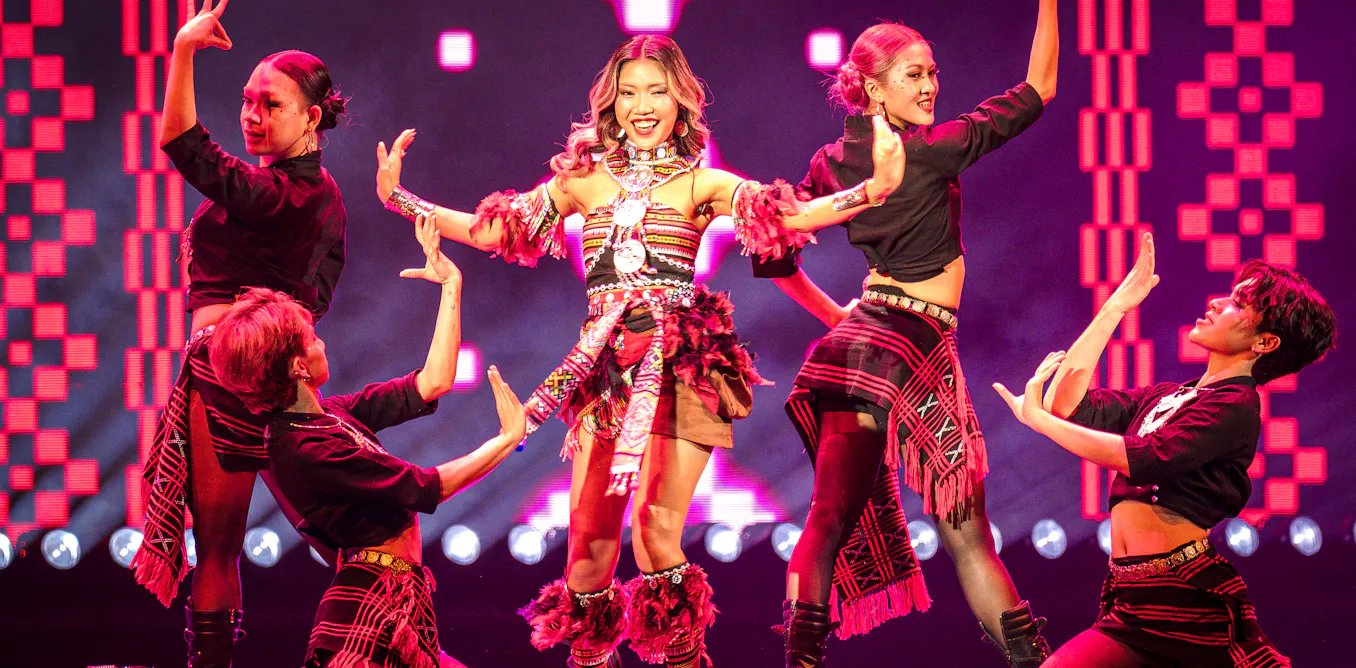
Filipino Singer Carmelle Wins Inaugural Eurovision Song Contest Asia
Filipino singer Carmelle won the first-ever Eurovision Song Contest Asia in Bangkok on Nov. 14, 2026, beating entries from 11 other Asian countries with her women’s empowerment anthem “Sobra-Sobra” (“Too Much”).
The show marked Eurovision’s boldest expansion of its format in its 70-year history, and Carmelle now hopes the victory will serve as a springboard to international fame, much as the contest did for ABBA and Céline Dion.
The inaugural Asian edition nearly did not happen. In late October 2026, the Swedish newspaper Aftonbladet reported that the show’s original budget of approximately US$4.5 million had been cut by US$1 million, and with two decades of failed planning behind the project, some critics doubted the Asian version would succeed. The European Broadcasting Union, however, confirmed the show would go on as planned.
The road to Bangkok was long. Eurovision’s proposed expansion into Asia dates back to 2008, when the European Broadcasting Union — the transnational coalition of public service media organizations that has organized the contest since 1956 — announced plans for “Our Sound – The Asia-Pacific Song Contest.”
That project was originally slated to debut in 2010 but never materialized. On March 31, 2026, Voxovation, a European-led production company that oversees the development of Eurovision’s spinoffs, announced that Bangkok would host the inaugural competition in partnership with Thailand’s Channel 3 and S2O Productions.
Eurovision Asia is now the second European Broadcasting Union-licensed global spinoff to reach the airwaves. In 2022, Voxovation organized the American Song Contest, featuring original songs by artists from all 50 U.S. states, five territories and Washington. Despite promotion in a Super Bowl commercial hosted by Kelly Clarkson and Snoop Dogg, the American edition failed to attract a large viewership and was not renewed.
At 8:30 p.m. Bangkok time, Thai media personalities Woody Milintachinda and Cindy Bishop welcomed viewers tuning in via television broadcast and a YouTube livestream. “Maybe you’ve never heard of Eurovision before, or maybe you’re one of the hardcore Eurofans,” Bishop said. “It doesn’t matter, because you will be blown away by the talent here tonight!”

Over the following two-and-a-half hours, each country’s representative performed an original song. Vietnam’s Tóc Tiên opened the show with “Em Tiên” (“Fairy Maiden”), an entry stocked with what have become ideal Eurovision ingredients: bilingual lyrics, large props, flashy outfits and a dance break, with instrumentation that included a flute and a bamboo xylophone before a second, high-energy dance break reminiscent of electronic dance music.
Laos’ contestant, Thinla, was also among the performers, in a photograph credited to Chanakarn Laosarakham/AFP via Getty Images.
The use of traditional Asian musical signifiers followed the approach long taken by European entrants who have incorporated folk traditions to promote their national cultures to an international audience — among them Ukraine’s 2004 winner Ruslana, whose “Wild Dances” opened with the trembita, a long alpine horn associated with the Hutsul people of the Carpathian Mountains, and Armenia’s 2008 entry, Sirusho’s “Qele, Qele,” which combined a traditional Armenian duduk flute, zurna trumpet and dhol drums with an upbeat rhythm.
The European Broadcasting Union, which has organized the Eurovision Song Contest since 1956, was established in 1950 and has its administrative headquarters in Geneva. As of 2026, it comprises 115 member organizations from 57 countries, along with 27 associate members from a further 17 countries.
Beyond producing the contest, the union owns and operates the Eurovision and Euroradio telecommunications networks used to distribute live broadcasts to its members, and also runs a daily Eurovision news exchange in which members share breaking news footage. Its members stretch from Iceland in the north to Algeria in the south, and since 2026 include Canada.
The Conversation reported the account of the contest’s staging and history, drawing on a scholar of contemporary European popular music and politics who watched the show to see how closely Eurovision Asia would resemble the flagship contest — or whether it would carve out an identity of its own.