
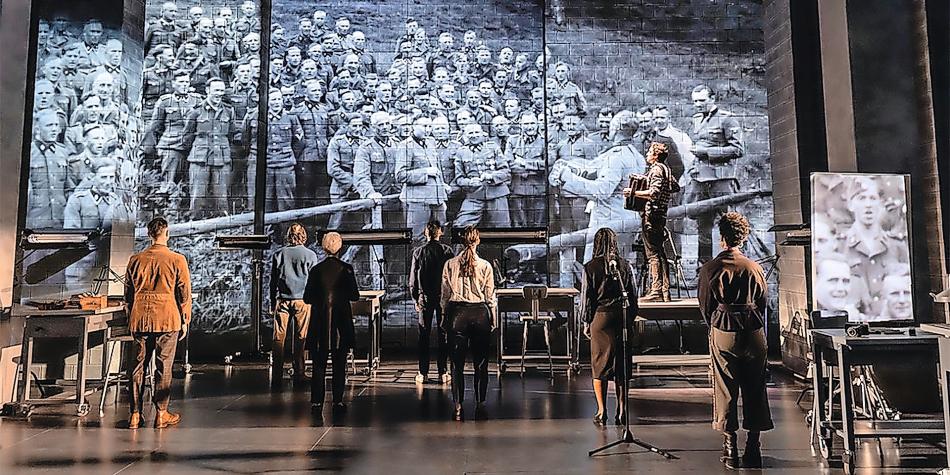
A new play, “Here You’ll see Blueberries,” now running in London, centers on the private photo album of Karl Friedrich Höcker, an SS officer who served in Auschwitz. The play, written by Moises Kaufmann and Amanda Gronich, is based on an album Höcker meticulously compiled containing over 150 images of SS officers and female auxiliary staff.
The photographs depict a scene of unsettling normalcy: officers laughing, lounging on chairs, drinking together, and posing with pets. These images, taken in 1944, were captured within the confines of the concentration camp while, in the background, gas chambers were operating, prisoners were being tortured, and bodies were being removed, according to the play’s creators.
Höcker, who served as an adjutant to the camp commander, deliberately excluded any evidence of the camp’s brutality from his album, focusing instead on a curated depiction of leisure and camaraderie. The album was discovered after the war and found its way to the United States Holocaust Memorial Museum before being featured in a California production and, now, on a London stage.
According to web search results, Höcker was born on December 11, 1911, in Engershausen, Germany, and died on January 30, 2000, in Lübbecke. He joined the SS in October 1933 (SS number 182.961) and the Nazi Party in May 1937 (member number 4.444.757). He served in various capacities within the SS, including at the Neuengamme and Majdanek concentration camps, before being stationed in Auschwitz from May 1944 to January 1945 as an adjutant to Richard Baer and SS-Gerichtsführer.
The play’s creators suggest Höcker’s intention with the album was to portray a vision of a carefree and prosperous future for Germany, a nation “cleansed” of what he termed “vermin.” Gronich, in an interview with the Financial Times, described the album as presenting both truth and falsehood simultaneously, offering a highly curated and incomplete picture of reality.
Following World War II, Höcker faced legal proceedings but was ultimately convicted only of aiding and abetting, receiving a relatively light sentence of nine months in prison, which he did not serve. He subsequently resumed his civilian life, working as a bank cashier until his retirement, according to reports.
Kaufmann has stated that the play is significant because it presents Nazi perpetrators as ordinary people, reflecting Hannah Arendt’s concept of the “banality of evil.” “They feed the pets, they sunbathe, they are not the monsters we assume behind the mass murder,” Kaufmann said. He added that this ordinariness is particularly unsettling, especially in a time when “otherness” is increasingly challenged in everyday life.
The production utilizes enlarged images from the album to underscore the narrative, prompting audiences to confront the unsettling juxtaposition of normalcy and atrocity. The play runs until February 28th.
