
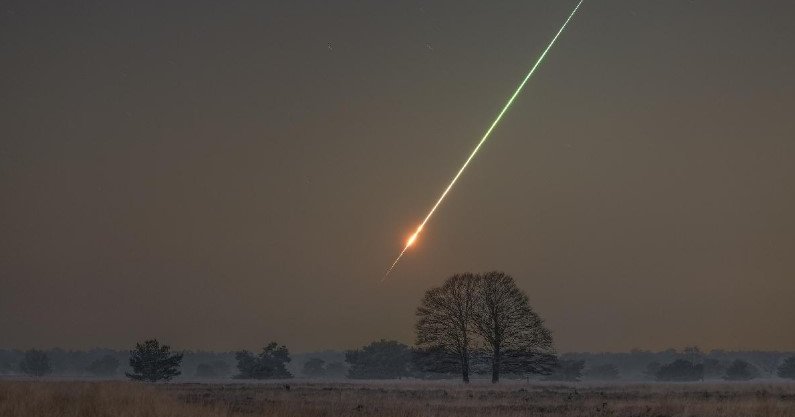
Rare Meteorite Fall Over Normandy Yields crucial Insights for Planetary Defense
Normandy, France – In a landmark event for planetary science, a small asteroid designated 2023 CX1 entered Earth’s atmosphere and impacted over Normandy on February 13, 2023, at 02:59 UTC. The event, remarkable for the speed with which it was detected and studied, has provided scientists with an unprecedented opportunity to analyze a meteorite both before and after its journey through space and our atmosphere.
The asteroid, now named Saint-Pierre-le-Viger (SPLV) after the French village near its impact zone, was discovered just seven hours prior to entry. Roughly spherical and under a meter in diameter, it weighed approximately 650 kg. What truly set this event apart was its disintegration: SPLV abruptly exploded at an altitude of 28 km, releasing an astonishing 98% of its kinetic energy in a fraction of a second. This dispersed over a hundred fragments across the Normandy landscape.
(Image: Kampina nature reserve, in the Netherlands. Credit: Gijs de Reijke)
A Global Scientific Effort
the fall of SPLV triggered an remarkable mobilization of the scientific community. Over 100 researchers and citizen scientists from across Europe, the Americas, Africa, and Australia collaborated to study every facet of the event. This included tracking the asteroid’s trajectory, analyzing optical, infrasound, and seismic data, and conducting detailed geochemical analyses of the recovered fragments. This collaborative spirit highlights the power of international cooperation in addressing rare but critical
