
The Shifting Landscape of Global Trade: A World Less Reliant on the U.S.
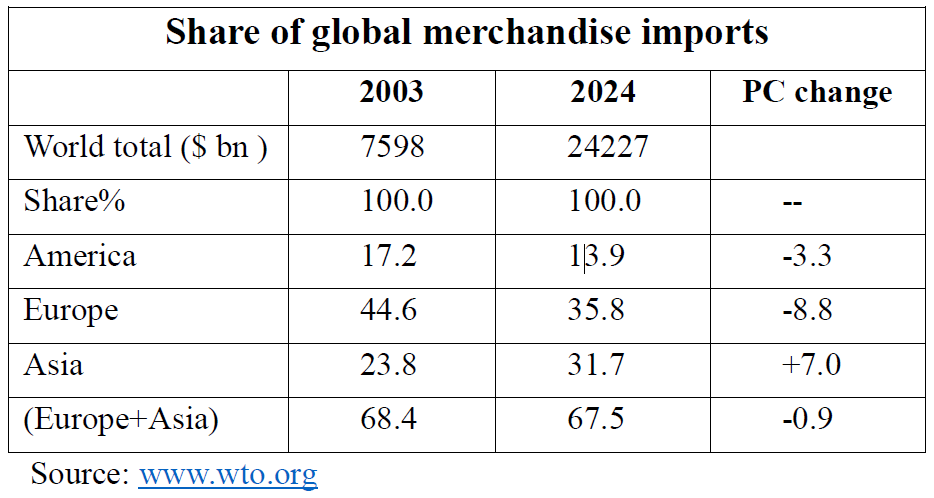
Recent data adn analysis indicate a important shift in the global trade landscape, characterized by decreasing U.S. influence and a growing reliance on trade networks operating independently of American policy. While the United States remains a significant player, its share of global imports is demonstrably smaller than that of Europe and Asia combined.
Currently, Europe and Asia together account for two-thirds of total world imports – five times the volume imported by the United States. This highlights the dominance of intra-regional trade within Europe and Asia, as well as trade between these two continents. The U.S. effectively has no influence over 86.1% of the world’s import activity.
This trend is consistent across major import categories. In agricultural products, Europe’s share (32.5%) is more than three times that of the U.S. (10.1%), with China also exceeding American imports at 12.0%. Similar disparities exist in minerals, where Europe accounts for 28.7% versus the U.S.’s 7.6%, and China’s 19.7%. Even in sectors targeted by recent U.S. tariffs – iron and steel (8.3% U.S. share vs.34% for Europe) and automobiles (20.4% U.S. share vs. 36.4% for Europe) – the U.S. holds a smaller portion of global trade.
These figures have prompted commentary on the potential for American isolation in global trade. A recent article in the German newspaper Frankfurter Zeitung, titled “America is not that strong,” suggests the U.S. is increasingly being sidelined in favor of China.
Beyond trade flows, the U.S. is also facing challenges to its influence within multilateral trading mechanisms, especially the World Trade Organization (WTO). With 166 member states representing 98% of world trade, the WTO operates on a rules-based system currently governing 74% of global trade. The “America First” agenda and attempts to unilaterally reset trade rules are considered impractical given the U.S.’s position as one member among many.
The WTO itself has demonstrably contributed to global economic growth. Over the past 30 years, merchandise and service trade volume have increased fivefold, from $6.3 trillion in 1995 to $31.3 trillion in 2024, contributing to poverty alleviation – lifting approximately 1.5 billion people out of poverty. this is partially attributed to the WTO’s provision of zero tariffs for least developed countries (LDCs).
In contrast, the imposition of high tariffs (up to 40%) on LDCs by the Trump governance, despite these countries accounting for less than 0.3% of the U.S. global trade deficit, has positioned many developing economies firmly in support of the WTO and the multilateral trading system.
Furthermore, a network of 375 regional trade agreements (RTAs) – including the EU, ASEAN, CPTPP, RCEP, AfCFTA, CELAC, and MERCOSUR – are fostering trade cooperation and economic integration without U.S. participation.
Experts like Adam Posen,president of the Peterson Institute for International Economics,are analyzing the consequences of U.S. tariffs and the potential for long-term isolation. His work, titled ”A new economic geography-Who profits in a post American world?” suggests a correction of course is needed, advocating for the U.S.to rejoin the multilateral trading system for the benefit of both the world and itself.
