
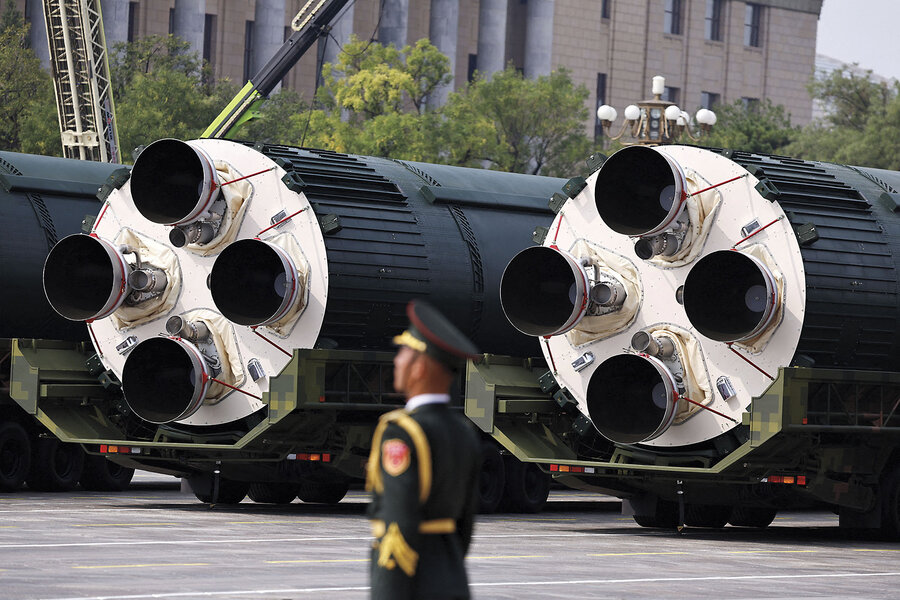
Beijing’s rapid expansion of its nuclear arsenal, now exceeding 600 warheads and projected to surpass 1,000 by 2030 according to a 2025 Pentagon report, is reshaping the global strategic landscape and fueling a renewed arms competition. The buildup, dramatically accelerated since Chinese leader Xi Jinping came to power in 2012, marks a departure from decades of maintaining a comparatively modest nuclear force.
“China is on the path of a massive nuclear buildup with very little transparency about the end goal,” said Tong Zhao, senior fellow with the Nuclear Policy Program and Carnegie China. “What we have is driving a renewed nuclear competition.” The shift comes as the United States and Russia navigate a world without a nuclear arms treaty, following the expiration of New START, which Beijing termed “regrettable.”
China is evolving from a land-based nuclear force to a triad encompassing land, air, and sea capabilities. It now possesses six nuclear-weapons-capable submarines, with at least one continuously at sea, experts say. This expansion isn’t simply about increasing quantity; it’s about developing a more sophisticated arsenal capable of neutralizing enemy nuclear missiles and engaging in nuclear warfare, a move away from its traditional “second-strike” posture designed for survival and limited retaliation.
The motivations behind this expansion are multifaceted, but a central objective appears to be establishing a more powerful China on the world stage. “Xi Jinping wants China to be strong,” explained Jeffrey Lewis, distinguished scholar of global security at Middlebury College. “The Xi Jinping vision is to have a nuclear force that looks more like Russia and the United States,” which collectively control approximately 86% of the world’s nuclear warheads.
A public demonstration of this ambition occurred in September when Xi Jinping presided over a military parade in Beijing, unveiling the People’s Liberation Army’s (PLA) newest intercontinental ballistic missile (ICBM), the DF-61. “The goal is to showcase the quick advancement of China’s strategic capability,” Zhao noted.
However, China’s nuclear development hasn’t been without setbacks. Recent years have seen a major military purge within the PLA’s Rocket Force, responsible for both nuclear and conventional missiles, linked to widespread corruption and quality control issues with newly constructed missile silos. Despite these challenges, the program continues to advance at a pace that is raising concerns in Washington.
The United States initially proposed that China join nuclear arms control discussions in 2020, a proposal Beijing rejected. Now, China’s expansion is prompting discussions about a potential U.S. Response, including increasing the number of warheads on its own missiles. “We are likely to see the U.S. Starting to upload more warheads to missiles,” Zhao predicted. “This action-reaction dynamic…will have broader global implications.”
Adding to the complexity, the potential for collaboration between China and Russia against the United States is a growing concern. While experts believe a full-scale alliance with joint nuclear planning remains unlikely due to mutual distrust, increasing cooperation in nuclear technology and joint military exercises – such as patrols over the Sea of Japan and South China Sea involving nuclear-capable bombers – signal a deepening strategic alignment. Russia and China condemned recent strikes in Iran in an emergency meeting of the U.N. Security Council, highlighting a shared interest in challenging the existing global order.
China is also pursuing advancements in areas considered particularly destabilizing, including the development of an early warning system – mirroring those of the U.S. And Russia – to enable launch-on-warning capabilities. This posture, born of the Cold War, is inherently risky due to the potential for false alarms and the compressed timeframe for decision-making. In 2019, Russia confirmed collaboration with China on such a system. China tested an orbital bombardment system in 2021, raising concerns about potential surprise attacks on U.S. Leadership or command and control infrastructure. The development of dual-capable missiles, able to carry both nuclear and conventional warheads, further complicates the situation by introducing ambiguity in wartime scenarios.
Despite accusations from the Trump administration regarding explosive nuclear tests, which Beijing has denied as “groundless,” China shows little inclination towards arms control negotiations. The expiration of New START has removed a key constraint on U.S. And Russian modernization efforts, potentially exacerbating the situation. Russia is weighing the strategic risks and opportunities presented by the escalating tensions.
Former Under Secretary for Arms Control Rose Gottemoeller noted that despite the expiration of New START, President Trump has encouraged continued engagement between U.S. Nuclear experts and their Russian counterparts. Igor Korotchenko, a Russian military expert, indicated Russia is open to resuming talks, though its primary concern remains the potential deployment of a U.S. Anti-missile shield, which it views as a threat to its deterrent capabilities.
With four scheduled meetings between President Trump and Xi Jinping this year, opportunities exist for dialogue regarding nuclear risk reduction and improved controls, according to Gottemoeller. However, the path forward remains uncertain, and the global community awaits further developments in this increasingly complex and dangerous arena.
