
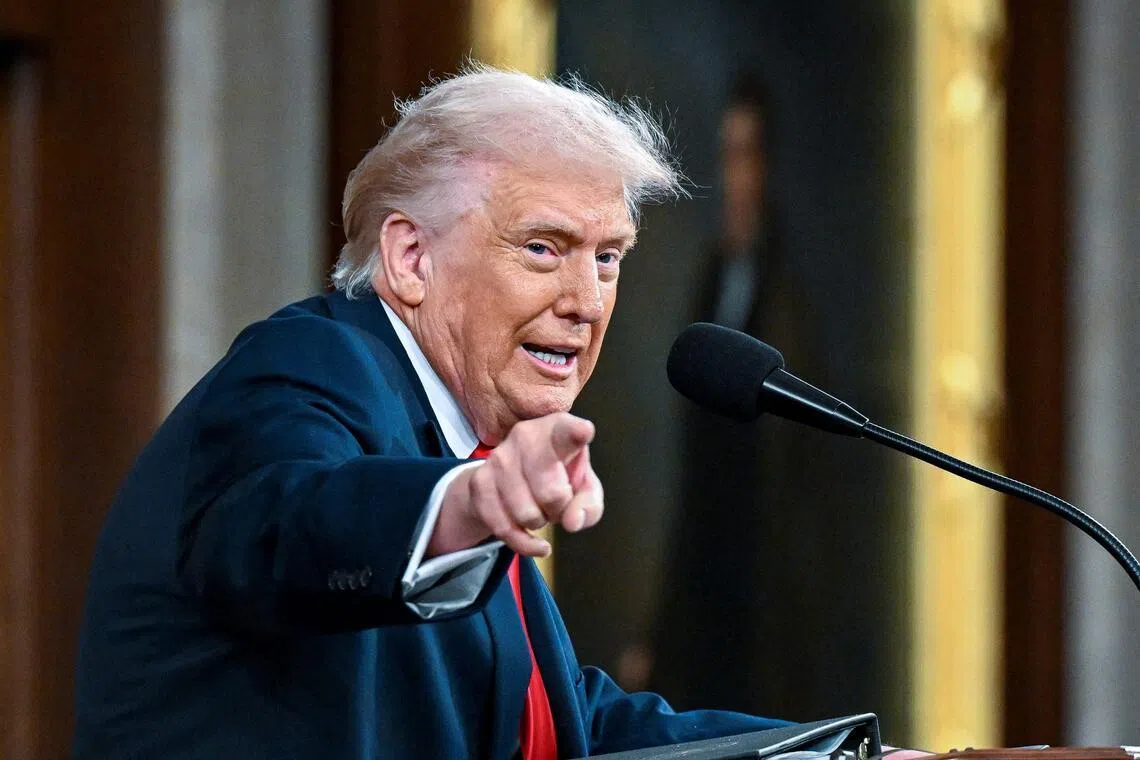
WASHINGTON – President Donald Trump delivered a two-hour and ten-minute State of the Union address to a joint session of Congress on February 24, focusing heavily on the economy while navigating rising international tensions and domestic anxieties about the cost of living. The speech, intended to galvanize Republican support ahead of November’s midterm elections, featured a blend of economic pronouncements, personal anecdotes and pointed criticisms of the Democratic opposition.
Trump dedicated a significant portion of his address to portraying a positive economic outlook, asserting that his administration had engineered a “turnaround for the ages.” He highlighted falling inflation, increasing stock market values, and growth in oil production and construction jobs. However, these claims contrast with government data indicating that inflation ticked up in 2025, and factory job creation remained sluggish. Reuters/Ipsos polling data reveals that 56% of voters disapprove of his handling of the economy, while only 36% approve.
The President outlined proposals to lower healthcare costs, including reducing drug prices and implementing direct federal payments to individuals. He also defended his use of tariffs, claiming they were generating revenue despite being struck down by the Supreme Court, and asserted they were being reinstated under a different legal framework. Party strategists have cautioned that a more forceful message addressing inflation is crucial to avoid losing control of Congress in the upcoming midterms.
The address was punctuated by carefully orchestrated displays of patriotism and political theater. Trump awarded the Medal of Honor to Army Chief Warrant Officer Eric Slover for his actions during the operation to capture Venezuelan President Nicolás Maduro. He also recognized Korean War navy pilot E. Royce Williams and Team USA hockey goaltender Connor Hellebuyck, and publicly acknowledged Erika Kirk, the widow of conservative activist Charlie Kirk. These gestures, while intended to resonate with voters, underscored the increasingly performative nature of the State of the Union address.
Trump’s discussion of foreign policy was notably delayed, with Iran not mentioned until well into the speech. He reiterated his long-standing concerns about Iran’s nuclear program and accused the country of supporting terrorism through regional proxies, alleging the Tehran leadership had killed “tens of thousands of people” during recent protests. He did not, however, articulate a clear rationale for potential military action or define specific objectives. CBS News reported that Iran responded to the speech by accusing Trump of disseminating “big lies” regarding its nuclear program and the handling of protests.
The President offered only brief mentions of Venezuela, Russia, and Ukraine, despite recent diplomatic efforts focused on these regions. His administration deposed the leader of Venezuela in January, and has devoted considerable resources to managing relations with the country. His previously stated ambition to acquire Greenland was not addressed. Trump has dispatched senior aides to various capitals in an attempt to resolve the war in Ukraine and negotiate with Iran.
Trump attempted to reframe the narrative on immigration, highlighting crimes committed by immigrants while omitting any discussion of his administration’s enforcement tactics or the controversies surrounding the actions of US Border Patrol and Immigration and Customs Enforcement. He argued that Democrats were failing to secure the border and protect American citizens. This approach echoes his campaign rhetoric from 2024, which resonated with voters.
The speech signaled a shift in priorities compared to Trump’s previous address to Congress. Plans to reclaim the Panama Canal and annex Greenland, prominent in the 2025 speech, were absent this year. Mentions of entrepreneur Elon Musk and the Department of Government Efficiency were also omitted, reflecting a cooling of Trump’s enthusiasm for both. He did announce a new program focused on fraud, to be chaired by Vice-President J.D. Vance.
Trump concluded by advocating for election law changes, including voter identification requirements and limitations on mail ballots, arguing that Republicans deserved continued control of Congress based on their record on the economy, immigration, and public safety. He launched a sharp attack on Democratic lawmakers, accusing them of being “crazy” and “destroying this country,” further emphasizing the increasingly partisan tone of the annual address. Democrats in the chamber responded with visible irritation, while Republicans offered enthusiastic applause. Several Democratic representatives, including Al Green, Ilhan Omar, and Rashida Tlaib, voiced their dissent during the speech.
