
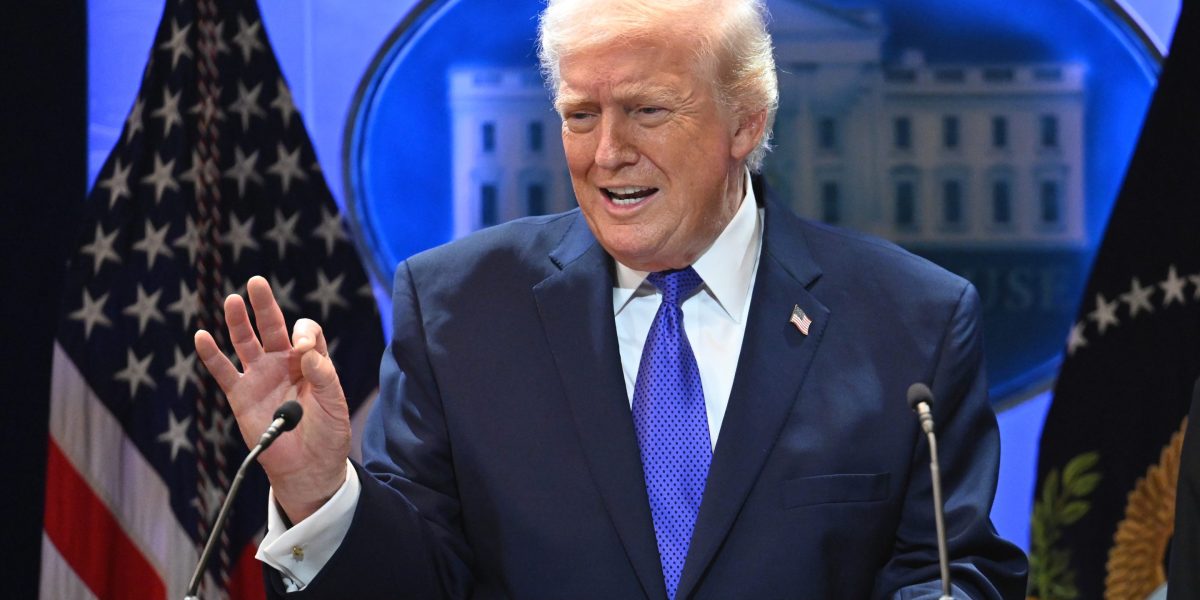
“I inherited a mess,” President Trump told supporters in Georgia last Thursday, referring to the U.S. Economy. He further asserted that Democrats “caused the affordability problem, and we’ve solved it!” and, two days prior on Fox Business, proclaimed, “I think we have the greatest economy actually ever in history.” The pronouncements, made 37 weeks before the midterm elections, signal the central role the economy will play in the upcoming contests, particularly as voter sentiment diverges from official economic indicators.
Even as the U.S. Economy experienced 2.2% growth last year, adjusted for inflation – exceeding many economists’ expectations – a significant portion of the electorate does not share that positive assessment. The national unemployment rate remains low at 4.3%, and wages have increased, though not at a dramatic pace. However, consumer sentiment, as measured by the University of Michigan’s long-running survey, is approximately 20% lower than when President Trump took office.
The disparity between economic data and public perception highlights a fundamental aspect of human psychology: a heightened sensitivity to negative economic experiences. Joanne Hsu, director of the Michigan consumer survey, noted a surge in sentiment among consumers with substantial stock portfolios, but “stagnated and remained at dismal levels” for those without such investments. This suggests that economic gains are not being felt equally across the population.
Experts point to a cognitive bias where negative economic news carries more weight than positive developments. The high inflation of the early 1980s, for example, left a lasting impression on consumers, even after inflation rates significantly decreased by 1985. Gallup polling at that time revealed that roughly 20 million adults still identified inflation as the most pressing issue facing the nation. This phenomenon demonstrates that the potential for negative economic outcomes looms larger in the public consciousness than equivalent positive gains.
Last year, double-digit price increases for essential goods like beef, dairy, coffee, shoes, and clothing likely contributed to this negative sentiment, regardless of subsequent price fluctuations or overall GDP growth. Conversely, declines in the prices of gasoline and propane, while beneficial, have not registered as strongly with consumers.
The dynamic mirrors the 1992 presidential election, where President George H.W. Bush emphasized a recovering economy, while Bill Clinton successfully tapped into voters’ anxieties with the phrase, “I feel your pain.” Clinton’s victory underscored the power of acknowledging and validating voters’ emotional responses to economic conditions.
While the current economic landscape differs from both the Trump and Bush presidencies – with no recession occurring last year – the historical precedent suggests that a strategy of dismissing voters’ economic concerns as unfounded may prove challenging for the incumbent party as they seek to maintain control of Congress. The Fortune Workplace Innovation Summit is scheduled for May 19–20, 2026, in Atlanta, focusing on the evolving future of perform.
