
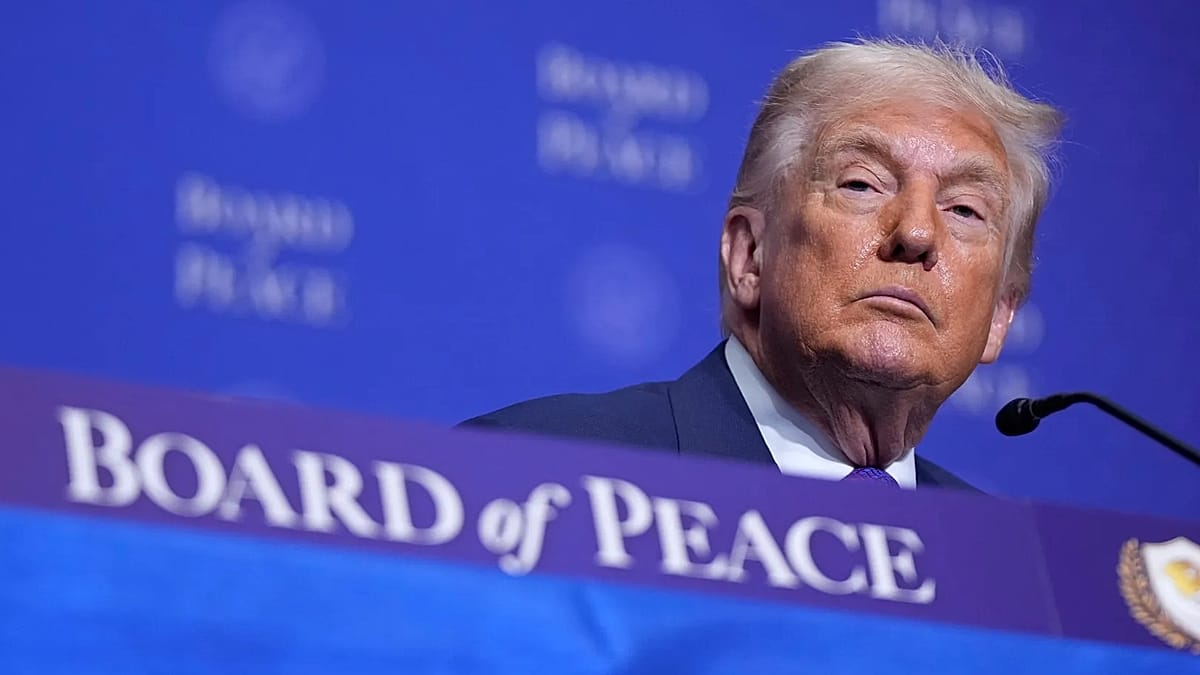
President Donald Trump pledged $10 billion in U.S. Public funds to a newly formed “Board of Peace” during its inaugural meeting, initially conceived to rebuild Gaza but now with a broadened scope. The announcement came as Trump also issued repeated threats of military action against Iran in recent weeks, though he did not specify how the funds would be allocated.
Trump revealed that nine additional nations had committed a further $7 billion to finance aid programs for Gaza. The contributing countries are Kazakhstan, Azerbaijan, the United Arab Emirates, Morocco, Bahrain, Qatar, Saudi Arabia, Uzbekistan, and Kuwait. “Every dollar spent is an investment in the stability and hope of a new and harmonious region,” Trump stated at Thursday’s meeting.
Whereas the pledged donations represent a substantial sum, they fall significantly short of the estimated $70 billion required to rebuild Gaza, which has been largely reduced to ruins following more than two years of Israeli military operations. The initiative follows a U.S.-brokered ceasefire between Israel and Hamas in October, negotiated with the assistance of Qatar and Egypt.
The Board of Peace has drawn criticism for its ambiguous structure and its potential overlap with existing international institutions, such as the United Nations. Trump dismissed these concerns, asserting that the UN would “be much stronger,” and that the Board of Peace would “almost be in charge of watching the United Nations and making sure it functions properly.”
According to reports, Trump would retain a veto power over most decisions made by the Board, granting him an unprecedented level of control within an international body. He could also potentially remain at the helm of the initiative even after leaving office. Other nations will be required to contribute $1 billion to secure permanent membership. This funding model, as reported by Slate Magazine, raises questions about the ultimate beneficiaries of the Board’s substantial financial resources.
The launch of the Board of Peace coincided with escalating rhetoric from Trump regarding Iran. U.S. Media outlets reported Thursday that American military officials believed the armed forces would be prepared to strike Iran within days. Sources indicated that any U.S. Military operation would likely be a large-scale, multi-week campaign conducted in conjunction with Israel, and that the Trump administration was “closer to a major war in the Middle East than most Americans realize.”
Alongside the financial commitments, the meeting addressed the establishment of an international stabilization force tasked with monitoring borders, maintaining security, and demilitarizing Gaza. Indonesia, Morocco, Kazakhstan, Kosovo, and Albania have pledged to contribute troops, while Egypt and Jordan have committed to providing police training, according to the force’s commander, Major General Jasper Jeffers.
Several world leaders attended the inaugural meeting in Washington, including Indonesian President Prabowo Subianto, Argentinian President Javier Milei, and Hungarian President Viktor Orbán. FIFA President Gianni Infantino was also present. European Commissioner for the Mediterranean Dubravka Šuica attended as an observer, a move that prompted objections from several European nations, including France, Belgium, Spain, Ireland, Slovenia, Sweden, and Portugal, who expressed concern that her presence could be interpreted as tacit endorsement of the controversial organization. France formally requested the European Commission provide an explanation for Šuica’s attendance.
