
A short-acting psychedelic, dimethyltryptamine (DMT), delivered intravenously alongside psychotherapy, has shown promising results in alleviating symptoms of major depressive disorder (MDD) in a Phase IIa clinical trial, according to research published in Nature.
The trial, conducted by Small Pharma (now Cybin UK), involved 34 participants with moderate-to-severe MDD who had previously found conventional treatments ineffective. Participants were randomly assigned to receive either a single or double dose of DMT fumarate, or a placebo, combined with a “time-limited, relational psychotherapeutic framework focused on psychological flexibility.”
The primary outcome measure was the change from baseline in the Montgomery-Åsberg Depression Rating Scale (MADRS) score at two weeks after the first dose. Researchers found that those receiving DMT demonstrated a statistically significant improvement in their MADRS scores compared to the placebo group. Further analysis indicated that a second dose of DMT did not provide additional benefit over a single dose.
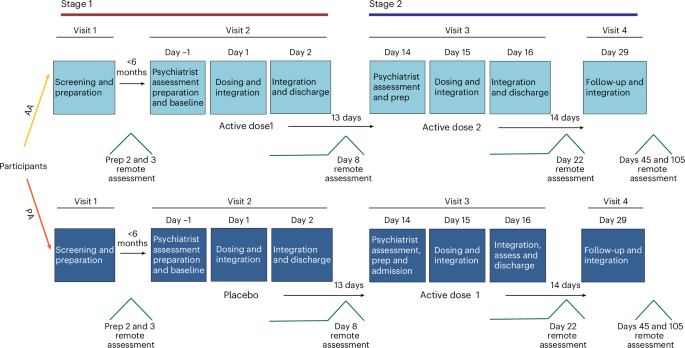
The trial was designed in two stages. In the first stage, participants received either DMT or placebo. Two weeks later, in the second stage, participants who received placebo in stage one received an open-label dose of DMT, while those who received DMT in stage one received a second dose. Some participants declined a second dose or were deemed unsuitable by the study psychiatrist, and their data was also included in the analysis.
The DMT was administered intravenously over 10 minutes, with a dose of 21.5mg. The treatment took place in a controlled inpatient setting, with participants receiving preparation sessions with therapists the day before dosing, including guided visualization and discussion of expectations. During the DMT session, participants wore eyeshades and noise-canceling headphones and listened to ambient music designed to complement the psychedelic experience. Two therapists were present throughout the session to provide support.
Following the DMT administration, participants received integration therapy sessions, designed to help them process their experiences and apply insights to their daily lives. These sessions were conducted on days one, two, and fifteen post-dose, with additional follow-up check-ins.
The trial adhered to rigorous ethical and scientific standards, including oversight by the UK Medicines and Healthcare products Regulatory Agency and the London–Brent Research Ethics Committee. All participants provided written informed consent, and the trial was registered on ClinicalTrials.gov (NCT04673383) and ISRCTN (ISRCTN63465876).
Researchers also collected data on adverse events, finding that the DMT was generally well-tolerated. Detailed safety monitoring, including blood pressure, heart rate, and ECGs, was conducted throughout the study. Participants were asked if they regretted the experience as part of the tolerability assessment.
Exploratory analyses examined the relationship between the subjective effects of DMT, measured by tools like the Mystical Experience Questionnaire, and clinical outcomes. Further research is planned to investigate these relationships in more detail.
An exploratory six-month follow-up visit was conducted to monitor long-term outcomes, with results pending further analysis. The study sponsor, Cybin UK, had full oversight of the clinical trial and data analysis.
