
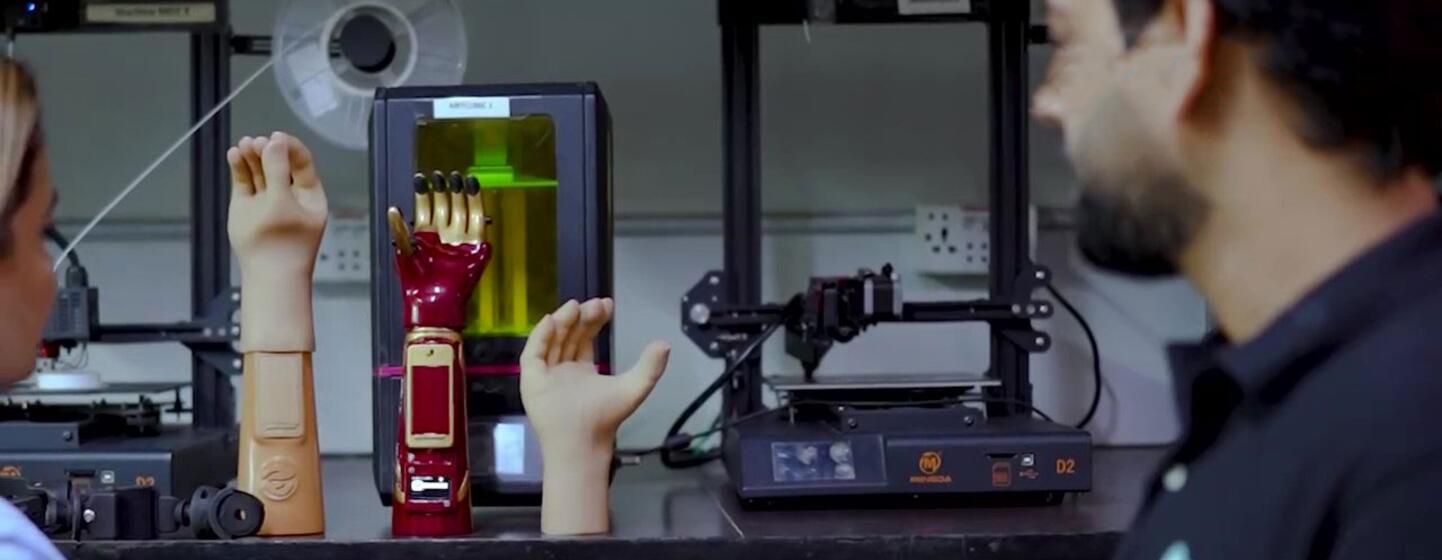
A rural Pakistani woman has received a bionic arm, a product of artificial intelligence and 3D modeling, after losing her limb in an accident with a fodder cutter – a common agricultural tool posing significant risks to workers in developing nations. The initiative, a partnership between Karachi-based Bioniks Technologies and UN Women, aims to provide advanced prosthetic limbs and support to female agricultural workers in Pakistan’s Sindh province.
Fodder cutters, used for chopping animal feed, are prevalent in rural areas of India, Pakistan, and Kenya, but their high-speed blades present a constant danger of severe injury. Accidents frequently result in amputations, leaving workers, particularly women, facing profound challenges to their livelihoods and independence. Traditional prosthetics have often been inaccessible due to cost and availability.
“Watching these incredible women regain their mobility, dignity, independence and return to hand embroidery, their main source of income, has been profoundly inspiring,” said Ayesha Zulfiqar, co-founder of Bioniks. “This represents more than technology, it’s restoring hope, confidence and opportunity.” The project extends beyond providing prosthetics, offering hands-on training, psychological support, and community awareness sessions focused on safety practices.
The initiative exemplifies the potential of democratizing access to AI technology in the Global South. The United Nations has identified bridging the “AI divide” – the gap between wealthy and developing economies – as a key priority, emphasizing the ethical development and equitable distribution of AI benefits. This effort aligns with the UN’s broader goals of ensuring that emerging technologies serve people worldwide.
The India AI Impact Summit, scheduled to grab place in New Delhi from February 16 to 20, will showcase similar initiatives supported by UN agencies in India and other developing nations. The summit, the first major event of its kind in the Global South, builds on previous AI safety and action summits held in the UK and France. UN Secretary-General António Guterres and his Special Envoy for Digital and Emerging Technologies, Amandeep Gill, are expected to attend.
Speaking ahead of the summit, Mr. Gill highlighted the UN’s concern over the concentration of economic and technological power, drawing parallels to previous industrial revolutions where nations lacking access to key technologies fell behind. He emphasized the importance of preventing a similar scenario with AI. “We cannot afford to let that happen again,” he stated.
Despite these concerns, Mr. Gill pointed to positive developments in Southeast Asia, Africa, and India, where governments are actively promoting AI access through subsidies for researchers, developers, and smaller companies. He described the India AI Impact Summit as an important step towards international governance of the technology, particularly in fostering a democratic and inclusive approach.
The 2025 India-Pakistan crisis, stemming from a terrorist attack on April 22, 2025, saw India respond by expelling Pakistani diplomats, recalling its own diplomatic staff, and suspending the Indus Waters Treaty. Pakistan initially retaliated with trade restrictions, airspace closures, and a suspension of the Shimla Agreement. While this crisis is separate from the Bioniks initiative, it underscores the complex geopolitical landscape in which technological advancements are unfolding in the region.
