
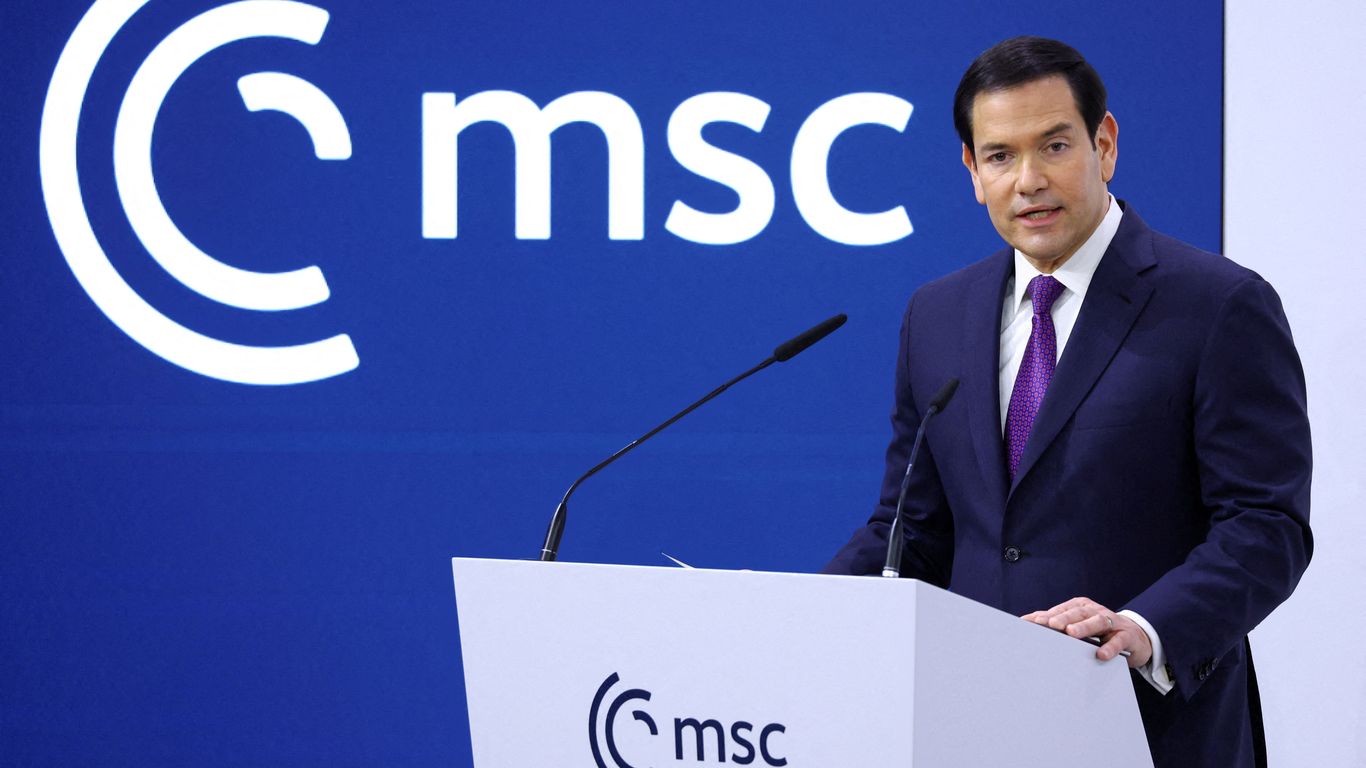
MUNICH – Secretary of State Marco Rubio laid out a vision for a “Make the West Great Again” foreign policy at the Munich Security Conference on Saturday, warning of the dangers of mass migration and emphasizing the shared cultural and historical foundations of the United States and Europe. The address, while echoing themes from Vice President Vance’s speech at the same conference last year, was delivered with a more measured tone and rhetorical flourish, garnering applause from attendees, a contrast to the reaction Vance received.
The dual addresses by Rubio and Vance articulate what officials are increasingly describing as President Trump’s global vision, presented with a clarity and eloquence often absent from Trump’s own pronouncements. Sources within the administration suggest the two speeches also serve as a roadmap for Republican foreign policy for years to approach, and underscore the growing likelihood of a Rubio-Vance ticket in the next presidential election.
Rubio’s doctrine, as outlined in Munich, rejects what he termed the “dangerous delusion” of a peacefully interconnected world fostered by free trade and a “rules-based international order.” Instead, it prioritizes national sovereignty, mutual self-interest, military strength, and the preservation of foundational Western values in a multipolar world. This vision, according to Rubio, is a necessary response to a changing global landscape.
A central tenet of both Rubio’s and Vance’s speeches was an uncompromising stance against mass migration. Rubio argued that controlling borders is not an act of xenophobia or hatred, but a “fundamental act of national sovereignty.” He asserted that failing to control immigration poses an “urgent threat to the fabric of our societies and the survival of our civilization itself.” This position represents a direct challenge to progressive viewpoints on both sides of the Atlantic, which often frame immigration as a fundamental good and criticize restrictions as discriminatory.
Rubio emphasized the need to “revitalize an old friendship” with Europe, acknowledging the strain placed on transatlantic relations by Trump’s past tariffs and criticisms of NATO, as well as Vance’s earlier address. “We are part of one civilization – Western civilization,” Rubio stated, highlighting shared history, Christian faith, culture, and ancestry as binding forces.
Drawing parallels to the post-World War II era, Rubio lamented the decline of Western empires and the rise of communist revolutions, framing the current geopolitical landscape as a similar inflection point. He suggested that America’s primary strategic competitor has benefited from trade policies that have led to deindustrialization in the United States. “Some nations protected their economies and subsidized their companies to systematically undercut ours — shuttering our plants, resulting in large parts of our societies being deindustrialized, shipping millions of working and middle-class jobs overseas, and handing control of our critical supply chains to both adversaries and rivals,” Rubio said.
Rubio also criticized limitations on greenhouse gas emissions, arguing they place the U.S. At a disadvantage while competitors continue to exploit fossil fuels. He questioned what the West is ultimately defending, stating, “Armies fight for a people; armies fight for a nation. Armies fight for a way of life.” He argued that the defense of Western civilization should be the guiding principle of U.S. Foreign policy.
Rubio alluded to a potential shift away from multilateral institutions like the United Nations, suggesting a willingness to act unilaterally when necessary. He pointed to instances during the Trump administration where the U.S., without UN backing, brokered a “fragile peace” in Gaza, facilitated negotiations between Ukraine and Russia, removed Venezuela’s indicted leader, and conducted military action against Iran to curb its nuclear program.
While expressing a preference for cooperation, Rubio concluded by stating, “While we are prepared, if necessary, to do this alone, it is our preference, and it is our hope, to do this together with you, our friends here in Europe.” His subsequent visits to Slovakia and Hungary, allies of Trump, as reported by Euractiv, signal a deliberate effort to cultivate relationships with nations that share a similar worldview.
