
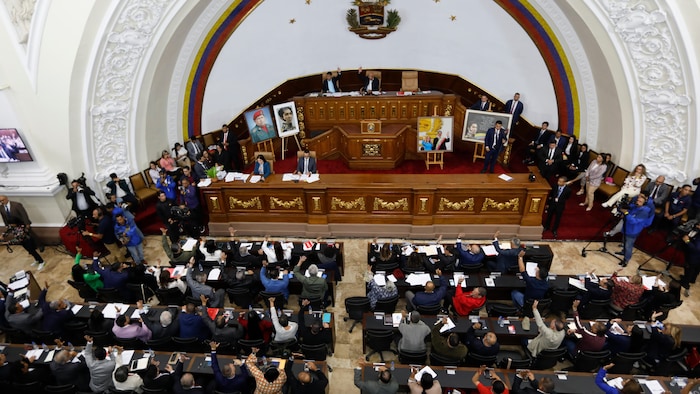
Caracas – Venezuela’s National Assembly has postponed a vote on a sweeping amnesty law intended to secure the release of numerous political prisoners, following a lack of consensus among lawmakers. The delay, announced Thursday, comes as the interim government of Delcy Rodriguez seeks to navigate a delicate path between domestic reconciliation and international pressure, particularly from the United States.
The amnesty law, which passed its first reading on February 5th, had been slated for a final vote this week. However, Assembly President Jorge Arreaza announced the postponement, citing a demand to avoid unproductive debate and allow for a more unified approval at a future session. “In order to preserve the climate of conciliation and consensus necessary, we agreed to postpone the discussion… to avoid falling into unnecessary debates and to be able to approve the law at the next session of the National Assembly,” Arreaza stated.
The postponement follows a morning demonstration at the Central University of Venezuela (UCV) in Caracas, the first large-scale opposition protest since the capture of former President Nicolas Maduro by U.S. Forces on January 3rd. Thousands participated, demanding the immediate passage of the amnesty law. Protestors carried banners reading “Amnesty Now!” and “Venezuela Will Be Free!”
The primary point of contention centers on Article 7 of the proposed legislation, which stipulates that individuals seeking amnesty must “regularize” their status. Opposition lawmakers, such as Luis Florido, argue this clause implicitly acknowledges guilt, rendering it unacceptable for those they maintain are political victims. “This article simply says that the person who claims the amnesty law, by regularizing their status, is guilty,” Florido asserted. “Political detainees are victims… persecuted by the justice system.”
Conversely, some lawmakers aligned with the ruling party, including former minister Iris Varela, contend that amnesty should not be granted to those who have not committed crimes. “You cannot amnesty someone who has not committed a crime. Someone who has not committed a crime does not have to ask for amnesty,” Varela stated.
Opposition leader Maria Corina Machado, a Nobel Peace Prize laureate, expressed support for the protests on social media, stating, “Long live our students!” Dannalice Anza, a 26-year-old geography student participating in the UCV demonstration, told AFP, “We have spent a lot of time in hiding, mute, silent in the face of everything Venezuela has experienced with repression… but today we rise, we unite and we come together to demand each of the necessary claims for this country.”
Simultaneously, supporters of the interim government held a counter-demonstration, also drawing thousands, in observance of National Youth Day.
The debate over the amnesty law coincides with a visit by U.S. Secretary of Energy Chris Wright, who has been touring Venezuelan oil fields with President Rodriguez. Wright stated Wednesday that the “quarantine” on Venezuelan oil was “for the most part, over,” signaling a potential shift in bilateral relations. Rodriguez, speaking on public television Thursday, expressed pride in demonstrating “the truth of Venezuela,” emphasizing the country’s resilience despite ongoing sanctions. Laura F. Dogu, the U.S. Chief of mission in Venezuela, posted on X that the two countries are “actively working to create the conditions that stimulate the economic transformation of the country for the benefit of Venezuelans and Americans.”
In an interview with NBC, broadcast Thursday but recorded Wednesday, President Rodriguez affirmed her commitment to holding elections, stating, “Absolutely, in accordance with the Constitution. Free and fair elections. This also implies a country liberated from sanctions. We see justice for Venezuela and justice for the Venezuelan people.”
Venezuelan Attorney General Tarek William Saab, who participated in consultations regarding the law, suggested Wednesday that any amnesty should be contingent on reciprocal action from the United States, specifically the release of Maduro and his wife, who are currently detained in New York.
