
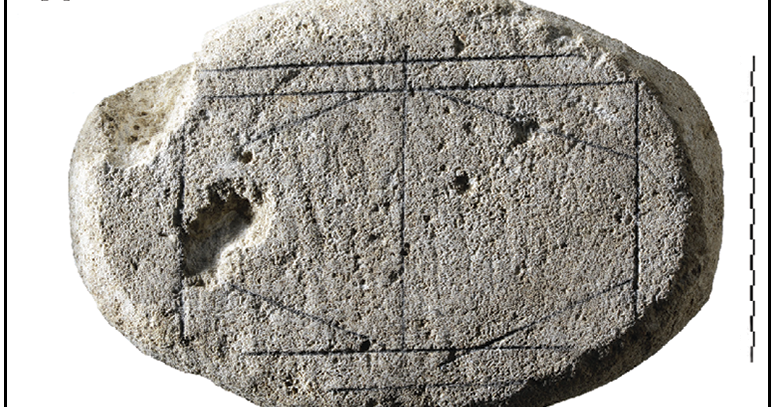
HEERLEN, Netherlands – A limestone slab discovered in the Roman settlement of Coriovallum, now Heerlen in the Netherlands, has been identified as a board game dating back nearly 2,000 years, thanks to the application of artificial intelligence. The finding, announced this week, pushes back the known history of strategic board games in Europe by centuries.
The stone, currently housed in Het Romeins Museum, features a grid of incised lines. For years, archaeologists suspected the markings indicated a game, but its precise nature remained elusive. Recent analysis, combining detailed wear pattern examination with AI-driven simulations, has revealed the likely rules and gameplay.
Researchers from Leiden University and Maastricht University collaborated on the project. Walter Crist, an archaeologist at Leiden University specializing in ancient games, explained that 3D imaging revealed uneven abrasion along the engraved lines. “One can see wear along the lines on the stone, exactly where you would slide a piece,” Crist said in a statement. “The appearance of the stone combined with this wear strongly suggests it’s a game.”
To decipher the game’s rules, the team employed Ludii, an AI platform designed to model historical board games. Dennis Soemers, from Maastricht University, explained that Ludii was trained using the rules of approximately 100 ancient games from the region. The AI then generated numerous possible rule sets and simulated gameplay, identifying variants that would produce wear patterns consistent with those observed on the stone. “The computer produced dozens of possible rule sets. It then played the game against itself and identified a few variants that are enjoyable for humans to play,” Soemers said.
The simulations indicated the game was a “blocking game,” where the objective is to restrict an opponent’s movement rather than capture pieces. Researchers believe players likely used small game pieces made of glass, bone, or earthenware, though none were found directly with the stone. The Antiquity journal published the research and posted a video explaining the game on social media.
While the AI analysis provides a strong indication of the game’s rules, researchers caution that absolute certainty is impossible. “If you present Ludii with a line pattern like the one on the stone, it will always find game rules,” Soemers noted. “we cannot be sure that the Romans played it in precisely that way.”
Karen Jeneson, curator of Het Romeins Museum in Heerlen, emphasized the significance of the finding. “We know the rules we found explain the wear marks on the stone and that they are consistent with games from comparable cultural periods,” Jeneson said in a statement. “Of course we considered other possible uses for the stone, such as an architectural decorative feature, but we found no alternative explanation. So, the stone really is a board game.”
The discovery builds on previous findings of Roman-era game pieces in the region. In 2015, archaeologists uncovered dice and other gaming materials in a Roman settlement in Germany, located along the Rhine River.
