
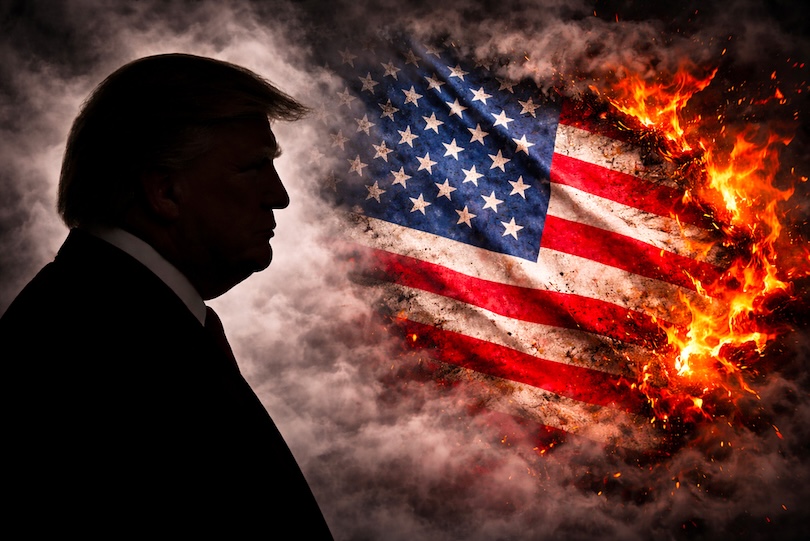
Donald Trump has stated he would be constrained only by his “own morality,” a declaration that observers are increasingly framing as a hallmark of tyranny. The assertion, made in January 2026, has prompted renewed discussion among scholars and journalists regarding the nature of his politics and leadership, with comparisons drawn to historical forms of authoritarian rule.
While terms like fascism, totalitarianism, and authoritarianism have been used to characterize Trump and his administration, some analysts suggest the concept of tyranny more accurately captures the essence of his governance. This perspective centers on what is perceived as the arbitrariness of his policies and a self-obsessed approach to power, distinct from the ideological coherence often associated with other authoritarian models.
Recent incidents, such as the deaths of two U.S. Citizens shot by Immigration and Customs Enforcement (ICE) agents, and the reported deaths of an additional 32 people in ICE custody since 2025, exemplify this perceived arbitrariness. The administration’s reported framing of these deaths as “collateral damage,” as interpreted by ABC News in January 2026, is seen by critics as dehumanizing and indicative of a disregard for consistent legal or moral principles. These incidents, they argue, do not align with any discernible ideological framework, but rather appear as unpredictable acts of power.
This pattern extends beyond law enforcement, manifesting in abrupt shifts in trade tariffs, volatile social media pronouncements, and seemingly capricious granting or withholding of favor. This contrasts sharply with the Cold War rivalry between the United States and the Soviet Union, which, despite its brutality, operated within a discernible, if antagonistic, rationality, as evidenced by interactions between leaders like Richard Nixon and Leonid Brezhnev.
Analysts point to a range of characteristics associated with tyranny, as defined by classical political philosophers like Plato and Aristotle. Aristotle, in his *Politics*, distinguished between “good” forms of government – monarchy, aristocracy, and polity – which prioritize the common good, and “awful” forms – tyranny, oligarchy, and democracy – which serve the interests of those in power. Tyranny, in this framework, represents a corruption of kingship, where a single ruler governs without law and solely for personal gain.
The comparison to fascism, recently explored by Jonathan Rauch in *The Atlantic* (January 25, 2026), remains relevant, with observers noting the demolition of norms, glorification of violence, and politicization of law enforcement under the current administration. Still, the argument for tyranny emphasizes that these traits are not consistently applied with ideological rigor, but rather deployed arbitrarily. Trump, for example, has been observed cultivating relationships with individuals across the political spectrum, including New York City Mayor Zohran Mamdani, while simultaneously fostering white supremacist ideologies.
Drawing on Aristotelian thought, analysts suggest that tyrants often rise to power by exploiting societal divisions, pitting groups against each other – the “poor” against the “wealthy,” “nationals” against “foreigners” – and fabricating identities to suppress opposition. Trump’s rhetoric, characterized by attacks on minorities and perceived enemies, is cited as a contemporary example of this tactic. Aristotle also argued that tyrants maintain control through fear and distraction, offering “bread and circuses” to divert attention from substantive political issues.
This dynamic, some observers contend, is reflected in the current political landscape, where the consumption of politics as entertainment, exemplified by Trump’s background as a television host and the recruitment of figures from the entertainment industry into his administration, diminishes the potential for informed and compassionate engagement with complex policy challenges. Neil Postman’s analysis of the decline of politics as a serious endeavor in *Amusing Ourselves to Death* is frequently referenced in this context.
Aristotle posited that tyranny ultimately collapses due to its inherent lack of reason and prudence, replaced by oppression and fear. He believed that such conditions would eventually provoke revolt, not only from the general populace but also from within the regime itself, including elements of the military. However, the realization of this outcome hinges on the presence of civil courage among citizens, a quality that appears unevenly distributed, as evidenced by the support – or what some describe as sycophancy – offered to Trump by prominent figures in the tech industry, including Jeff Bezos, Mark Zuckerberg, Tim Cook, and Sundar Pichai, many of whom previously benefited from policies promoting liberal trade and immigration. Thirty-three of these tech leaders reportedly attended a dinner at the White House on September 4, 2024.
The situation, as some commentators note, echoes the tragic themes of classical Greek drama, where hubris and unchecked power lead to downfall. The absence of reason and prudence, they argue, represents a profound crisis for modern society, demanding caution, empathy, and a renewed commitment to the principles of good governance.
