
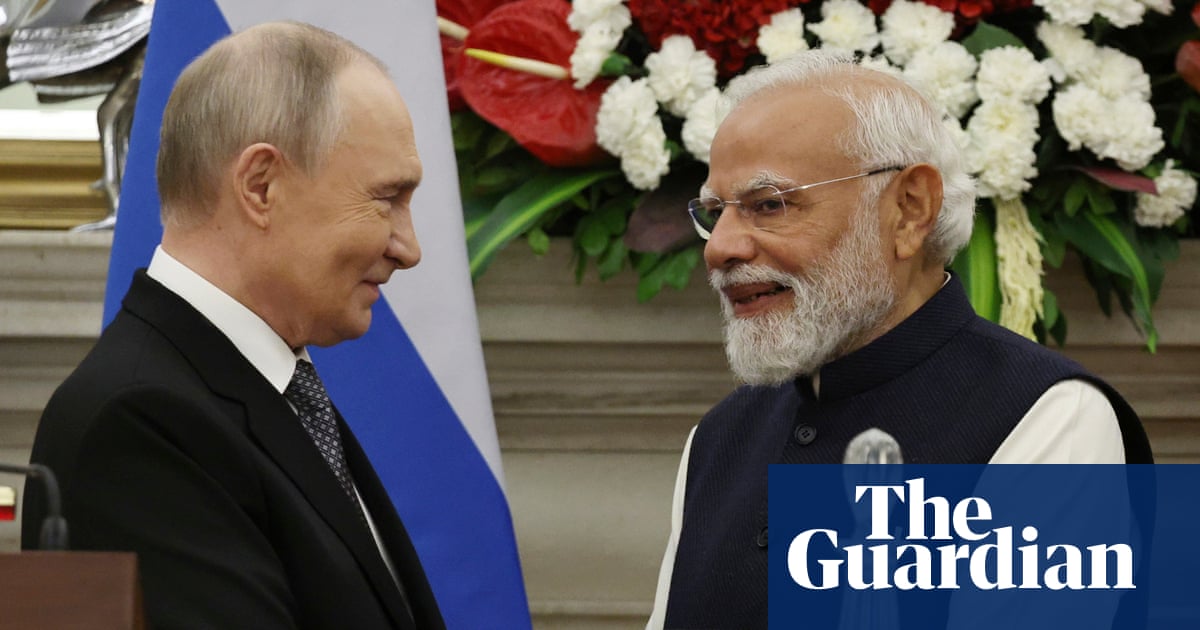
NEW DELHI – russian President Vladimir Putin affirmed Russia‘s commitment to maintaining “uninterrupted” fuel supplies to India, positioning energy resources as vital to India’s economic growth, during a bilateral summit with Indian Prime Minister Narendra Modi on Thursday adn Friday. The meeting, Putin’s first visit to India as the invasion of Ukraine, underscored a continued strong partnership despite international pressure.
putin stated, “russia is a reliable supplier of energy resources and everything necessary for the advancement of India’s energy sector.We are ready to continue ensuring the uninterrupted supply of fuel for the rapidly growing Indian economy.” Modi, while not directly referencing oil, highlighted “energy security” as “a strong and notable pillar of the India-Russia partnership.”
Prior to the meeting,Putin challenged U.S. interference regarding India’s purchases of Russian oil, questioning the disparity in access to resources, stating, “If the US has the right to buy our [nuclear] fuel, why shouldn’t India have the same privilege?”
The leaders demonstrated a visible effort to maintain the strength of their relationship, with Modi personally greeting Putin upon his arrival and the two sharing a warm embrace before a private dinner. Modi described the partnership as ”a guiding star,” emphasizing its resilience “based on mutual respect and deep trust.”
A joint statement released after talks affirmed the resilience of Russian-Indian ties “to external pressure” amid a “complex, tense, and uncertain geopolitical situation.” Putin had previously signaled intentions to bolster cooperation with both India and China in response to sanctions imposed by the U.S. and EU.
the summit yielded multiple agreements focused on defense and economic cooperation, including an economic cooperation program aiming to double bilateral trade to $100 billion annually by 2030. Discussions also centered on reshaping defense ties, with Russia remaining a key weapons supplier to India, though Delhi is actively diversifying its sources. While specific defense system purchases, such as Sukhoi Su-57 fighter aircraft, were not explicitly mentioned, the leaders agreed to pursue joint production of advanced defense platforms.
