
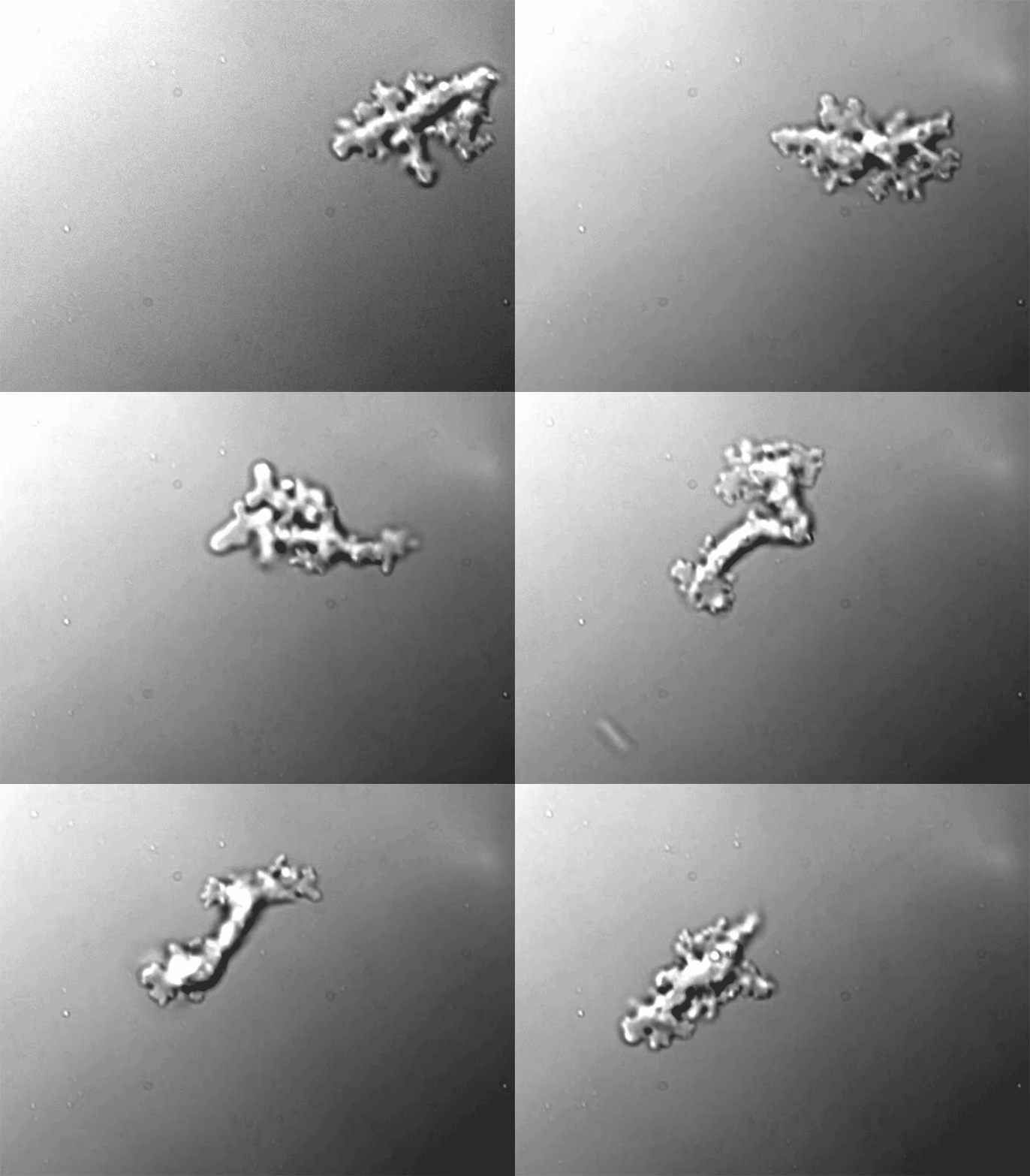
‘Fire Amoeba’ Shatters Heat Tolerance Record for Complex Life
LASSEN VOLCANIC NATIONAL PARK, CA – A newly discovered amoeba, Incendiamoeba cascadensis, is challenging long-held assumptions about the limits of life, thriving at temperatures previously considered lethal for complex, eukaryotic cells. The single-celled organism, found in a seemingly unremarkable hot stream within Lassen Volcanic National Park in northern California, can survive adn reproduce at 63°C (145°F) and remain active at 64°C (147°F), surpassing the previous record of 60°C for eukaryotes – organisms with cells containing a nucleus and internal structures.
The discovery, detailed in a preprint published November 24th, suggests a basic need to reassess the potential for complex life to exist in extreme environments.”we need to rethink what’s possible for a eukaryotic cell in a significant way,” says Angela Oliverio, a microbiologist at Syracuse university in New York, and a member of the research team.
I. cascadensis, translating to ‘fire amoeba from the cascades,’ was identified by oliverio and fellow Syracuse microbiologist Beryl Rappaport.Despite initial microscopic examinations of water samples appearing lifeless, culturing revealed the amoeba’s presence and remarkable heat tolerance. Researchers observed the organism not only dividing at unprecedented temperatures but also forming resilient dormant cysts capable of reactivation even after exposure to 70°C (158°F).
This finding raises questions about the evolutionary adaptations that allow I. cascadensis to flourish in such conditions and could have implications for understanding the potential for life in other extreme environments, both on Earth and beyond. Lassen Volcanic National Park,known for its geothermal features,provided an unexpected home for this groundbreaking discovery. “it’s the most uninteresting geothermal feature you’ll find in Lassen,” notes Rappaport, highlighting the unassuming nature of the stream where the ’fire amoeba’ was found.
