
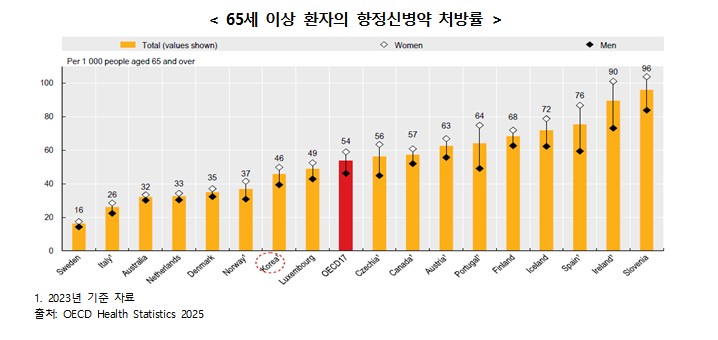
Seoul, South Korea - Antipsychotic prescriptions for South Koreans aged 65 and older have surged over the past decade, increasing by approximately 1.7 times, according to a recent analysis by the Ministry of Health and Welfare based on the OECD’s ‘Health at a Glance 2025’ report.
The prescription rate climbed from 29.7 per 1,000 people in 2013 to 45.9 per 1,000 in 2023. The rate surpassed 40 prescriptions per 1,000 individuals in 2019, reaching 40.8, and continued its upward trend.
Despite the increase, South Korea’s rate remains below the OECD average of 54 prescriptions per 1,000 people aged 65 or older as of 2023.
‘Health at a Glance’ is a bi-annual OECD publication comparing healthcare indicators across 38 member countries, plus candidate and partner nations including Brazil, China, and Russia. it began publication in 2001.
The Ministry’s analysis also revealed other trends in medication use: Korea’s outpatient antibiotic prescriptions averaged 25DDD (Defined Daily Dose) per 1,000 people per day in 2022, exceeding the OECD average of 16DDD.While the long-term prescription rate of benzodiazepines among those over 65 was lower than the OECD average (11.5 vs. 27 per 1,000), the prescription rate for long-acting benzodiazepines was significantly higher (98.3 vs. 42 per 1,000).
The report also indicated that 38.6% of deaths in South Korea occurred in medical institutions in 2023, lower than the OECD average of 49%, a metric used as an indirect measure of end-of-life care quality.
