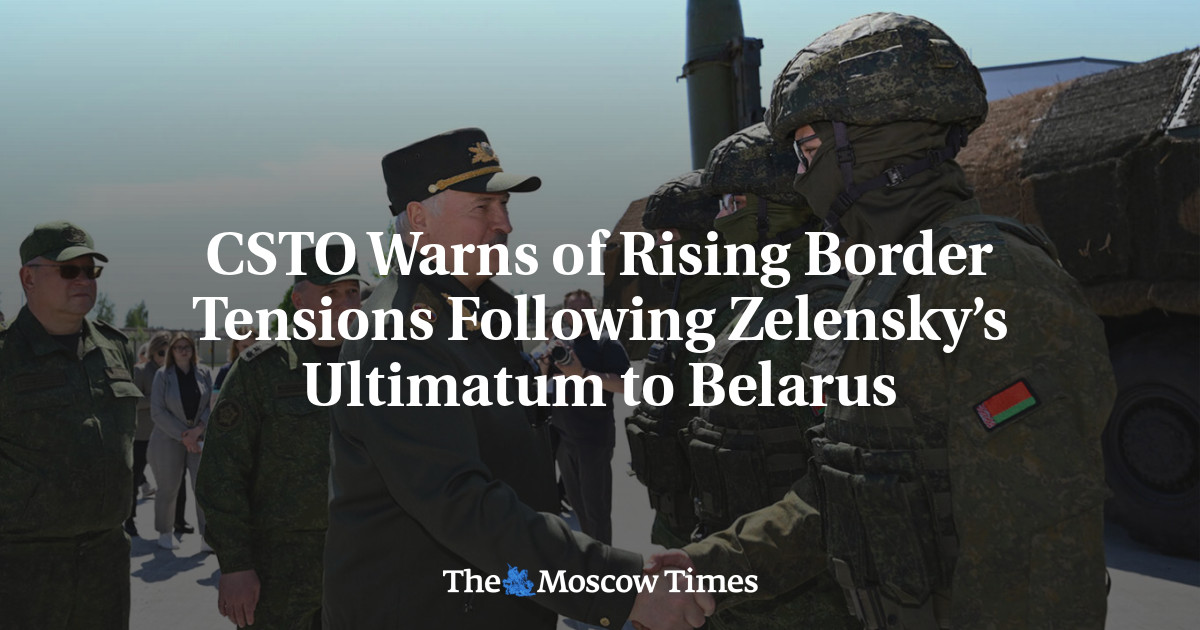
Zelensky Warns: Ukraine Will Strike Belarusian Ground Stations If Russia’s Use Continues
Ukrainian President Volodymyr Zelenskyy has threatened preemptive strikes against military ground stations in Belarus, citing their role in facilitating Russian aerial operations. As of June 24, 2026, the Collective Security Treaty Organization (CSTO) has warned this ultimatum risks a massive regional escalation, potentially drawing Belarus into a direct kinetic conflict.
The Strategic Shift in the Belarus-Ukraine Borderlands
The core of the current crisis lies in the physical infrastructure located within Belarusian territory. Zelenskyy’s administration has accused Minsk of permitting Russian forces to utilize radar, logistics, and launch facilities to sustain the ongoing conflict. By labeling these stations as legitimate military targets, Kyiv is moving away from its previous policy of territorial restraint.
The Collective Security Treaty Organization, a military alliance led by Russia, issued a formal statement today characterizing the threat as a dangerous provocation. The organization argues that any strike on Belarusian soil would trigger mutual defense obligations under the treaty’s charter, effectively expanding the theater of war. This creates a precarious environment for businesses and residents in the border regions who must now account for the sudden risk of kinetic fallout.
“The rhetoric has shifted from containment to active neutralization of supporting infrastructure. When a state identifies a neighbor’s facilities as immediate targets, the buffer zone ceases to exist in both diplomatic and tactical terms.”
Regional Instability and the Economic Impact
For those operating in Eastern Europe, the threat of an expanded conflict presents severe logistical and legal challenges. Supply chains that rely on transit through the Baltic and Eastern European corridors are currently facing heightened insurance premiums and potential route closures. Businesses attempting to mitigate these risks are increasingly turning to international trade law firms to assess their exposure to force majeure clauses and cross-border liability.

Historical precedent suggests that cross-border threats often lead to rapid, localized infrastructure hardening. According to the Organization for Security and Co-operation in Europe (OSCE), the volatility of the Belarus-Ukraine border has reached its highest level since the conflict began in 2022. Local governments near the border are already advising residents to review emergency protocols, a task that often requires the expertise of specialized risk management consultants.
Comparative Analysis: The Escalation Timeline
The following table outlines the key shifts in the security posture between Kyiv and Minsk throughout the last quarter:
| Date | Event | Primary Actor |
|---|---|---|
| May 12, 2026 | Increased Russian air patrols reported near Gomel. | Russian Aerospace Forces |
| June 18, 2026 | Zelenskyy issues ultimatum regarding ground stations. | Government of Ukraine |
| June 24, 2026 | CSTO issues formal warning of mutual defense intervention. | CSTO Secretariat |
Legal and Diplomatic Ramifications
The potential for a strike on Belarusian territory raises complex questions regarding international law and the sovereignty of non-belligerent states. While Ukraine maintains that the stations are complicit in Russian aggression, legal scholars note that such actions could be interpreted under international law as an act of war against Belarus, regardless of Russian involvement.
For corporations with assets in the region, the legal landscape is becoming increasingly hostile. Navigating the intersection of sanctions, border closures, and potential combat-related losses requires precise counsel. Many regional firms are currently engaging commercial litigation specialists to prepare for potential property damage or contract disputes arising from these heightened tensions.
Operational Challenges for Local Infrastructure
Beyond the immediate military threat, the region is grappling with the degradation of cross-border utility and transport networks. Local municipal leaders are reporting that energy grids and transport hubs are being prioritized for defense, often at the expense of civilian utility. The United Nations High Commissioner for Refugees has noted that even the threat of such strikes is causing significant displacement in border communities.

Securing physical infrastructure against the risks of regional conflict is not a task for general contractors. It requires firms with specific expertise in high-threat environments. Professional entities listed under emergency infrastructure restoration services are increasingly being sought after to fortify facilities against the possibility of collateral damage.
The Path Forward
As of this afternoon, there have been no reports of physical strikes, but the diplomatic channel remains effectively frozen. The ultimatum issued by Kyiv has forced the CSTO to clarify its red lines, effectively pinning the security of the entire region to the behavior of these specific ground stations.
History shows that ultimatums of this nature rarely lead to de-escalation without a third-party mediator. Whether a diplomatic solution can be reached before the threat of a strike becomes a reality depends on the willingness of Minsk to decouple its infrastructure from Russian military objectives. Until such a shift occurs, the region remains on a knife-edge. For those tasked with protecting personnel and capital in these volatile areas, the time for proactive planning has arrived. Engaging with verified security and risk assessment professionals is the only reliable way to ensure that your operations are resilient in the face of rapidly changing geopolitical realities.