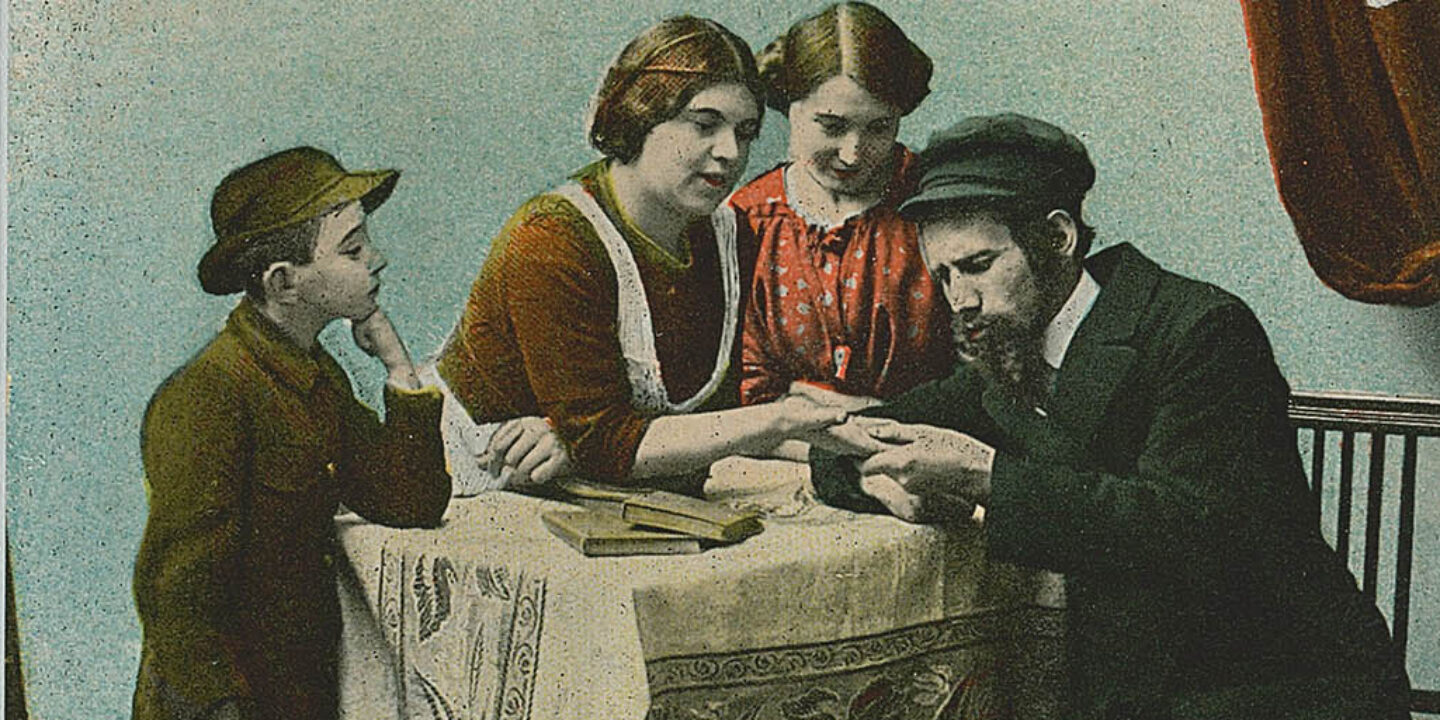
Yivo Institute exhibits history of Jewish occult practices
“These people had echte Probleme, aber keine Lösungen,” said Eddy Portnoy, explaining how historical figures turned to occult practices when faced with the crushing pressures of their era.
The YIVO Institute for Jewish Research in New York is currently exhibiting that history, exploring centuries of palmistry, telepathy, and professional psychics in the exhibition titled Jews Are Magic: Occult Practices from Palmistry to Professional Psychics, juedische-allgemeine.de reported.
From the Lower East Side to Stalin’s Inner Circle
Among the prominent figures featured in the New York exhibition is Else Teresa Frenkel, who operated under the professional name Laila. Born in 1901 in Austria-Hungary, likely in Czernowitz, she built a career as a self-styled professor of the occult starting in 1930 in Berlin. Laila claimed to speak 18 languages, including Yiddish, though she concealed her Jewish identity as she traveled the globe from New York and Los Angeles to London, where she predicted a future marriage for the Prince of Wales. Her telepathy and divination services attracted global political figures including Georges Clemenceau, Benito Mussolini, Lord Balfour, Lloyd George, and multiple Zionist leaders.
Dora Meltzer made her living through palmistry in New York’s Lower East Side during the late 19th century. Construction work on Orchard Street later uncovered her promotional flyers offering readings for 15 cents. Abraham Hochman, a Talmud student who settled in the same immigrant neighborhood, authored books on astrology and divination in English and Yiddish. Hochman once appeared at a courthouse to pay bail for an unacquainted defendant, asserting his thought-reading abilities proved the man’s innocence; the defendant was acquitted the following day. Hochman also used public advertisements to locate missing husbands, successfully predicting in 1903 that a missing spouse would appear at the corner of Pitt Street and Grand Street.
Naftali Herz Imber, the author of the lyrics to the Israeli national anthem Hatikwa, also worked as a clairvoyant. Hailing from a Galician shtetl near Lemberg, Imber traveled to Palestine, India, San Francisco, and eventually New York City. Operating under aliases such as the Apostle of the Kabbalah and the Mahatma, he warned of a major disaster in Paris shortly before a fire at the Bazar de la Charité in which hundreds of people died. In Los Angeles, he predicted that Californian wines would one day be the best in the world and that humanity would eventually harness solar energy. During his later years in New York, the Sulzberger family, owners of the New York Times, provided financial support to keep him afloat.
Velvi Messing, who performed under the name Wolf Messing, achieved prominence within Soviet political leadership. Born in 1899 to a poor Hasidic family in Góra Kalwaria near Warsaw, he studied under a local rabbi before developing talents in mental suggestion and clairvoyance. After predicting in 1939 that Hitler would overthrow Stalin, Messing fled to the Soviet Union. He spent the remainder of his life there, eventually serving in Stalin’s inner circle and later continuing his career under Nikita Khrushchev and Leonid Brezhnev.
Historical Tension Between Rabbinical Law and Popular Mysticism
The YIVO exhibition is curated by Eddy Portnoy, administrator of the YIVO archive containing approximately 24 million objects, alongside Samuel Glauber, a researcher at Saint Louis University specializing in Eastern European mysticism. Portnoy noted that while mysticism, Kabbalah, palmistry, and clairvoyance remained outside normative Judaism and were practiced discreetly, these traditions consistently attracted public interest. Archivists recovered more amulets and books than the gallery space could accommodate.
The official stance of senior rabbis, established long before the occult revival of the 1920s and 1930s, rejected such practices as incompatible with Jewish religious law. Yet historical figures frequently consulted practitioners when traditional avenues failed.
The exhibition also addresses the tragic trajectory of Erik Jan Hanussen, born Herschel Steinschneider in Vienna. The Weimar-era spiritism star moved in Nazi circles beginning in 1930, only to be found dead in a ditch near Berlin weeks after the Nazi seizure of power. Meanwhile, Laila avoided the Holocaust by fleeing from the police, though details of her later life remain sparse following her appearance in South America during the 1950s.
Contemporary Parallels in Social Media Wellness Culture
The YIVO display connects historical divination to modern digital spaces, drawing a direct line to contemporary influencers and wellness gurus operating on social media platforms. Portnoy observed that societal pressure consistently drives individuals toward alternative spiritualities in search of hope. The exhibition remains open at the Center for Jewish History in New York through December 31.