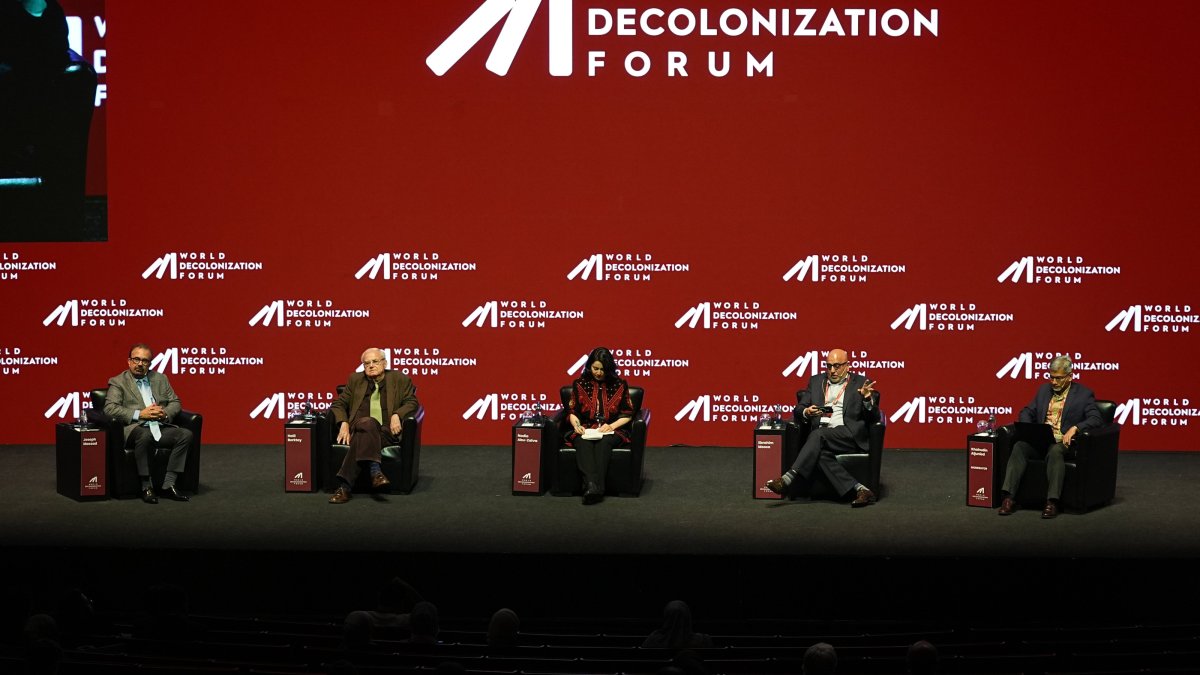
World Decolonization Forum in Istanbul Calls for End to Western Dominance
Prominent scholars and intellectuals gathered in Istanbul on May 11, 2026, for the World Decolonization Forum. The event aims to dismantle Western dominance in knowledge systems, challenging the intellectual hegemony that shapes global academia, policy, and history to make room for diverse, non-Western perspectives and indigenous wisdom.
For decades, the global standard for “truth”—whether in sociology, law, or history—has been filtered through a predominantly Western lens. This is not merely an academic grievance; We see a systemic problem. When the frameworks used to govern nations, judge crimes, and teach children are derived from a single geographic and cultural origin, the result is an intellectual erasure of the rest of the world.
The gathering in Istanbul represents a seismic shift. It is an admission that the “universal” truths we have relied upon are often just provincial Western views exported globally.
The Crisis of Epistemic Hegemony
At the heart of the World Decolonization Forum is the concept of epistemic justice. The speakers gathered this Monday are not calling for the deletion of Western knowledge, but rather for its “provincialization.” The goal is to stop treating Western thought as the default setting for humanity and instead treat it as one of many valid regional perspectives.

This dominance manifests in several critical ways:
- Academic Validation: The tendency for research from the Global South to be deemed “unscientific” or “anecdotal” unless it is validated by a Western university.
- Legal Frameworks: The imposition of Western legal codes on indigenous populations, often ignoring traditional restorative justice systems.
- Historical Narratives: A global curriculum that frames history through the lens of European exploration and expansion, rather than local agency and resistance.
This intellectual imbalance creates a practical vacuum. Local governments often find themselves utilizing outdated colonial-era policies because they lack the structural support to develop indigenous alternatives. To bridge this gap, many institutions are now seeking academic consultants who specialize in diversifying curricula and implementing inclusive pedagogical frameworks.
“Decolonization is not a metaphor; it is the active process of reclaiming the right to define one’s own reality, history, and future without the permission of a former colonial power.”
Why Istanbul? The Symbolism of the Bridge
The choice of Istanbul as the host city is far from accidental. As a city that physically and historically bridges Europe and Asia, Istanbul serves as a living metaphor for the forum’s objectives. It is a space where the legacies of the Byzantine and Ottoman Empires intersect with modern globalism, providing a neutral ground for intellectuals from Africa, Asia, and Latin America to converge.
This geographic anchoring highlights a broader trend: the shift of intellectual gravity toward the East and South. As regional economies grow, the demand for a “knowledge infrastructure” that reflects local values has intensified. This shift is impacting everything from urban planning to municipal laws, as cities move away from Eurocentric models of development toward more sustainable, community-led designs.
However, transitioning away from established Western norms is a logistical and legal minefield. Organizations attempting to repatriate cultural artifacts or rewrite land-tenure laws are increasingly relying on international law firms that understand the intersection of colonial treaty law and modern human rights standards.
Beyond the Classroom: Technology and Economics
The dialogue in Istanbul extends beyond textbooks. The forum is exploring how colonialism has evolved into “digital colonialism.” This occurs when the infrastructure of the internet—the algorithms, the data storage, and the AI models—is owned and programmed by a handful of Western corporations, effectively dictating how the rest of the world accesses information and perceives value.
When an AI is trained primarily on Western datasets, it inherits Western biases. This creates a feedback loop where non-Western cultures are further marginalized in the digital age. Dismantling this dominance requires a fundamental restructuring of how data is governed and who owns the “digital commons.”
The economic implications are equally stark. The forum participants are analyzing how global financial systems continue to favor the structures established during the colonial era, often trapping developing nations in cycles of debt and dependency. Addressing these systemic failures requires the intervention of cultural preservation societies and non-profit organizations that advocate for economic sovereignty and fair-trade paradigms.
The Path Toward Intellectual Sovereignty
The World Decolonization Forum is not just a talking shop; it is a call for a practical overhaul of global institutions. For this movement to succeed, it must move from the lecture hall to the legislative chamber. This means updating the way UNESCO approaches cultural heritage and how the United Nations supports the self-determination of non-self-governing territories.
The challenge remains: how do you build a global consensus when the very language of “consensus” has been defined by the dominant power? The answer lies in “pluriversality”—the idea of a world where many worlds fit.
We are seeing the first cracks in the monolith. From the repatriation of the Benin Bronzes to the rise of indigenous-led climate initiatives, the world is beginning to realize that the most effective solutions to modern crises often lie in the knowledge systems that were once suppressed.
As the forum concludes its sessions in Istanbul, the central question remains: are the stewards of global knowledge brave enough to share the podium? The dismantling of Western dominance is not an attack on the West, but an invitation for the rest of the world to finally speak in its own voice. Those who wish to navigate this changing landscape—whether through legal restructuring, educational reform, or civic advocacy—will find the necessary expertise and verified professionals within the World Today News Directory.