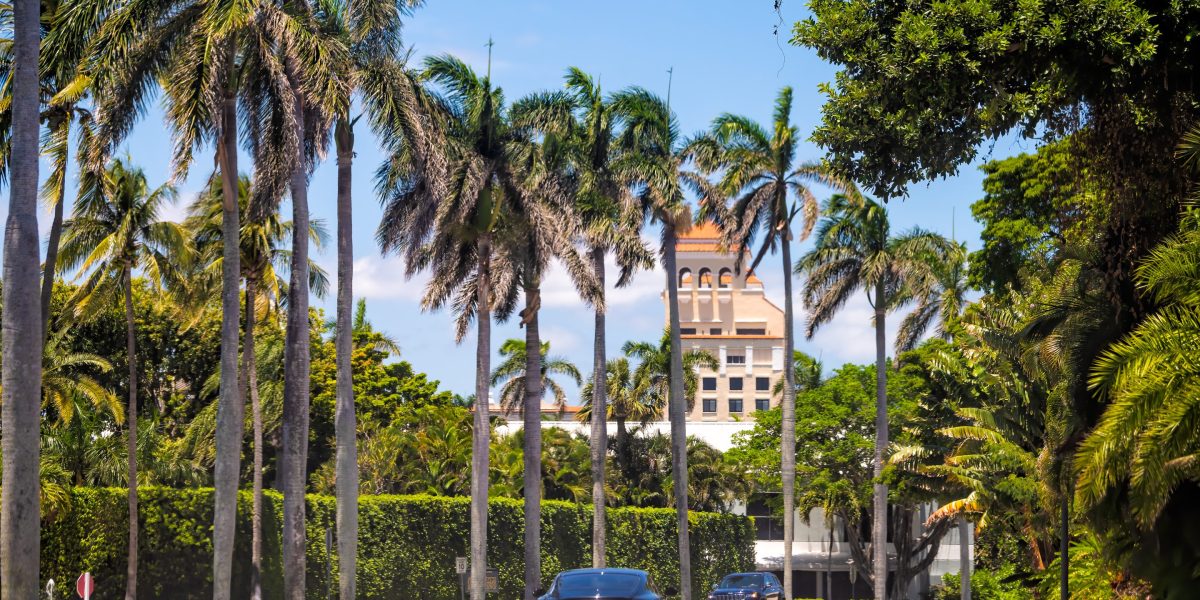
Why Security Is Driving the Palm Beach Luxury Real Estate Boom
Wealthy buyers now treat Mar-a-Lago’s indefinite security closure as a premium amenity, reshaping Palm Beach luxury real estate into a self-selecting market where exclusivity drives transaction velocity and premium pricing, with West Palm Beach luxury pending sales up 30% YoY and average home prices at $9.8M.
How Security Closures Redefined Luxury Access in Palm Beach
The indefinite closure of South Ocean Boulevard—triggered by heightened federal security following joint U.S.-Israel strikes on Iran and a Feb. 22 perimeter breach—has transformed from a logistical nuisance into a core value proposition for ultra-high-net-worth buyers. What began as a temporary restriction tied to presidential visits now operates as a permanent filter, reinforcing the island’s reputation for controlled access. This shift aligns with broader market dynamics: Palm Beach’s five-year home value appreciation hit 118.2%, the highest in major Florida markets, according to The Koolik Group’s April 2026 luxury real estate report. The average single-family home now sells for roughly $9.8 million, with nearly 70% of transactions exceeding $10 million. These figures aren’t just reflective of scarcity—they signal a market where privacy and discretion are priced into every square foot.
The security perimeter isn’t a barrier—it’s a badge. Buyers aren’t tolerating the closure; they’re seeking it out because it guarantees the particularly insulation they paid for.
This mindset shift is most pronounced in West Palm Beach, where luxury pending sales rose 30% year-over-year in January, per Redfin data, and average time on market dropped from 95 to 85 days. Elena Fleck, a Redfin Premier agent, notes that $1 million homes no longer qualify as high-end; instead, updated properties just above that threshold attract intense competition from out-of-state cash buyers. The phenomenon reflects a deeper trend: wealth migration to Florida, amplified by the state’s lack of income tax and West Palm Beach’s emergence as “Wall Street South,” has drawn hedge funds, family offices, and corporate executives seeking both lifestyle and operational insulation. For these buyers, the federal security presence doesn’t disrupt life—it validates it.
The B2B Problem: Managing Exclusivity in Real-Time
As access tightens, the buyer pool becomes more intentional—but this creates latest operational demands for agents, and sellers. Jessica Julian describes a fundamental shift: showings are now clustered, timed around security windows, and preceded by rigorous pre-vetting via virtual tours, FaceTime walkthroughs, and detailed digital dossiers. By the time a client arrives, the shortlist is often narrowed to one or two properties, not ten. This efficiency gain comes at a cost: agents must now invest in secure communication platforms, identity verification tools, and real-time access coordination systems to manage the flow of high-stakes, off-market transactions. The problem isn’t finding buyers—it’s managing the friction of exclusivity at scale.
This is where specialized B2B services become critical. Firms offering secure client relationship management (CRM) platforms tailored for luxury real estate enable agents to track buyer qualifications, schedule access-sensitive showings, and maintain audit trails for compliance. Similarly, identity verification and AML/KYC providers ensure that pre-vetting processes meet federal standards without delaying transactions. For developers selling off-market or through private waitlists, proptech analytics firms that model demand cycles and pricing elasticity in ultra-exclusive submarkets help optimize inventory release timing—turning scarcity into a programmable advantage.
Why This Isn’t Just About Real Estate—It’s About Access Economics
The Mar-a-Lago effect reveals a broader principle: in markets where physical access is constrained by security, governance, or geography, the perceived value of inclusion rises disproportionately. Palm Beach’s land is finite; its inventory is tight; and now, its access is actively managed. This isn’t a departure from historical norms—it’s the next evolution. As Julian observes, agents aren’t just marketing exclusivity anymore; they’re engineering it in real time through data-driven buyer filtering, synchronized showing schedules, and transparent communication about access windows. The result is a market where transaction velocity increases not despite restrictions, but because of them—provided the infrastructure to manage those restrictions exists.
For ultra-high-net-worth individuals, the calculus is simple: they’re not buying a home. They’re buying a controlled environment where the barriers to entry serve as a continuous screening mechanism. The federal security detail, once seen as an inconvenience, now functions as a de facto amenity—one that signals, without words, that this market remains insulated from volatility, intrusion, and noise. In an era of geopolitical uncertainty and information overload, that assurance carries a premium.
As Palm Beach’s luxury market continues to redefine the relationship between security, scarcity, and value, the winners will be those who treat access not as a constraint but as a configurable asset. For agents, developers, and wealth advisors navigating this shift, the next step is clear: partner with B2B providers who specialize in secure transaction orchestration, identity verification, and predictive access analytics. The World Today News Directory connects you with vetted firms in these categories—ensuring you don’t just keep pace with the market’s evolution, but anticipate it.