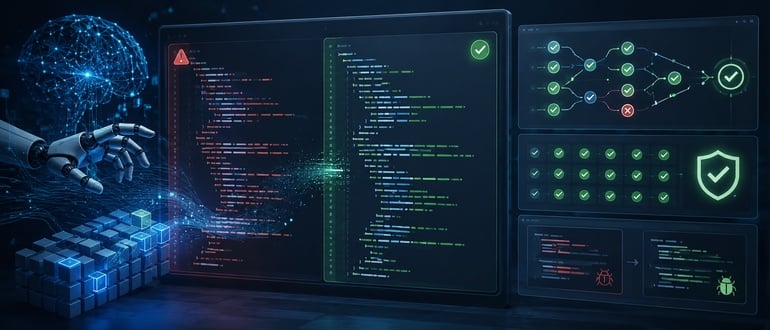
Why AI Code Generation Exposed the Flaws in Code Coverage
Microsoft Testing Agent Targets Trust Gap in AI Code Generation
As enterprise software teams grapple with swelling codebases driven by large language models, code coverage metrics are failing to catch critical bugs. According to reports from DevOps.com, Microsoft has introduced a new testing agent that utilizes mutation testing to address the growing trust gap in AI-generated code. The tool targets a persistent engineering problem: traditional line coverage metrics often give a false sense of security, masking untested logic and structural vulnerabilities within automated outputs.
- The Problem: Traditional code coverage metrics fail to verify the functional robustness of AI-generated code, creating hidden technical debt.
- The Solution: Microsoft’s new agent introduces mutation testing to automatically inject code changes and verify if existing test suites catch the alterations.
- Enterprise Impact: Engineering organizations can automate stricter quality gates, reducing reliance on manual code reviews for routine pull requests.
Exposing the Flaws in Automated Code Coverage
For years, development teams have relied on line coverage percentages to gauge test suite completeness. However, the sheer volume of code produced by modern assistants has exposed the limits of this approach. According to statements cited by DevOps.com from Ashley, coverage numbers have been misleading engineering groups, a problem exacerbated by automated code generation. A test suite might execute every line of a program without actually asserting the correctness of the underlying logic.
To counter this, Microsoft’s testing agent runs mutation testing. Instead of merely checking if lines run, the system systematically introduces small tweaks—mutations—into the source code, such as changing a conditional operator from > to < or altering a return value. If the test suite passes despite these deliberate alterations, the tests are flagged as weak or inadequate. This forces developers to write assertions that actually validate state changes rather than just hitting execution targets.
Integration and Implementation Realities
Deploying mutation testing at scale typically introduces severe computational bottlenecks. Traditional mutation testing frameworks require significant CPU overhead because they must compile and run the entire test suite against hundreds of mutated variants for every code change. Integrating such a mechanism into a continuous integration (CI) pipeline demands careful resource allocation to prevent excessive build times.
Engineering teams looking to audit their testing pipelines often collaborate with specialized [Relevant Tech Firm/Service] development agencies to containerize test runners and manage compute clusters efficiently. By offloading heavy mutation runs to scalable Kubernetes pods, organizations can maintain rapid feedback loops without saturating local development environments.
# Example CLI command for running a containerized mutation test suite
docker run --rm -v $(pwd):/app -w /app
  mcr.microsoft.com/dotnet/sdk:8.0
  dotnet stryker --mutation-level Basic
Implementing these automated validation checks requires strict adherence to SOC 2 compliance and robust continuous integration protocols. When managing automated pull request reviews, maintaining an audit trail of which code segments were generated by LLMs versus written by humans helps security teams isolate potential regressions.
Securing the Software Supply Chain
Beyond functional correctness, the rise of automated code generation introduces supply chain risks, including subtle logic flaws and hallucinated dependencies. When vulnerabilities slip past superficial test suites, organizations face heightened exposure to zero-day exploits. Enterprises handling sensitive financial or health data frequently partner with professional [Relevant Tech Firm/Service] cybersecurity auditors to perform deep static and dynamic code analysis before merging AI-assisted contributions into main production branches.
As software organizations scale their deployment pipelines, the focus is shifting away from simple output generation speed toward verifiable correctness. Tools that automate mutation testing represent a necessary shift from measuring how much code exists to proving how resilient that code actually is under adversarial conditions.
Disclaimer: The technical analyses and security protocols detailed in this article are for informational purposes only. Always consult with certified IT and cybersecurity professionals before altering enterprise networks or handling sensitive data.