
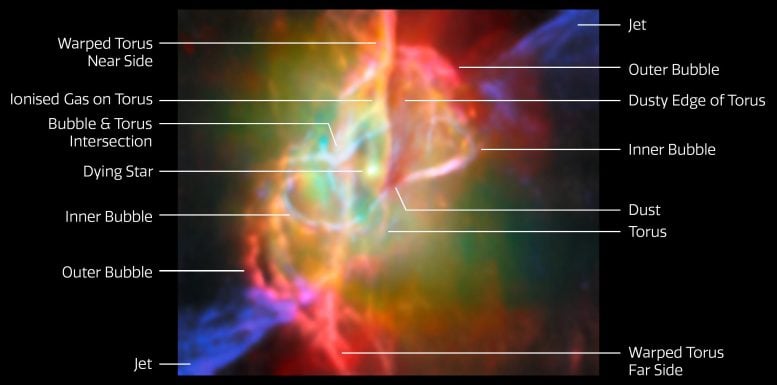
Webb Telescope Reveals Hidden Star, Molecular Building Blocks in Butterfly Nebula
WASHINGTON – The James Webb Space Telescope (JWST) has pierced through obscuring dust to reveal the central star of the Butterfly Nebula (NGC 6302) and identified a wealth of molecules crucial for life, including complex organic compounds, within its swirling structures. The findings, published August 27, 2025, in Monthly Notices of the Royal Astronomical Society, offer unprecedented insight into the chemical complexity of planetary nebulae and the environments around dying stars.
Using the Mid-Infrared Instrument (MIRI) in integral field unit mode – combining a camera and spectrograph to capture images across multiple wavelengths simultaneously – an international team of researchers analyzed data supplemented by observations from the Atacama Large Millimetre/submillimetre Array. This powerful combination allowed them to identify nearly 200 spectral lines, each representing a different atom or molecule within the nebula.”These lines reveal nested and interconnected structures traced by different chemical species,” explained the research team.Previously hidden by thick dust, the central star was pinpointed by MIRI’s sensitivity to mid-infrared wavelengths, revealing a previously undetected dust cloud heated by the star itself. Prior attempts to locate the star were unsuccessful due to the lack of sufficient infrared sensitivity and resolution.
The observations are notable as they demonstrate the presence of polycyclic aromatic hydrocarbons (PAHs), complex molecules considered building blocks for life, forming within the nebula. The research suggests these PAHs are being triggered by ultraviolet radiation from the central star interacting with the surrounding gas and dust.
“The JWST/MIRI view of the planetary nebula NGC 6302 – I. A UV-irradiated torus and a hot bubble triggering PAH formation” is authored by Mikako Matsuura, Kevin Volk, Patrick Kavanagh, and 36 other researchers. The study’s DOI is 10.1093/mnras/staf1194.
