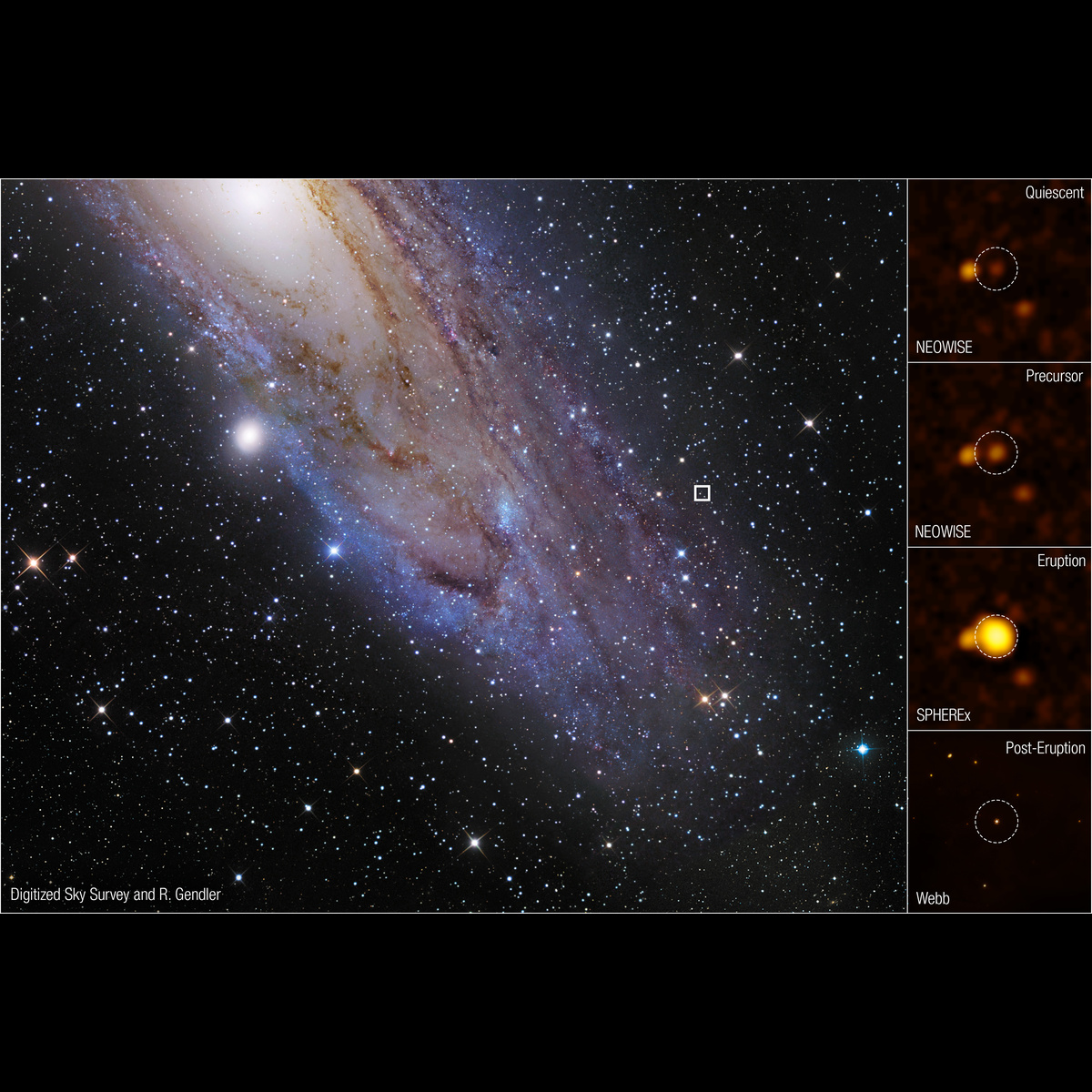
Webb Confirms First Direct Observation of Star Merging With Supergiant in Andromeda
Astronomers have confirmed the first direct observation of a star spiraling into and merging with a supergiant, using James Webb Space Telescope data taken 47 days after the eruption peaked, according to a study published in Nature on Wednesday, Nov. 18.
The system, nicknamed Bao and formally designated AT 2025abao, sits in the outskirts of the Andromeda galaxy, the Milky Way’s nearest major neighbor. A star slightly less massive than the Sun was dragged into the core of a companion seven times as massive, 350 times its radius and 18,000 times brighter, per the Nature paper by Viraj Karambelkar, Kishalay De, Karel D. Temmink and 42 other authors.
The Tech TL;DR:
- Webb observed the merger’s aftermath on Dec. 24, 2025, the earliest-ever follow-up of an event like this, under a just-in-time Director’s Discretionary Time program.
- The event let researchers measure how efficient common envelope evolution was.
- Karambelkar said that there is going to be a large influx of similar discoveries just ahead.
Stellar mergers are hard to catch because they are hard to predict. The team first flagged the object in February 2023, when data from NASA’s retired NEOWISE mission showed an unusual variable star where a stable luminosity had been before 2018. They published their first paper right before the eruption in 2025.
“Stellar mergers are very, very difficult to observe in real time because they are hard to predict,” said Viraj Karambelkar, first author of a new paper in Nature published Wednesday and a NASA Hubble Fellow at Columbia University in New York. “However, we noticed something unusual was going on in 2023 and continued to monitor the system to see what it would do. Then, in 2025, it erupted!”
Two Stars Became One in Seven Orbits
Before their transformation, the two stars spent millennia placidly orbiting one another as a binary pair. Once the smaller star came into contact with the surface of the giant star, their “unification” happened after only seven orbits (about seven years). Other known binary star mergers, featuring two smaller stars, occurred after thousands of orbits.

The outburst itself was faster than anyone modeling the system expected. “We thought it would take centuries for an outburst to happen,” said co-author Nadia Blagorodnova, an assistant professor at the University of Barcelona in Spain. “And then one day it erupted! We were flabbergasted.”
“One day, its brightness started rising and within a week, it peaked,” Blagorodnova said.
The mechanism is common envelope evolution: the primary star engulfed the smaller star and the companion plummeted, spiraling through the envelope as it was robbed of orbital energy by drag. The Columbia group—overseen by Professor De—led the identification and follow-up of this event from the start, and this paper marks the first time that that possibility has been directly observed.
“When a companion star begins to interact with the outer surface of the primary star, it produces a subtle effect—a slow brightening, which we clearly saw in Bao’s data,” said co-author Kishalay De, an assistant professor at Columbia University in New York. “As the companion continues its orbit, it keeps peeling off the primary star’s outer layers, and that gas flows away into the surrounding space.”
How the Observation Pipeline Caught It
Observations from the Wide-field Infrared Transient Explorer (WINTER) in September 2024 showed that Bao was not only beginning to brighten, but also spew dust. In November 2025, the team received fast-turn observations from NASA’s now-retired Neil Gehrels Swift Observatory and NOIRLab’s Gemini North telescope in Hawaii.
Webb’s observations were taken on Dec. 24, 2025, as part of a just-in-time Director’s Discretionary Time program. The team’s analysis of Bao offers an approach to reconstructing the events: They conducted their analysis and made observations of the stars’ merger in real time.
“Webb observed Bao only 47 days after the stars’ eruption peaked, the earliest-ever follow-up of an event like this,” Karambelkar said. “The telescope’s data helped us characterize what the system looked like before, during, and immediately after the merger, which is absolutely mind-blowing.”
The Simulation That Settled the Masses
The team concluded that prior to the eruption, Bao’s primary star dwarfed the Sun: It was seven times as massive, 350 times the radius, and 18,000 times brighter — making “Big Bao” an appropriate nickname.
“It was an absolute beast of a star, completely outshining its companion in the data,” said co-author Karel Temmink, a Ph.D. student at Radboud University in
While Webb’s data proved the stars merged, a merger wasn’t the only possible outcome for this system. In other systems, both stars survive the process — shedding a lot of mass along the way, but remaining independent in tight orbits.
Roman’s Survey Changes the Detection Math
Viraj Karambelkar et al., An inspiral of a star inside a common envelope with its giant companion, Nature (2026).
“There’s going to be a large influx of similar discoveries just ahead,” Karambelkar said.
The Andromeda galaxy, about 2.5 million light-years from Earth, is the nearest major galaxy to the Milky Way and the largest member of the Local Group, spanning roughly 152,000 light-years.
Long known as the Andromeda Nebula, it was described as a “nebulous smear” by the Persian astronomer Abd al-Rahman al-Sufi around 964 CE—the earliest known reference to a galaxy other than the Milky Way. It is visible to the naked eye on new moon nights, and the two galaxies have about a 50% chance of colliding and merging within the next 10 billion years.
The full study, “An inspiral of a star inside a common envelope with its giant companion,” is available in Nature.