Astronomers Witness First Real-Time Stellar Merger in Andromeda Galaxy
Astronomers expected stellar mergers to stay theoretical; instead, a star slightly less massive than the Sun spiraled into a bloated supergiant in the Andromeda galaxy, and telescopes recorded the whole sequence in real time.
The system, nicknamed Bao and formally designated AT 2025abao, erupted in 2025, and NASA reported the findings on Wednesday.
The Tech TL;DR:
- For the first time, researchers observed a common envelope event — a star being engulfed and shredded inside a giant companion — from start to finish, per NASA.
- The merger completed in about seven orbits, roughly seven years; typical mergers of smaller stars take thousands of orbits, according to Sci.News: Breaking Science News: Breaking Science News.
- The event exposes gaps in standard models of how energy moves inside giant stars, with implications for how astronomers simulate binary evolution at scale.
The system sits about 2.5 million light-years away in Andromeda. According to the paper published November 18 in Nature, lead author Viraj Karambelkar, a NASA Hubble Fellow at Columbia University, and colleagues reconstructed the merger using data spanning ultraviolet, visible, and near-infrared light.
The Numbers Behind Bao’s Seven-Year Inspiraling
Modeling puts the primary star, Big Bao, at seven times the Sun’s mass, 350 times its radius, and 18,000 times its brightness. Its companion, Little Bao, weighed in at about 0.7 solar masses, Sci.News: Breaking Science News reported. Once the smaller star touched the giant’s surface, the two merged within seven orbits — about seven years.

| Parameter | Value | Comparison |
|---|---|---|
| Big Bao mass | 7 solar masses | Slightly larger than the Sun’s 1 |
| Big Bao radius | 350 solar radii | Puffy supergiant |
| Little Bao mass | 0.7 solar masses | Slightly less than the Sun |
| Inspiral duration | ~7 orbits / ~7 years | Typical small-star mergers: thousands of orbits |
| Eruption ejecta | 0.1–0.2 solar masses | Expelled at outburst |
| Webb follow-up | 47 days after peak | Earliest follow-up of such an event, per NASA |
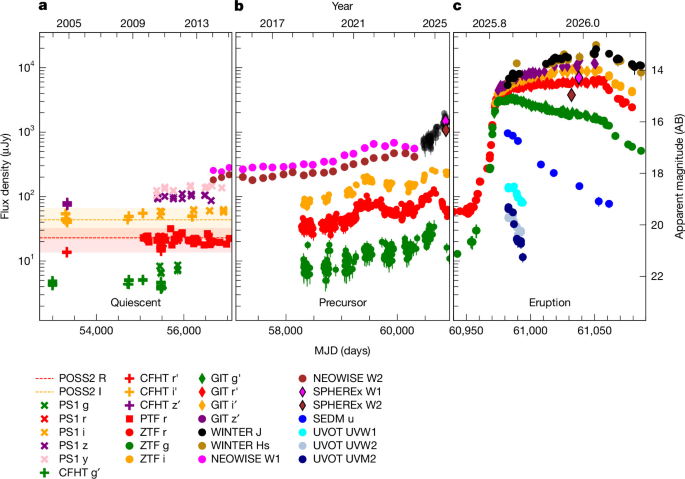
SPHEREx serendipitously caught the outburst in 2025, New Scientist reported: over about a month, the object expanded at 330 kilometres per second and flashed 100 times brighter than before. Space.com added that the eruption likely occurred when Little Bao rammed into the giant’s core. The team estimates the blast expelled material equal to 0.1 to 0.2 solar masses, Space.com reported.
NEOWISE Data Reveals Star Before Eruption
Bao first surfaced in February 2023 as an unusual variable star in data from NASA’s retired NEOWISE mission, NASA reported. Earlier archival analysis showed the red giant had been brightening gradually since 2018. The team published its first paper right before the eruption in 2025.
“Stellar mergers are very, very difficult to observe in real time because they are hard to predict. However, we noticed something unusual was going on in 2023 and continued to monitor the system to see what it would do. Then, in 2025, it erupted!”
said Viraj Karambelkar, a NASA Hubble Fellow at Columbia University in New York, per NASA.
The rapid-response chain matters as much as the discovery. In November 2025, the team pulled fast-turn observations from NASA’s now-retired Neil Gehrels Swift Observatory and NOIRLab’s Gemini North in Hawaii. Webb observed Bao on December 24, 2025, under a just-in-time Director’s Discretionary Time program — 47 days after the eruption peaked, the earliest follow-up of an event like this, NASA reported.

For teams building similar transient-detection pipelines, the architecture is instructive: survey instruments feed alert brokers, which trigger follow-up allocations within days. Much of the underlying infrastructure — from the Zwicky Transient Facility’s real-time image subtraction pipeline to the open-source SkyPortal data platform — is documented publicly, and survey data flows through services like NASA-IPAC’s IRSA.
# Query NASA/IPAC IRSA for NEOWISE single-exposure photometry
curl -G "https://irsa.ipac.caltech.edu/cgi-bin/Gator/nphQuery" \
  --data-urlencode "catalog=neowiser_p1bs_psd" \
  --data-urlencode "spatial=Cone" \
  --data-urlencode "radius=8.4" \
  --data-urlencode "ra=9.7027" \
  --data-urlencode "dec=40.7689" \
  --data-urlencode "outfmt=1"
Why Seven Orbits Breaks the Standard Models
The surprise is inside the star. The common envelope phase — where two stars share a single outer layer of gas — lasted longer than models predicted, and energy from the inspiral reached the giant’s surface by convection, New Scientist reported. Prevailing assumptions held that convection would not matter and the smaller star’s energy would immediately puff up the giant’s atmosphere.

“This is probably the most uncertain and critical phase in the evolution of a star,”
said Jason Nordhaus at the Rochester Institute of Technology in New York state, who was not involved in the research, per New Scientist.
Nordhaus told New Scientist the common envelope phase is “probably the most uncertain and critical phase in the evolution of a star.” That matters beyond stellar physics: common envelope efficiency parameters, long tuned against post-common-envelope binaries, feed directly into population models for gravitational-wave sources and Type Ia supernova progenitors.
“We were able to see all different phases of this process – we were able to see the quiescent system, we were able to see the moment the stars touched each other, we were able to see the inspiral, and we were able to see the big outburst in 2025.”
said Karambelkar, per New Scientist.
Merged or Survivors? What’s Still Open
The outcome is not settled. One scenario involves the two stars merging into one, while another involves their remaining in a much tighter orbit. Confirming the final state requires continued monitoring once the eruption’s brightness subsides, as astronomers plan to continue observing the system.
The detection rate should climb. New Scientist and Space.com both point to the Rubin Observatory and the Nancy Grace Roman Space Telescope as instruments that will surface far more of these events. “There’s going to be a large influx of similar discoveries just ahead,” Karambelkar said, per Sci.News: Breaking Science News.