
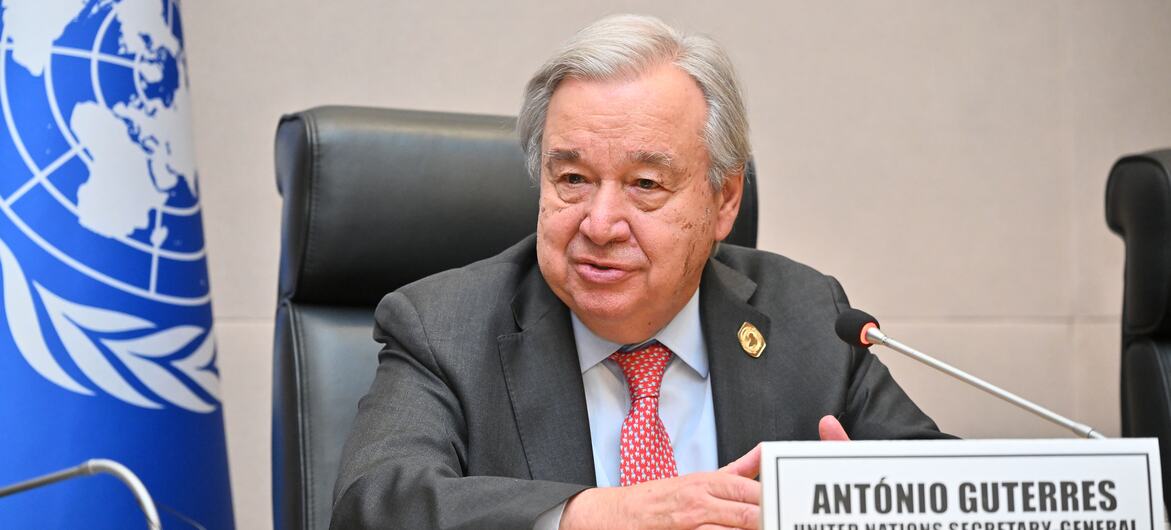
Addis Ababa, Ethiopia – The 39th Ordinary Session of the Assembly of the African Union (AU) concluded on February 15, 2026, with the transition of leadership from Angola to Burundi, and a renewed call for global economic and climate justice from United Nations Secretary-General António Guterres.
Addressing the summit, Guterres characterized the AU as “a flagship for multilateralism” and lauded Africa’s leadership in the pursuit of “justice and equality.” He highlighted a decade of strengthened cooperation between the UN and AU, encompassing peace and security, sustainable development, and human rights initiatives. The session formally welcomed Évariste Ndayishimiye, President of the Republic of Burundi, as the new Chairperson of the African Union for 2026, succeeding João Manuel Gonçalves Lourenço, President of the Republic of Angola.
Guterres outlined three key priorities for deepened collaboration: peace, economic action, and climate justice. He specifically called for an immediate finish to hostilities in Sudan, a resumption of dialogue in South Sudan, and respect for the territorial integrity of the Democratic Republic of the Congo. Across the Sahel region, Libya, and the Horn of Africa, he emphasized the necessity of African-led political solutions, supported by sustained international assistance.
The Secretary-General delivered a stark assessment of the global financial landscape, noting a $4 trillion annual shortfall in funding for the Sustainable Development Goals (SDGs) and that Africa loses more capital through debt servicing and illicit financial flows than it receives in aid. He described the current economic system as “simply unconscionable” for the continent, advocating for a tripling of the lending capacity of multilateral development banks and greater African representation within international financial institutions.
Guterres insisted on a fundamental shift in how Africa’s natural resources are utilized, stating, “No more exploitation. No more plundering. The people of Africa must benefit from the resources of Africa.” He urged that African nations directly benefit from their critical minerals through fair, sustainable value chains and increased manufacturing capacity, aligning with UN recommendations.
On climate change, Guterres warned that the world is on track to exceed the 1.5 degree Celsius warming limit established by the Paris Agreement. He underscored the climate injustice faced by Africa, which, despite contributing the least to the climate crisis, is experiencing faster-than-average warming, increased droughts, floods, and deadly heat waves. He called on developed nations to triple adaptation finance, mobilize $1.3 trillion annually for developing countries by 2035, and bolster the Loss and Damage Fund.
Guterres also stressed the urgent need for reform within global institutions, specifically citing the lack of permanent African representation on the UN Security Council as “indefensible” in 2026. He asserted that Africa must have a seat at the table whenever decisions impacting the continent and the world are being made.
The Assembly of the African Union concluded following two days of high-level deliberations at the AU Headquarters in Addis Ababa, Ethiopia. The AU Theme of the Year 2026, “Ensuring sustainable water availability and safe sanitation systems to achieve the goals of Agenda 2063,” was formally launched.
