
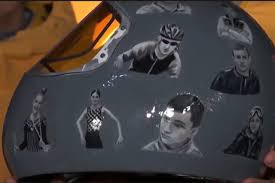
The controversy surrounding Ukrainian skeleton racer Vladyslav Heraskevych’s disqualification from the , Winter Olympics in Milan and Cortina d’Ampezzo continues to escalate, revealing a bizarre proposal from the International Olympic Committee (IOC) that has drawn further criticism. Heraskevych was barred from competing due to the imagery on his helmet, which depicted Ukrainians killed in the ongoing conflict with Russia.
While the IOC maintained its stance on neutrality and adherence to Olympic principles, the handling of the situation has been widely condemned as insensitive and a double standard. The latest revelation, reported by TV3 and detailed by Latvian skeleton pioneer Dainis Dukurs, paints an even more unsettling picture of the IOC’s approach.
According to Dukurs, who has been in communication with Heraskevych’s father and coach, the IOC suggested a peculiar alternative to allow the helmet’s message to be displayed: the coach would run the length of the track with the helmet in his hands, handing it back to Heraskevych at the finish line. This would, in the IOC’s view, satisfy the requirement for Heraskevych to compete with an approved helmet.
Dainis Dukurs
Latvian Skeleton Pioneer
“It’s even more bizarre that they offered the coach to stand at the start with this helmet, then run down the track to the finish and hand the helmet back to the athlete. Of course, he would have slowed down, and then handed the helmet back to the athlete, but he had to race with a different helmet. They didn’t agree, and the decision was made.”
Dukurs believes Heraskevych made the correct decision in refusing to compromise his principles, even at the cost of his Olympic participation. “He has had four years of work go to waste, but I think his choice was the right one,” Dukurs stated. “If you weigh these four runs at the Olympic Games against the events in the war-torn country he represents, the decision was correct.”
The incident has sparked outrage from Ukrainian allies, with Ukrainian President Volodymyr Zelenskyy awarding Heraskevych the Order of Merit for “civic courage and patriotism, defending the ideals of freedom and democracy.” Zelenskyy criticized the IOC’s decision, stating, “Sport should not signify amnesia, and the Olympic movement should help stop wars, not play into the hands of the aggressor.” He argued that the committee’s decision contradicts the fundamental principles of the Olympics.
Andriy Sybiha, Ukraine’s Minister of Foreign Affairs, echoed Zelenskyy’s sentiments, asserting that the IOC had dealt a blow to its own reputation rather than hindering a Ukrainian athlete’s participation. Sybiha reminded that the IOC has consistently failed to take decisive action against Russia, which he described as “the biggest violator of international sports and the Olympic Charter.”
Raimonds Lazdiņš, President of the Latvian Olympic Committee, acknowledged the IBSF jury’s authority to enforce the Olympic Charter but expressed concern over the proportionality of the decision. According to reporting from LA.LV, Lazdiņš stated that the Latvian Olympic Committee respects the authority of the IBSF jury and its responsibility to ensure compliance with the Olympic Charter. However, he believes that a clear evaluation of the decision’s justification and proportionality is crucial.
“The information available to the Latvian and Lithuanian Olympic Committees indicates that the helmet design did not contain political messages, slogans, or calls to action. It featured images commemorating Ukrainian athletes who lost their lives in the war,” Lazdiņš said.
The situation highlights the increasingly complex challenges facing the IOC as it attempts to navigate the geopolitical landscape and maintain its neutrality in the face of global conflicts. The IOC’s response to Heraskevych’s helmet has been widely perceived as prioritizing political expediency over the spirit of the Olympic Games, raising questions about its commitment to its stated values. The proposed solution of having the coach run with the helmet further underscores the perceived absurdity of the situation and the IOC’s apparent willingness to engage in symbolic gestures rather than address the underlying issues.
The incident is likely to fuel further debate about the role of politics in sports and the IOC’s responsibility to uphold human rights and freedom of expression. As the Milan-Cortina d’Ampezzo Olympics continue, the fallout from Heraskevych’s disqualification is sure to linger, casting a shadow over the games and prompting calls for greater transparency and accountability from the IOC.
